- 29 August, 2026
August 29, 2026: The Our Father ends—but have you noticed what the priest prays next?

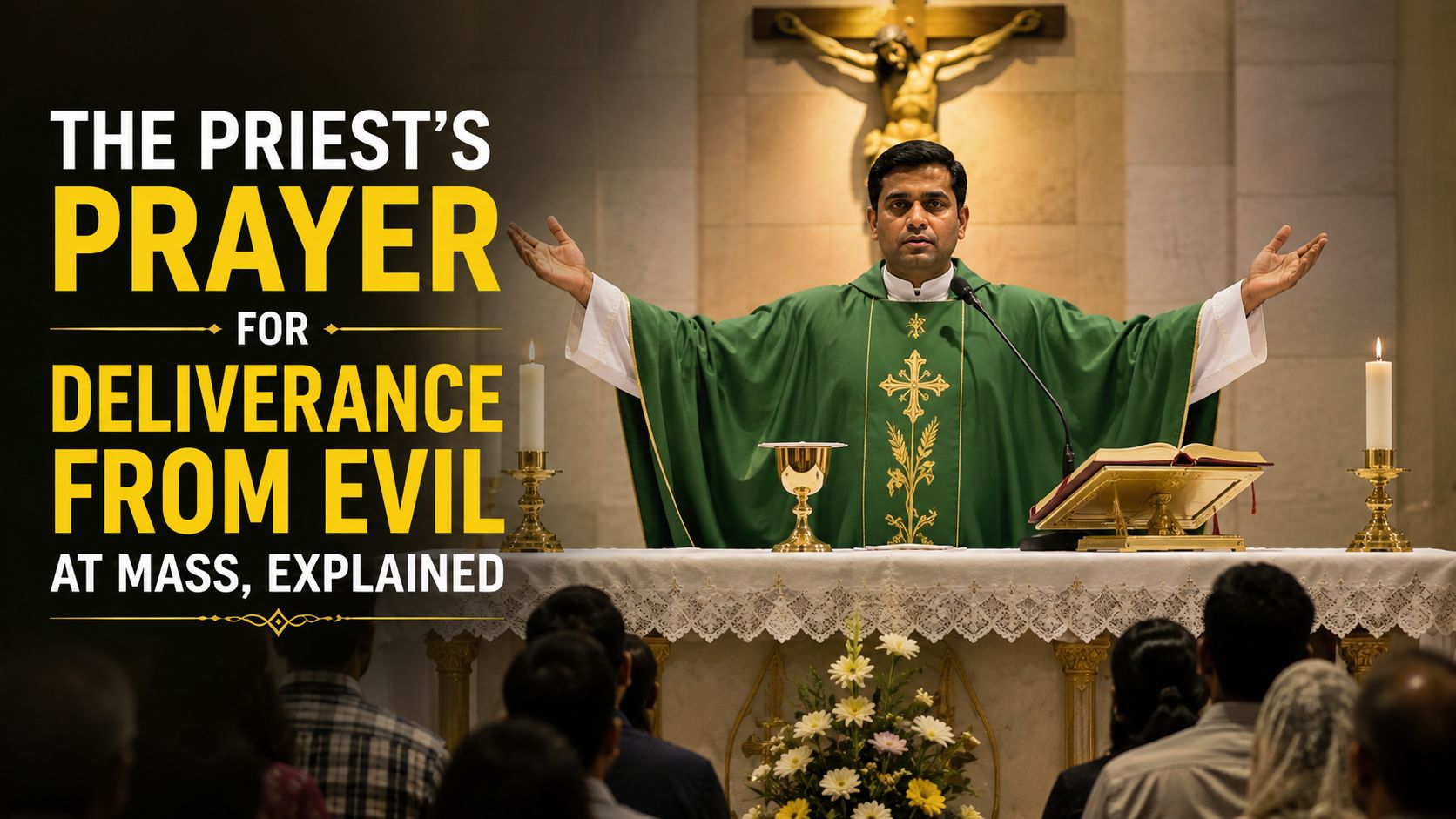
The answer is found in a short prayer that follows the Lord’s Prayer at every Mass. After the congregation says, “but deliver us from evil,” the priest prays the embolism, expanding upon that final petition:
“Deliver us, Lord, we pray, from every evil, graciously grant peace in our days, that, by the help of your mercy, we may be always free from sin and safe from all distress, as we await the blessed hope and the coming of our Saviour, Jesus Christ.”

But why does the Church place so much meaning into these few words?
“Deliver us, Lord, we pray, from every evil”
The priest begins by expanding the congregation’s petition from “evil” to “every evil.” The prayer is not limited to one particular danger. It expresses the Christian’s dependence on God for deliverance from evil in all its forms, with freedom from sin at the centre of that request.
“Graciously grant peace in our days”
Why ask for peace immediately after asking for deliverance?
Because Christian peace is not simply the absence of problems. It is a gift from God. The Church asks that, amid the realities of daily life, God’s peace may accompany His people.
“That, by the help of your mercy, we may be always free from sin”
Here the prayer reaches something deeper than external danger.
The Christian asks God’s mercy to remain free from sin. The wording matters: “by the help of your mercy.” Victory over sin is not presented as a matter of human strength alone, but as something for which we continually need God’s grace.
“And safe from all distress”
Does this mean Christians will never suffer?
No. The prayer does not promise a life without distress. It asks God to preserve His people through it, placing their difficulties within His merciful care.
“As we await the blessed hope”
The final part changes the prayer’s horizon. We are not asking only for help today. We are awaiting “the coming of our Saviour, Jesus Christ.”
The prayer therefore connects our present life with the fulfilment of Christian hope: Christ’s coming.
And there is a beautiful movement in what follows. After the embolism, the priest invites the faithful to offer one another a sign of peace. The liturgy then moves toward Holy Communion.
We have prayed for deliverance, mercy and peace—and now we turn toward Christ Himself in the Eucharist.
The next time you hear this prayer, listen beyond its familiar words. In a single petition, the Church teaches us what Christians continually need: deliverance from evil, freedom from sin, God’s mercy, peace amid distress and hope in Christ’s coming.
By Catholic Connect Reporter
Why Do We Say “Lamb of God” Three Times Before Holy Communion?
When Does the Bread and Wine Become the Body and Blood of Christ at Mass?
Why Do Catholics Ring Bells During Mass?
What Happens When We Sing “Holy, Holy, Holy” at Every Mass?
Why Does the Priest Wash His Hands During Mass?
Why Did Jesus Choose Bread and Wine for the Eucharist?
Why Does the Church Pray for the Whole World at Mass?
Why Do Catholics Say the Creed After the Homily?
Why Can’t We Skip the Homily at Sunday Mass?
Three Little Crosses Before the Gospel — But What Do They Mean?
Why Do Catholics Sit for the Readings but Stand for the Gospel?
Why Is There a Psalm Between the Readings?
Why Are There Usually Three Readings at Sunday Mass?
Why Does the Priest Say “The Lord Be with You” So Often at Mass?
Why Do We Keep Saying “Amen” at Mass? What Are We Really Saying?
The Prayer After “Let Us Pray” Changes at Mass—Do You Know Why?
Why Do Catholics Sing the Gloria—but Not at Every Mass?
Why Do We Confess Our Sins at the Start of Mass? The Deeper Meaning Explained
Why Does the Priest Kiss the Altar at Mass?
Why Does Mass Begin and End with the Sign of the Cross?
What Makes the Catholic Mass Different from Other Christian Worship Services?
If God Made the Seventh Day Holy, Why Do Catholics Worship on Sunday?
Four Parts, One Beautiful Story: Understanding the Flow of the Mass
Why Does the Mass Follow the Same Order Every Time? The Church's Timeless Wisdom
Why Do Catholics Call It the Mass? The Answer Begins with Three Latin Words
How the Mass Developed Over 2,000 Years: A Journey Through History and Worship
If God Made the Seventh Day Holy, Why Do Catholics Worship on Sunday?
© 2026 CATHOLIC CONNECT POWERED BY ATCONLINE LLP