
- 29 August, 2026

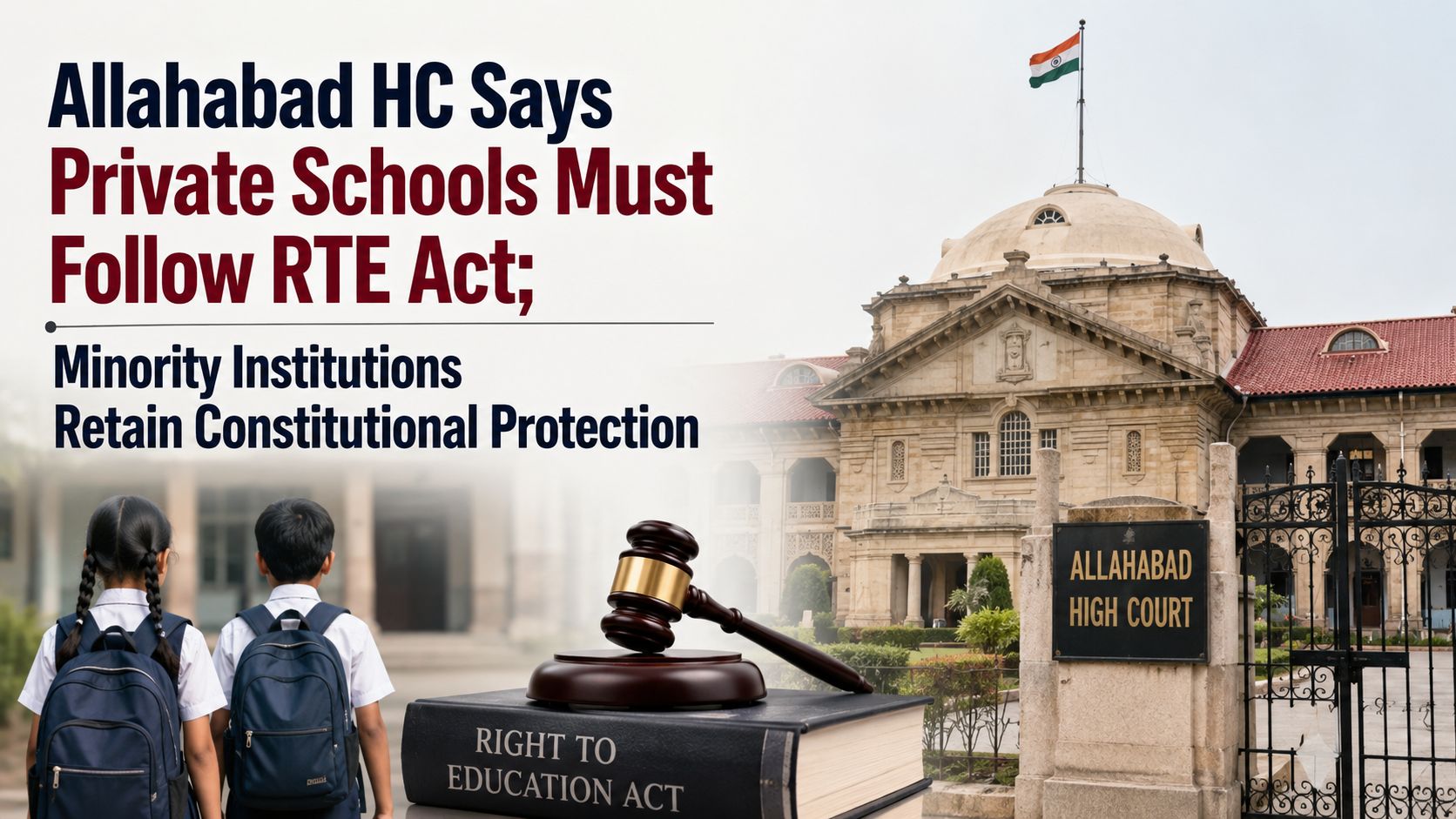
New Delhi, August 29, 2026: The legal status of minority educational institutions under the Right of Children to Free and Compulsory Education Act, 2009, has come into focus following a recent Allahabad High Court ruling that held private schools cannot claim a general exemption from the Act’s provisions.


The court’s position has to be read alongside a 2014 Constitution Bench judgment of the Supreme Court, which specifically held that the RTE Act cannot be applied to minority educational institutions, whether aided or unaided, where doing so would infringe the rights guaranteed under Article 30(1) of the Constitution.
The issue has assumed significance as states continue to enforce provisions of the RTE Act, including the requirement that eligible private schools provide free admission to 25 per cent of children from disadvantaged and weaker sections.


According to Supreme Court advocate and former member of the National Commission for Minority Educational Institutions Sr. Jessy Kurian, minority educational institutions enjoy constitutional protection from the RTE Act by virtue of Article 30(1).
The RTE Act was enacted on August 4, 2009, and came into force on April 1, 2010, giving statutory effect to the fundamental right to education for children aged six to 14 under Article 21A of the Constitution.
Section 12 of the Act requires specified private schools to admit at least 25 per cent of children from weaker and disadvantaged sections at the entry level and provide them free education. Questions over its applicability to minority institutions have, however, been settled by the Supreme Court.
In Society for Unaided Private Schools of Rajasthan vs Union of India (2012), a three-judge Bench upheld the constitutional validity of the RTE Act but held that it did not apply to unaided minority schools protected under Article 30(1). The judgment had, however, held that the Act applied to aided minority institutions.
That position was subsequently reconsidered by a five-judge Constitution Bench in Pramati Educational and Cultural Trust & Ors vs Union of India & Ors (2014).
The Constitution Bench held that applying the RTE Act to minority schools, whether aided or unaided, would affect the fundamental right guaranteed to minorities under Article 30(1).
The court concluded that the RTE Act, to the extent that it was made applicable to minority educational institutions covered by Article 30(1), was unconstitutional. It also held that the earlier judgment was incorrect insofar as it had extended the RTE Act to aided minority schools.
The distinction is important in the context of the Allahabad High Court’s recent ruling. The High Court’s observation that no private school is generally exempt from the RTE Act does not override the specific constitutional protection accorded to minority educational institutions by the Supreme Court.
Sr. Jessy said the exemption should not be understood as permitting minority institutions to disregard provisions intended to safeguard children’s welfare. She said measures relating to the protection of children, including prohibition of corporal punishment, appropriate transfer of students, promotion of children without unnecessary failure or detention and prescribed qualifications for teachers, should be implemented in the larger interest of education and justice.
Another issue concerns institutions that have applied for minority status but are awaiting a formal declaration from the competent authority.
Sr. Jessy pointed to the Supreme Court’s judgment in N. Ammad vs Emjay High School (1998), which held that an educational institution does not become a minority institution only when the government formally declares it to be one.
The Supreme Court observed that a government declaration recognises an existing factual and legal position — namely, that the institution was established and administered by a minority community. The legal character of the institution, therefore, exists independently of the formal declaration.
For an institution to qualify as a minority educational institution, Sr. Jessy identified four key requirements: it must have been established by a minority community; it must be administered by that community; the founding members of its society, trust or corporate agency must belong to the minority community; and its founding documents must establish that the institution was created primarily for the benefit of the minority community concerned.
The evolving legal debate thus involves two distinct principles: the general applicability of the RTE Act to private schools and the constitutional protection available to genuine minority educational institutions under Article 30(1).
While private schools cannot claim a blanket exemption from the RTE Act merely because they are privately managed, minority institutions that satisfy the constitutional requirements remain protected from provisions of the Act that would interfere with their Article 30(1) rights.
The issue continues to underscore the need to balance the fundamental right to education with the constitutional autonomy guaranteed to minority communities to establish and administer educational institutions.
By Catholic Connect Reporter
© 2026 CATHOLIC CONNECT POWERED BY ATCONLINE LLP