- 22 September, 2026

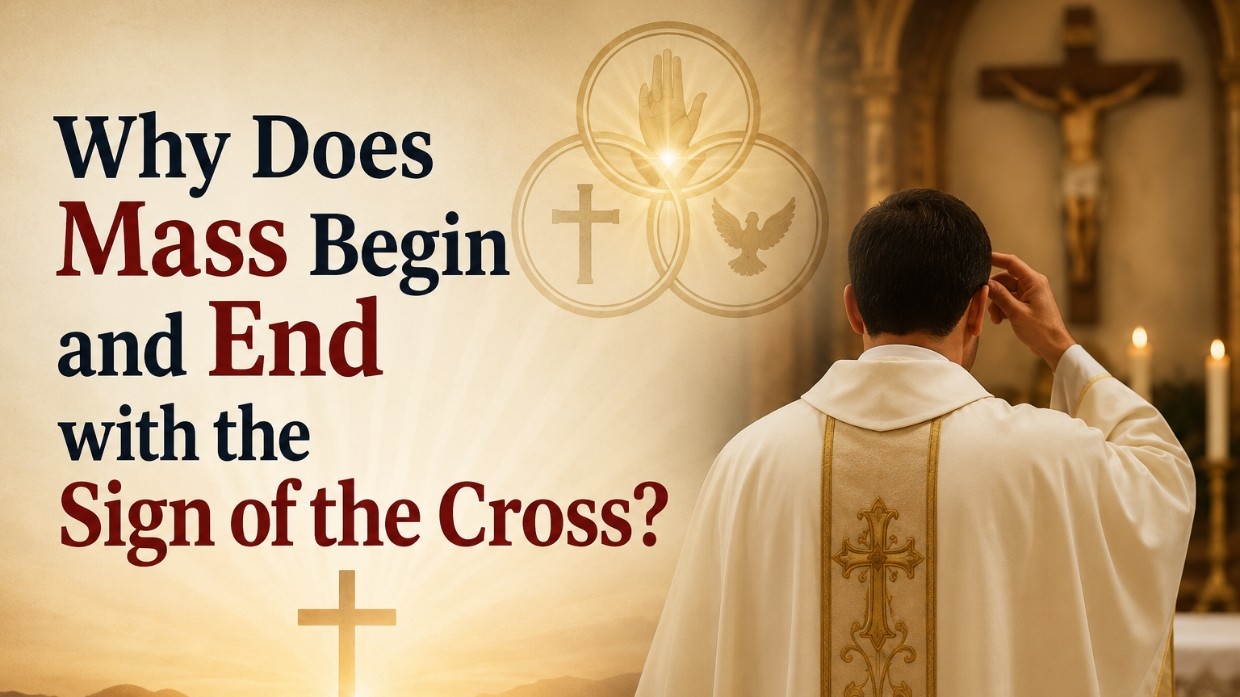
August 08, 2026: You have probably heard the priest say these words at the beginning of Mass countless times:


"In the name of the Father, and of the Son, and of the Holy Spirit. Amen.”
By now, making the Sign of the Cross can almost feel automatic. But why do we invoke the Trinity at the beginning of Mass? And why do we sign ourselves with a Cross while saying it?

Why invoke the Trinity?
The words “Father, Son and Holy Spirit” bring us immediately to the heart of Christian faith: the one God in three Persons.
The Mass is not simply a gathering of people for prayer. We gather in the name of the Triune God, to worship the Father, through the Son, in the Holy Spirit.
These are also the words Christ gave His Apostles when He commanded them to baptise all nations (Matthew 28:19).
Beginning Mass in this name reminds us that everything we are about to celebrate is rooted in the life and action of the Holy Trinity.
Before anything else happens, we remember whose presence we have gathered in.
But why the Cross?
If we are invoking the Father, Son and Holy Spirit, why do we physically trace a Cross over ourselves?
Because the Cross directs us particularly to Jesus Christ, the Son.
The Cross is not simply a symbol of suffering. It recalls Christ's Passion, death and Resurrection—the saving mystery at the heart of the Christian faith.
By tracing it over ourselves, we make a visible profession of faith: we believe in Christ crucified and risen, and we belong to Him.
The words proclaim the Trinity; the gesture places before us the Cross of Christ.
When did Christians begin doing this?
The Sign of the Cross is an ancient Christian practice. Christian writers from as early as the second century refer to Christians marking themselves with the Cross.
By the fourth century, St Cyril of Jerusalem encouraged Christians to make the Cross over themselves in their daily lives—over their food and drink, in their coming and going, and in their ordinary activities.
So the practice was not originally limited to the Mass. Christians used the Cross as a visible sign of their faith and their belonging to Christ.
Over time, it became an established part of Christian prayer and worship.
What does Baptism have to do with it?
The Sign of the Cross also recalls our Baptism.
Jesus commanded His Apostles to baptise “in the name of the Father and of the Son and of the Holy Spirit” (Matthew 28:19). Through Baptism, we are incorporated into Christ and brought into the life of the Church.
So when we make the Sign of the Cross, we are not repeating our Baptism; we are recalling the identity we received through it.
And why do we make it again at the end?
Notice the symmetry: Mass begins with the Sign of the Cross and ends with it as the priest gives the final blessing.
At the beginning, we gather in the name of the Father, Son and Holy Spirit. At the end, we receive a blessing in that same Trinitarian name before being dismissed.
The Cross therefore frames the celebration.
We begin by placing ourselves in the name of the Triune God, encounter Christ in the celebration of the Eucharist, and leave with His blessing.
That familiar gesture at the beginning and end of Mass is therefore much more than a routine.
It reminds us who God is, whose we are, and the Cross through which Christ has saved us.
By Catholic Connect Reporter
Read more:
What Makes the Catholic Mass Different from Other Christian Worship Services?
If God Made the Seventh Day Holy, Why Do Catholics Worship on Sunday?
Four Parts, One Beautiful Story: Understanding the Flow of the Mass
Why Does the Mass Follow the Same Order Every Time? The Church's Timeless Wisdom
Why Do Catholics Call It the Mass? The Answer Begins with Three Latin Words
How the Mass Developed Over 2,000 Years: A Journey Through History and Worship
Is the Mass Biblical? Discover the Bible in Every Part of the Holy Mass
Continue Reading on Catholic Connect App
Get access to exclusive news articles & more.


© 2026 CATHOLIC CONNECT POWERED BY ATCONLINE LLP