- 22 September, 2026

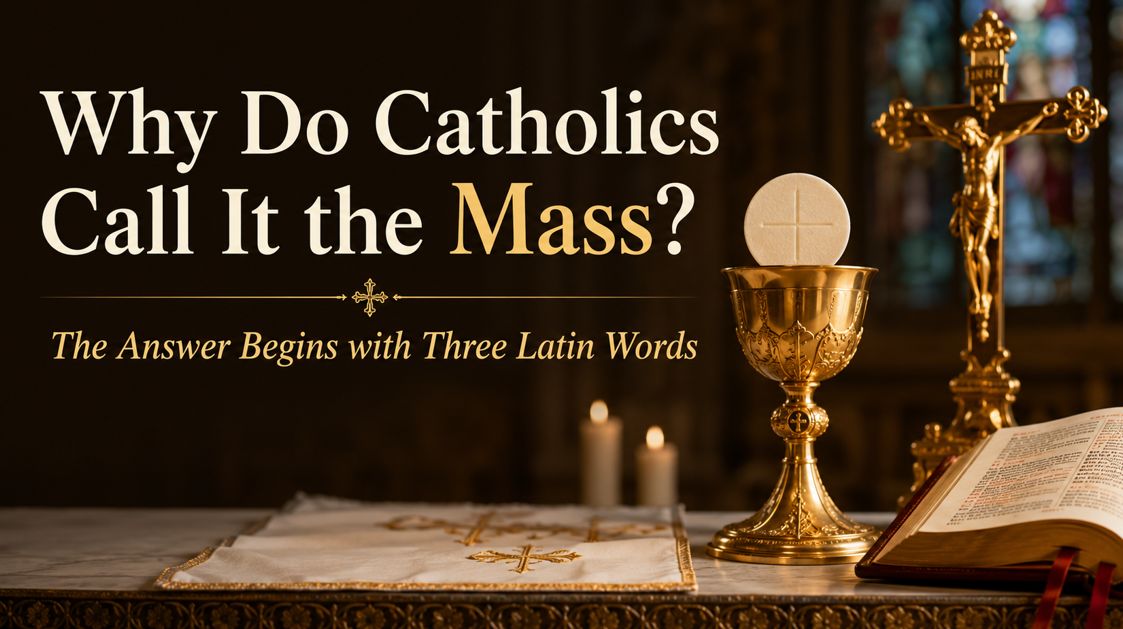
August 1, 2026: Every Sunday, millions of Catholics around the world gather to celebrate the Mass. We know it is the centre of our faith, but have you ever stopped to wonder why it is called the Mass in the first place?


The answer begins with three simple Latin words spoken near the end of the celebration: Ite, missa est.
The word Mass comes from the Latin missa, and it is closely connected with the dismissal formula Ite, missa est. In the Church’s liturgical tradition, missa is fundamentally tied to the act of dismissal—the sending forth of the people.
In a literal sense, the Catholic Encyclopedia explains that Ite missa est should be understood as “Go it is the dismissal.”

And yet, when the Church celebrates in the Roman Rite, the dismissal is also expressed with the Missal’s meaning: “The Mass is ended, go in peace.”
Over time, the word missa came to refer not only to the dismissal moment itself, but also to the Eucharistic celebration as a whole.
(CLICK HERE to follow Catholic Connect and to stay updated with Catholic News & Content)
The Church recognizes that these closing words are more than a polite end to worship. They express a spiritual reality: after receiving Christ, Christians are meant to live as witnesses of the Gospel in daily life.
Here is the important precision: missa is primarily “dismissal” (its linguistic-historical meaning), while the missionary “sending” is a theological implication drawn from what the dismissal signifies in Christian life.
Pope Benedict XVI states that in antiquity missa simply meant “dismissal,” and only in Christian usage did it gradually come to imply “mission.”
At the same time, the Handbook for Liturgical Studies notes that attempts to make missa mean “mission” are without foundation (even though the dismissal truly functions as a starting point for mission).
The Mass is the highest form of worship in the Catholic Church. During the Liturgy of the Word, we listen to God speaking to us through Sacred Scripture. During the Liturgy of the Eucharist, bread and wine are consecrated, and—through the power of the Holy Spirit and the ministry of the priest—Christ is truly made present for our communion.
United with Christ’s one sacrifice, we worship the Father and receive Christ in Holy Communion.
The final dismissal is much more than a conclusion of a celebration. It is a commissioning. Pope Benedict XVI explains that the dismissal helps us grasp the relationship between the Mass just celebrated and the mission of Christians in the world.
So when Catholics hear Ite, missa est, the message is not merely “the service is over,” but “Christ is with you—go in peace, and live as disciples.” The liturgy continues in the way we live, serve, and love each day.
Ite, missa est is the normal dismissal, but on certain days with the character of fasting or penance, it may be replaced by another dismissal formula—Benedicamus Domino.
So, the next time you hear Ite, missa est, remember: the celebration may be ending, but the dismissal truly sends you out—to live the Gospel in your home, work, and community, as a witness of Christ’s love.
By Catholic Connect Reporter


© 2026 CATHOLIC CONNECT POWERED BY ATCONLINE LLP