- 28 August, 2026

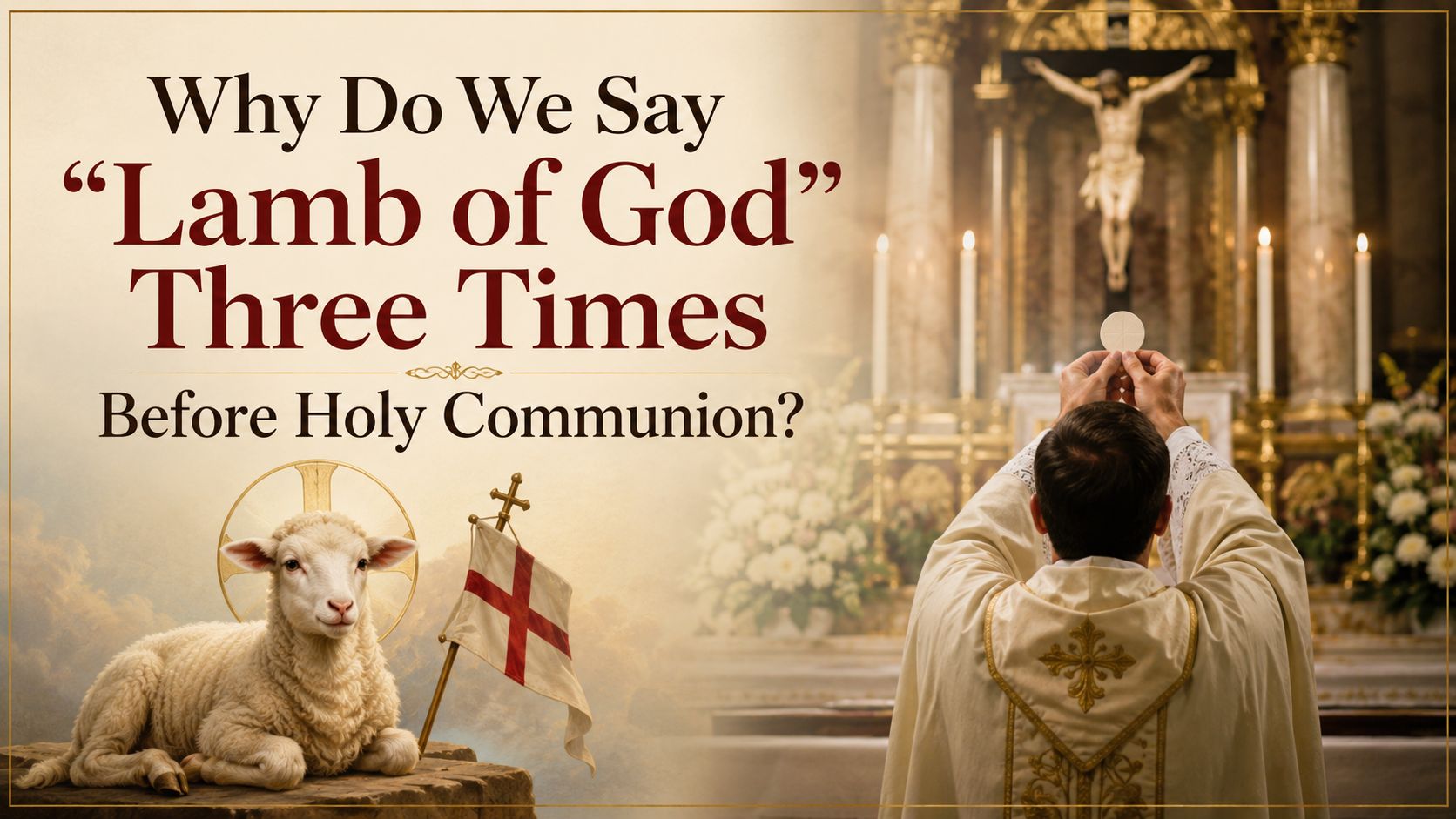
August 28, 2026: Just before Holy Communion, Catholics repeat a prayer that can easily become so familiar that its extraordinary meaning is overlooked:


“Lamb of God, you take away the sins of the world, have mercy on us.”
We say it three times. But why call Jesus a Lamb? Why repeat it? And why does the prayer come precisely before Communion?
The answers take us deep into the heart of the Eucharist.


Why Is Jesus Called the “Lamb of God”?
The title comes directly from John the Baptist, who points to Jesus and declares: “Behold, the Lamb of God, who takes away the sin of the world!” (John 1:29).
The image reaches back to the Passover. The Israelites sacrificed a lamb and marked their doorposts with its blood as God delivered them from slavery in Egypt. But there is an important detail: the Passover lamb was not merely sacrificed—it was also eaten (Exodus 12:8).
The New Testament presents Jesus as the fulfilment of this Passover. He is the Lamb whose sacrifice brings liberation from sin and death. And just as the Passover lamb was eaten, Christ gives himself to us as food in the Eucharist.
Why Do We Say It Before Communion?
This is where the timing becomes especially meaningful.
By this point in the Mass, the Eucharistic Prayer has been completed. Christ’s sacrifice has been sacramentally made present, and we are about to receive him in Holy Communion.
The Agnus Dei therefore turns our attention to who we are about to receive.
We are not simply approaching a religious symbol or remembering Jesus from the past. We are approaching Christ, the Lamb who offered himself for us and who now gives himself to his people.
This also connects with Jesus’ teaching in John 6, where he speaks of giving his flesh for the life of the world and calls us to receive him as true food.
The Lamb who was sacrificed is also the Lamb who is received.
Why Three Times?
The repetition gives the prayer a solemn and insistent character. It is not because Christ needs to be persuaded to show mercy.
Traditionally, the first two invocations ask: “Have mercy on us.”
The third changes the petition: “Grant us peace.”
That movement—from mercy to peace—is significant. Having acknowledged our need for Christ’s forgiveness, the prayer points to the peace that God gives through reconciliation with Him. It is not merely a peace we ask for; it is the peace that flows from being restored to communion with God.
What Does the “Supper of the Lamb” Mean?
Immediately afterwards, the priest says:
“Behold the Lamb of God… Blessed are those called to the supper of the Lamb.”
This language echoes the Book of Revelation, where the redeemed are invited to the “marriage supper of the Lamb” (Revelation 19:9).
The Mass therefore points beyond itself. At the Eucharistic table, the Church participates in Christ’s saving sacrifice while anticipating the eternal banquet of heaven.
So What Are We Really Saying?
The Agnus Dei is not simply a beautiful prayer before Communion. It is a profound proclamation of faith.
We are saying: Jesus is the Lamb who sacrificed himself for us. He takes away sin. He offers us mercy and peace. And now, he comes to us as the gift we are about to receive.
The next time the Agnus Dei is sung, listen to it differently. Before receiving Holy Communion, pause for a moment and ask yourself:
Am I truly aware of whom I am about to receive?
By Catholic Connect Reporter





© 2026 CATHOLIC CONNECT POWERED BY ATCONLINE LLP