- 28 August, 2026

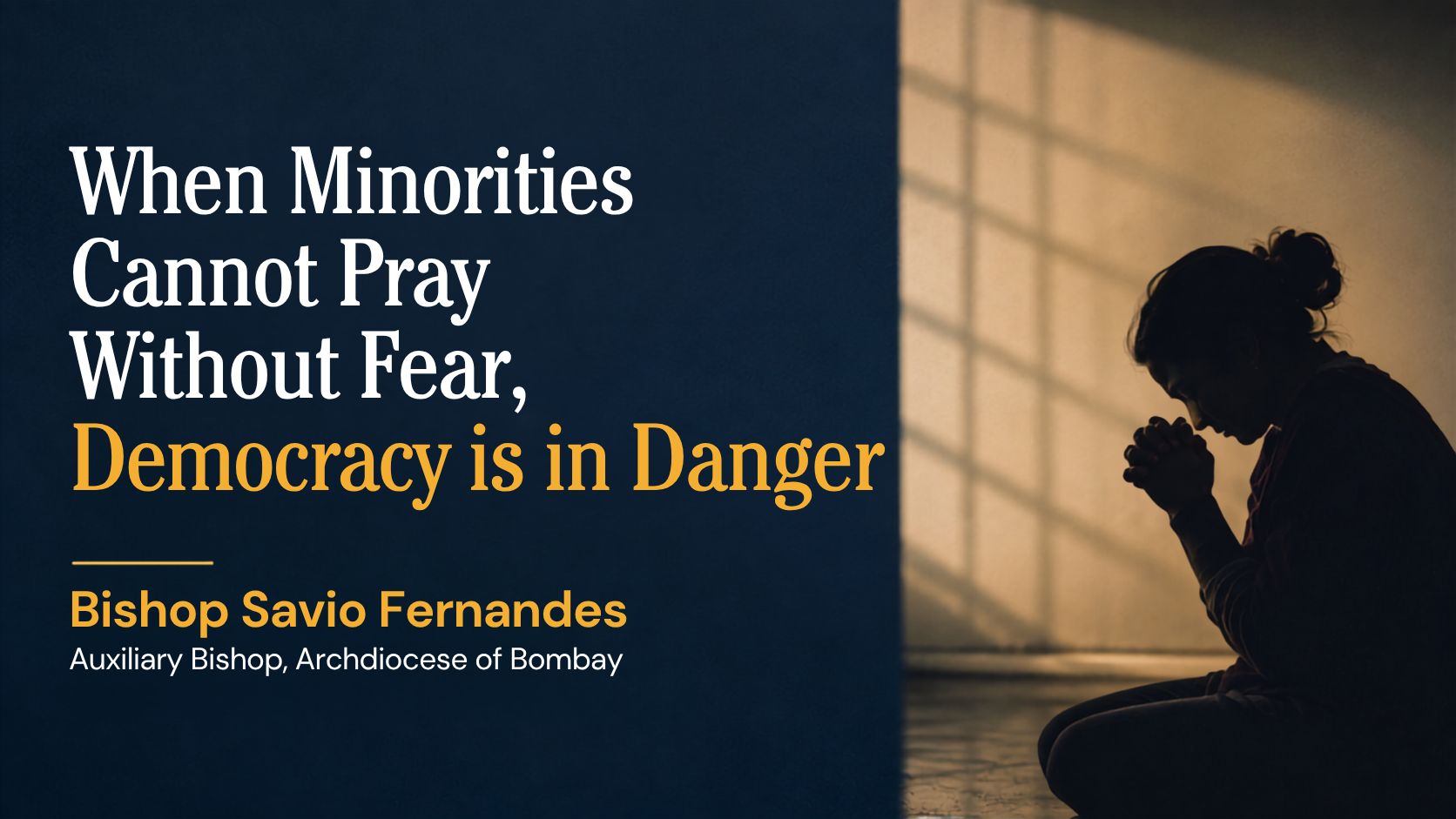
August 28, 2026: India’s Constitution does not merely permit religion; it protects the individual’s freedom of conscience. Article 25 guarantees every person the freedom of conscience and the right freely to profess, practise and propagate religion, subject to constitutional limitations. Article 21 protects life and personal liberty, encompassing dignity, autonomy and the freedom to make deeply personal choices. Together, these guarantees establish a fundamental principle: matters of faith ultimately belong to the conscience of the individual.


This principle — that “matters of faith ultimately belong to the conscience of the individual” — assumes particular importance as the Maharashtra Freedom of Religion Act, 2026, comes into force on August 28, 2026. The law is intended to prohibit conversions brought about through force, coercion, fraud, misrepresentation, undue influence or unlawful inducement.
The Catholic Church has always been against ‘forced conversion’, but it is also for safeguarding the right of every individual to voluntarily convert to any religion of one’s choice. Hence, it supports the legitimate objective of the State of protecting a person from being forced or deceived into changing one’s religion. No person should be compelled to abandon his or her faith.


Equally, however, no person should be prevented from voluntarily embracing another faith, practising it or declining to follow any religion at all. The danger, therefore, lies not necessarily in the stated objective of the law but in the manner in which such legislation can be interpreted, enforced or misused.
The evidence from other States, coupled with recent events in Maharashtra, demonstrates why concerns about the misuse of the law cannot simply be dismissed. The Maharashtra legislation contains ambiguous and broad concepts of ‘allurement’, ‘coercion’, ‘undue influence’, ‘brainwashing’ and other forms of allegedly unlawful conversion. It also establishes burdensome procedures involving prior notice and declarations and allows complaints by specified relatives of a person alleged to have been converted. Also, the punishment is very harsh and disproportionate, creating a chilling effect. Besides, if even two people convert together to another religion of their choice, the law treats it as “mass conversion”, carrying severe penalties.
This creates an obvious question: how does the State distinguish a genuinely forced conversion from a voluntary decision made by an adult exercising freedom of conscience?
That question becomes particularly urgent when allegations are initiated not by the person supposedly subjected to coercion, but by outsiders. A third party may object to a person attending a church, reading the Bible, receiving religious instruction, speaking with a pastor or even participating in prayer. But disagreement, suspicion or ideological hostility cannot, by themselves, establish coercion.
Indeed, the first signs of a chilling effect of such broad concepts in the legislation are already visible. Churches in the Mumbai Metropolitan Region, including areas such as Vasai, Virar, Mira-Bhayandar and Thane, have reportedly begun asking worshippers to sign declarations stating that they are attending prayer meetings voluntarily and without pressure, inducement or threat. The reported practice has emerged against a background of disruptions of Christian prayer meetings and FIRs arising from such incidents. This should concern every Indian, irrespective of religion.
A citizen should not have to sign an “innocence certificate” before entering a place of worship. A Hindu entering a temple does not ordinarily have to establish that nobody induced him to pray. A Muslim entering a mosque does not have to declare that nobody pressured him to worship. A Sikh entering a gurdwara does not have to prove that he has not been “influenced”. Christians should enjoy exactly the same constitutional dignity.
The State must, therefore, establish clear safeguards against misuse.
First, a mere allegation must never be treated as evidence of unlawful conversion. Police should be required to conduct a preliminary, objective assessment before taking coercive action against a religious gathering, pastor, priest, volunteer or institution. The fact that a person attended a prayer meeting, received religious literature, heard preaching or accepted ordinary charitable assistance cannot, by itself, establish unlawful conversion.
Second, the alleged victim’s own statement must receive central importance. Where an adult categorically states that participation in religious activity or a change of faith was voluntary, that statement cannot casually be displaced by the assertion of a third party merely because the third party disapproves of the person’s decision.
Third, religious worship must be protected from vigilante interference. No private individual, political organisation or self-appointed religious group has the authority to enter a prayer meeting, interrogate worshippers, disrupt worship, threaten participants or conduct its own “investigation”. The Constitution does not permit citizens to become investigator, prosecutor and judge. If there is evidence of an offence, the police — not a mob — must investigate it.
Fourth, the law must be enforced equally and consistently. If entering a school in Latur without permission promptly results in the filing of an FIR, then by the same standard, when right-wing fundamentalists, under the pretext of preventing forced conversion, trespass onto Christian premises, disrupt a prayer meeting, intimidate those present, destroy property and assault people, an FIR should likewise be filed promptly.
Fifth, legitimate charitable and social service must not be criminalised by association. Christian schools, hospitals, clinics, orphanages, NGOs and charitable institutions serve millions of Indians irrespective of faith. A Christian doctor treating a Hindu patient is not thereby attempting conversion. A Christian teacher educating a Hindu child is not thereby committing an offence. Providing food, medical care, education or assistance to a poor family cannot automatically be transformed into evidence of religious inducement.
Finally, the State must issue clear operational safeguards to police and district authorities before the law becomes a vehicle for intimidation. Complaints should be scrutinised objectively; frivolous or malicious allegations should have consequences; police officers should protect peaceful worship; and allegations of violence or disruption by vigilante groups should be investigated independently and promptly.
The answer to unlawful conversion is not to create an atmosphere in which every act of Christian worship is viewed with suspicion. Nor is it to place minorities under a permanent obligation to prove their innocence.
A person must be free not to convert. But a person must also be free, subject to the constitutional rights of others, to choose a religion, practise it, change it or reject religion altogether. Protecting that freedom is not a concession to minorities. It is an obligation imposed upon the State by the Constitution.
Maharashtra can enforce its Freedom of Religion Act firmly without allowing it to become an instrument of intimidation. It can punish genuine coercion, fraud and deception while protecting voluntary faith. It can investigate allegations without criminalising prayer. It can protect vulnerable citizens without treating minorities as presumptively guilty.
The test of the law will not be how many FIRs are registered. It will be whether genuine victims of coercion are protected without making innocent worshippers afraid to pray.
A democracy is truly free only when its minorities can practise their faith without fear and with their heads held high.
From August 28 onward, the Maharashtra Government must ensure that freedom of religion means precisely that: freedom — not curtailing of freedom. The constitutional rights of citizens cannot be protected merely on paper. They must be protected in the prayer hall, in the church, in the home, in the school, in the hospital and in every place where conscience is exercised.
By Bishop Savio Fernandes
Auxiliary Bishop, Archdiocese of Bombay

© 2026 CATHOLIC CONNECT POWERED BY ATCONLINE LLP