- 10 October, 2026
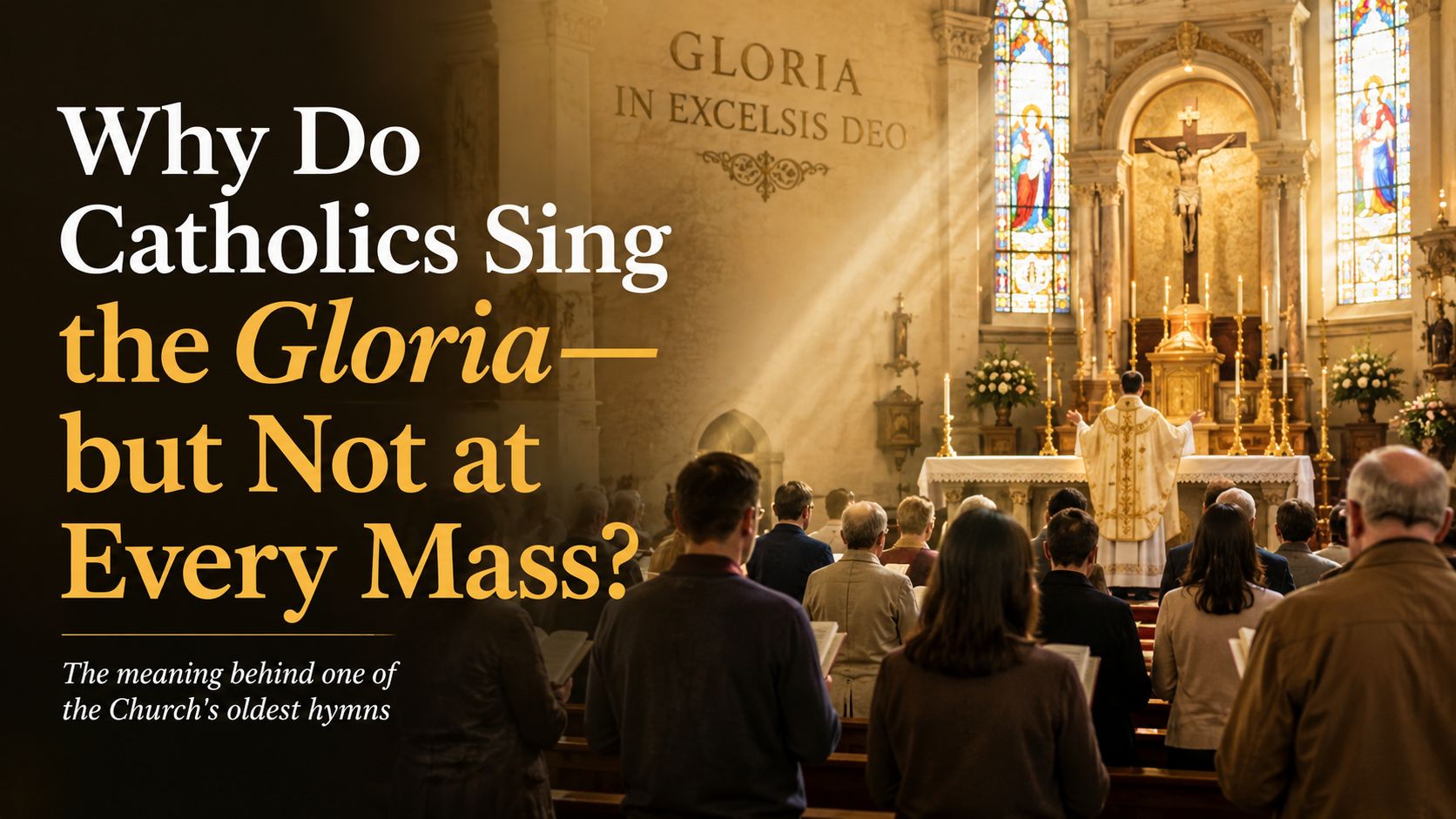
August 11, 2026: Most Catholics can sing the Gloria by heart, yet few stop to think about what they are actually praying. Why does this ancient hymn hold such an important place in the Mass—and why is it not sung every time Catholics gather for the Eucharist?

Did you know? The Gloria was not always sung as frequently as it is today.
Early liturgical sources suggest that the hymn was first associated with the celebration of Christmas and was later extended to Sundays and major feasts. For centuries, however, its use in the Roman Rite was largely reserved to bishops, while priests could sing it only on certain special occasions. Over time, the Church gradually expanded its use, reflecting the importance attached to this ancient hymn of praise.
(Click Here to follow Catholic Connect for regular News & Content)
Where Does the Gloria Come From and What Are We Actually Singing?
The Gloria is one of the oldest prayers in Christian worship. It begins with the words sung by the angels at the birth of Jesus: *"Glory to God in the highest, and on earth peace to people of good will"* (Luke 2:14). Over the centuries, the Church expanded this biblical hymn into a profound prayer of praise.
The Gloria unfolds in three parts. It begins by praising God the Father: *"We praise you, we bless you, we adore you, we glorify you, we give you thanks."* These repeated expressions are not mere poetry. They teach us that worship is first about honouring God for who He is, not simply asking Him for favours.
The prayer then turns to Jesus Christ. The longest section addresses Him directly as the *"Only Begotten Son"* and the *"Lamb of God who takes away the sins of the world."* Here, the Church proclaims Christ's saving mission and asks for His mercy. Finally, the Gloria concludes by affirming Christ's divine glory and ends with a reference to the Holy Spirit: *"You alone are the Holy One, You alone are the Lord... with the Holy Spirit, in the glory of God the Father."* In this way, the Gloria becomes a hymn of praise to the Holy Trinity—Father, Son and Holy Spirit.
Why Do We Sing the Gloria After the Penitential Act?
The Gloria follows the Penitential Act, where the faithful acknowledge their sins and seek God's mercy.
This sequence reveals something important about Christian worship. After recognising our need for forgiveness, the Church responds with praise rather than discouragement. The Gloria shifts the focus from our sinfulness to God's greatness and mercy. It reminds us that God's saving love is always greater than our failures.
For this reason, the Gloria has long been associated with joyful and festive celebrations.
Why Isn't the Gloria Sung at Every Mass?
The Gloria is sung or recited on Sundays outside Advent and Lent, as well as on solemnities and feasts. However, it is usually omitted during weekdays.
This does not mean weekday Masses are less important. Rather, the Gloria is reserved for occasions that the Church wishes to mark with particular solemnity and joy. Sunday, the day of Christ's Resurrection, holds a special place in the Church's life and therefore includes the Gloria throughout most of the year.
Weekday Masses generally follow a simpler form unless the day is a feast or solemnity. If a major celebration such as the Assumption of the Blessed Virgin Mary, All Saints' Day, or another solemnity falls on a weekday, the Gloria is sung.
The hymn is also omitted during Advent and Lent because these seasons have a distinct spiritual character. Advent is a time of preparation for Christ's coming, while Lent is a season of repentance and conversion before Easter. By setting aside certain joyful elements of the liturgy, the Church creates a sense of anticipation. When the Gloria returns at Christmas and Easter, its joyful words are experienced with even greater significance.
Can Any Song with the Word "Gloria" Be Sung at Mass?
No. The Gloria is not simply any hymn about giving glory to God. It is a specific liturgical text found in the Roman Missal.
While different musical settings may be used, the approved text of the Gloria must be preserved. A choir cannot replace it with a Christmas carol, a praise-and-worship song, or another hymn that happens to contain the word "Gloria."
This distinction highlights the unique role of the Gloria in the liturgy. More than a song, it is a prayer handed down through centuries of Christian worship. Whether sung in a village parish or a cathedral choir loft, it unites Catholics around the world in the same hymn of praise first begun by the angels of Bethlehem.
By Catholic Connect Reporter
Read more:
Why Do We Confess Our Sins at the Start of Mass? The Deeper Meaning Explained
Why Does the Priest Kiss the Altar at Mass?
Why Does Mass Begin and End with the Sign of the Cross?
What Makes the Catholic Mass Different from Other Christian Worship Services?
If God Made the Seventh Day Holy, Why Do Catholics Worship on Sunday?
Four Parts, One Beautiful Story: Understanding the Flow of the Mass
Why Does the Mass Follow the Same Order Every Time? The Church's Timeless Wisdom
Why Do Catholics Call It the Mass? The Answer Begins with Three Latin Words
How the Mass Developed Over 2,000 Years: A Journey Through History and Worship
Is the Mass Biblical? Discover the Bible in Every Part of the Holy Mass



© 2026 CATHOLIC CONNECT POWERED BY ATCONLINE LLP