- 27 November, 2026
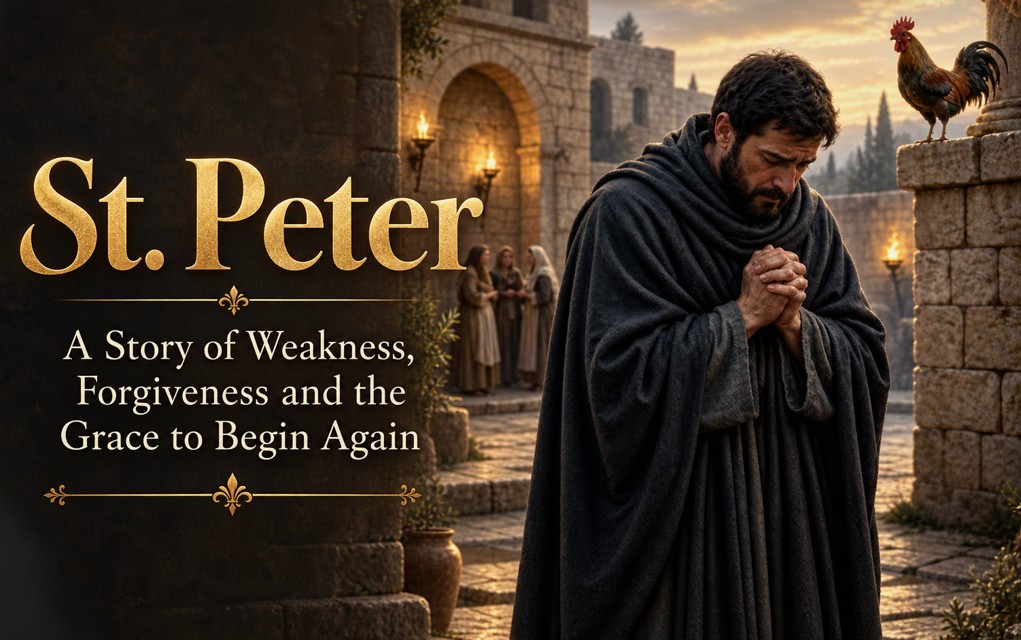
November 27, 2026: What the apostle’s mistakes teach us about humility, repentance and the transforming power of Christ’s grace.

Among the apostles, St. Peter is perhaps one of the most relatable. He was courageous, enthusiastic and deeply devoted to Jesus, yet he repeatedly stumbled in his journey of faith.
He doubted, misunderstood Christ’s mission, acted impulsively and even denied knowing his Master. Nevertheless, Jesus did not abandon him. Peter’s life reveals a profound Catholic truth: Christian discipleship does not mean never falling; it means following Christ in ongoing conversion, relying on His grace and responding to it with faith and love.
Peter boldly declared that he would never abandon Jesus (Matthew 26:33–35). Yet, when Jesus was arrested, fear overcame his confidence, and he denied Him three times (Luke 22:54–62).
His failure warns us against spiritual pride and self-reliance. The Catechism of the Catholic Church teaches that grace precedes, prepares and inspires our response to God (CCC 2001).
Faithfulness, therefore, requires prayerful dependence on Christ rather than confidence in our own strength. At the same time, God's grace does not remove our responsibility to respond; it enables us to cooperate freely with Him and grow in faithfulness.
When Jesus foretold His suffering and death, Peter objected, unable to accept a Messiah who would suffer (Matthew 16:21–23). Jesus firmly corrected him.
Peter’s mistake reflects a temptation familiar to Christians: wanting God to fulfil our expectations rather than surrendering to His will. Catholic teaching reminds us that Christ’s Passion and Resurrection are central to God's plan of salvation. Following Him means embracing the way of the Cross, even when it challenges our understanding, trusting that God's wisdom surpasses our own.
Peter once stepped out of a boat to walk towards Jesus. But when he noticed the strong wind, he became afraid and began to sink (Matthew 14:28–31). His cry, “Lord, save me,” expresses the prayer of every struggling disciple.
Faith does not mean an absence of fear or difficulty. It means turning to Christ for help, trusting Him even when our circumstances seem overwhelming. In the Christian life, Christ strengthens us through prayer and the sacraments, especially the Eucharist, which nourishes us with His presence and helps us persevere in our journey of faith.
The most moving moment in Peter’s story comes after the Resurrection. On the shore of the Sea of Galilee, Jesus asks him three times, “Do you love me?” Each response is followed by a renewed mission: “Feed my sheep” (John 21:15–17).
The three questions recall Peter’s three denials. Christ does not simply overlook his failure; He invites Peter to profess his love, restores him through mercy and entrusts him with a responsibility. This encounter beautifully illustrates the Catholic understanding of repentance, forgiveness and reconciliation.
Peter's restoration is not merely a personal experience of healing. Jesus entrusts him with the pastoral responsibility of caring for His flock. This commission highlights Peter's particular role in shepherding the early Church and reminds us that those who experience Christ's mercy are also called to serve others with love and humility.
In the Sacrament of Penance, Christ continues to offer forgiveness and reconciliation through the ministry of the Church. Those who approach this sacrament with sincere contrition are called to acknowledge their sins, turn away from them and return to God with a renewed commitment to live according to His will. God's mercy is freely given, and we are invited to receive it with humble and repentant hearts.
Strengthened by the Holy Spirit at Pentecost, Peter became a courageous preacher and shepherd of the early Church (Acts 2:14–41). His transformation reminds us that holiness is a lifelong journey sustained by grace. It is not achieved through human strength alone, but through God's help and our ongoing willingness to respond to His call.
Peter teaches us that failure need not have the final word. When we fall, we must not surrender to despair or take God's mercy for granted. Instead, we are called to acknowledge our failures, repent sincerely and return to Christ with humility and faith. The Jesus who restored Peter continues to call each of us to love Him, grow in holiness and serve His people.
Perhaps Peter’s greatest lesson is this: holiness does not begin when we stop making mistakes; it grows when, through God's grace, we repent, rise again and continue following Jesus with renewed love and commitment.
By Catholic Connect Reporter
Read More on Sainthood:
1) What If You Are Called to Be a Saint? Finding Holiness in Everyday Life
2) The Communion of Saints: How Are We Connected to Those Who Have Gone Before Us?
3) Do You Have to Be Extraordinary to Become a Saint? The Catholic Teaching on Holiness?
4) St Ignatius of Loyola: The Five-Minute Practice That Can Bring You Closer to God
5) What Does the Bible Say About Becoming a Saint? Understanding the Call to Holiness
6) St. Augustine: The Power of Conversion and a New Beginning
7) St. Monica: The Mother Who Never Stopped Praying – A Story of Faith, Patience and Perseverance
8) St. Francis of Assisi: He Gave Up Everything to Discover What Truly Matters
9) Live Like St. Joseph: Discovering Holiness in Life’s Quietest Moments
10) Beyond Likes and Followers: Five Virtues for a Holier Digital Life
11) St. Maximilian Kolbe: What Could Make a Man Choose Death to Save a Stranger?
12) St. Teresa of Calcutta: In a World of AI Conversations, Are We Forgetting Human Connection?
13) Why Do Catholics Ask Saints to Pray for Them? The Meaning Behind This Belief
14) The Beauty of Small Things: How St. Thérèse of Lisieux Found a Path to Sainthood
16) Are Catholics Worshipping Statues? The Catholic Explanation Behind Sacred Images
17) Are Catholic Relics Biblical or Pagan? What Scripture and Early Church History Reveal
18) St. Devasahayam Pillai: A Life That Refused to Renounce Christ
19) St. Maria Goretti : How Did an Eleven-Year-Old Girl Teach the World to Forgive?
20) St. Kuriakose Elias Chavara: Can a Classroom Become a Path to Holiness?
23) Why Do We Admire Saints but Rarely Imagine Becoming One?
24) Why Do Catholics Believe the Body Will Rise Again? The Extraordinary Hope Behind an Ancient Creed
25) St. John Paul II: How to Make Space for God When Your Life is Constantly Busy
26) Why Catholics Offer Their Suffering for the Souls in Purgatory

© 2026 CATHOLIC CONNECT POWERED BY ATCONLINE LLP