- 19 November, 2026
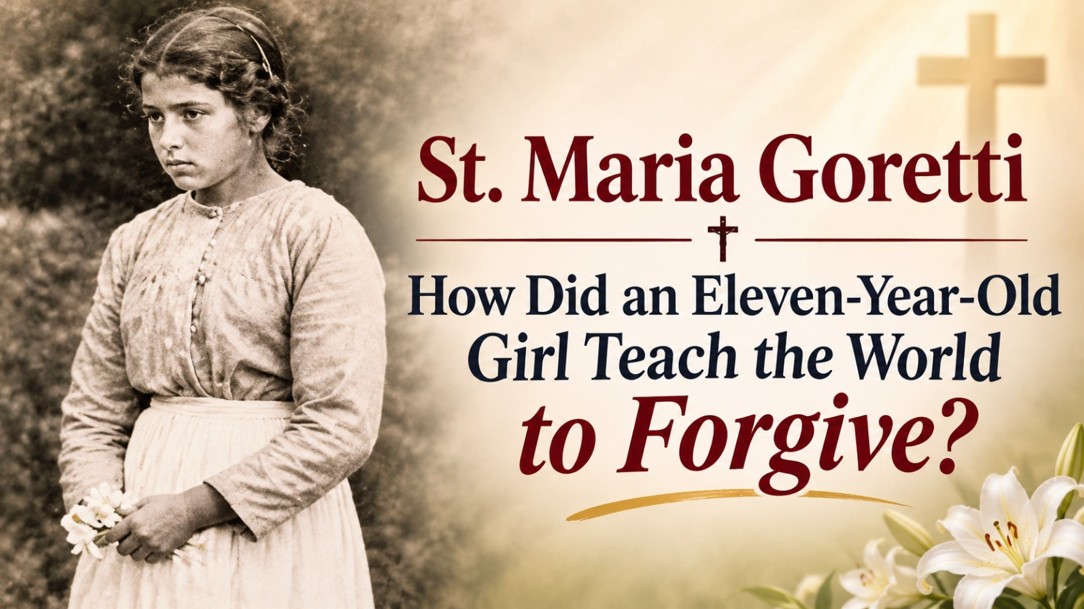
November 19, 2026: Can forgiveness reach someone who has committed a terrible crime? The life of St. Maria Goretti, an eleven-year-old Italian girl, offers one of the Catholic Church’s most moving answers. Before her death, she expressed forgiveness towards the man who had fatally attacked her. Yet her story is not simply about suffering; it is about the transforming power of God’s mercy and the possibility of conversion.


Born in Corinaldo, Italy, in 1890, Maria grew up in a poor but devout Catholic family. After her father died, she helped her mother care for her younger siblings while the family struggled financially. Despite their hardships, Maria’s life was deeply rooted in prayer, faith and love for her family.
On 5 July 1902, Maria was attacked by Alessandro Serenelli, a young man who lived nearby. When she resisted his attempted sexual assault, he stabbed her repeatedly. She was taken to hospital but died from her injuries the following day, 6 July 1902.
Before her death, Maria expressed forgiveness towards Alessandro and said she hoped he would one day join her in Paradise. Her words revealed a remarkable spirit of Christian mercy towards someone who had committed a terrible wrong.
Maria was canonised by Pope Pius XII on 24 June 1950. She is remembered as a powerful witness to faith, purity, courage and forgiveness.
It is important to remember that the responsibility for this terrible crime rested entirely with Alessandro. Maria’s resistance was an act of courage and self-defence, not a standard by which other victims should be judged. No victim is responsible for the violence committed against them.
Maria’s response reflects one of Christianity’s most challenging teachings: loving and praying for those who hurt us.
Jesus tells His disciples: “Love your enemies and pray for those who persecute you” (Matthew 5:44). On the Cross, He also prayed for those responsible for His suffering (Luke 23:34).
Maria’s forgiveness did not mean approving of Alessandro’s actions, minimising his crime or pretending that no harm had occurred. She recognised the evil of what he had done, yet refused to let hatred determine her response.
Her example reminds Catholics that forgiveness is made possible by God's grace. It involves asking God for the strength to renounce revenge and to desire the offender’s conversion, even when emotional healing takes time.
Forgiveness is not always an immediate or effortless decision. For someone who has experienced deep suffering, it can be a difficult spiritual journey requiring prayer, patience and support. It does not necessarily remove painful memories, erase grief or make healing happen overnight.
Rather, forgiveness means gradually entrusting our wounds to God and resisting the desire for revenge. It is a journey towards freedom from hatred, not a denial of the pain we have endured.
Alessandro initially showed little remorse and was sentenced to prison for his crime. Later, according to familiar biographical accounts, he described a dream in which Maria appeared to him, offering white lilies. He regarded this experience as significant in his spiritual journey.
This account is part of the traditional story of his conversion, rather than a teaching of the Church that Catholics are required to believe. His conversion involved more than the reported dream: it required repentance, a recognition of the evil he had committed and a change of heart, made possible by God's grace.
After serving his sentence, Alessandro reportedly sought forgiveness from Maria’s mother, Assunta. Accounts of their reconciliation describe her willingness to extend mercy towards him. This episode is remembered as a remarkable example of Christian forgiveness, although the details of their later interactions should be understood as biographical accounts.
Alessandro's story reminds us that no sinner is beyond the possibility of conversion. God's mercy is available even to those who have committed grave sins, provided they sincerely turn towards Him in repentance.
However, forgiveness does not guarantee that every offender will repent. Nor does it mean that victims must personally reconcile with those who have harmed them.
Catholic teaching never requires victims to accept abuse, remain in danger or abandon their right to protection and justice.
Maria resisted the assault, and her courage deserves recognition. But her story must never be used to suggest that victims who respond differently are less courageous or less faithful. Every victim deserves compassion, protection and support, regardless of how they respond to violence.
Forgiveness and accountability can coexist. Forgiving someone does not mean concealing a crime, preventing lawful action or shielding an offender from the consequences of wrongdoing.
The Church teaches that mercy seeks the sinner’s conversion while recognising the seriousness of sin. True repentance involves acknowledging the harm caused and turning away from wrongdoing.
Likewise, reconciliation is not the same as forgiveness. Reconciliation involves rebuilding a relationship and requires appropriate conditions, including genuine repentance, safety and trust. It cannot be demanded of victims, particularly when doing so could expose them to further harm.
Those who have suffered violence deserve justice, healing and compassionate support. Choosing to forgive does not mean giving up these essential protections.
St. Maria Goretti invites us to pray for the grace to forgive, to resist revenge and to hope for the conversion of sinners. Her life also reminds us of the importance of protecting the vulnerable and upholding the dignity of every human person.
Her story is not a demand that victims hide their pain, suppress their emotions or rush towards forgiveness. Rather, it is a witness to what God's grace can accomplish, even in the midst of profound suffering.
Maria's final act of forgiveness reflects the heart of Christ's teaching: love does not surrender to hatred, and mercy always leaves room for hope.
St. Maria Goretti teaches us that mercy does not call evil good; it refuses to let evil have the final word. Through God's grace, even deeply wounded hearts can find hope, healing and peace.
By Catholic Connect Reporter
Read More on Sainthood:
1) What If You Are Called to Be a Saint? Finding Holiness in Everyday Life
2) The Communion of Saints: How Are We Connected to Those Who Have Gone Before Us?
3) Do You Have to Be Extraordinary to Become a Saint? The Catholic Teaching on Holiness?
4) St Ignatius of Loyola: The Five-Minute Practice That Can Bring You Closer to God
5) What Does the Bible Say About Becoming a Saint? Understanding the Call to Holiness
6) St. Augustine: The Power of Conversion and a New Beginning
7) St. Monica: The Mother Who Never Stopped Praying – A Story of Faith, Patience and Perseverance
8) St. Francis of Assisi: He Gave Up Everything to Discover What Truly Matters
9) Live Like St. Joseph: Discovering Holiness in Life’s Quietest Moments
10) Beyond Likes and Followers: Five Virtues for a Holier Digital Life
11) St. Maximilian Kolbe: What Could Make a Man Choose Death to Save a Stranger?
12) St. Teresa of Calcutta: In a World of AI Conversations, Are We Forgetting Human Connection?
13) Why Do Catholics Ask Saints to Pray for Them? The Meaning Behind This Belief
14) The Beauty of Small Things: How St. Thérèse of Lisieux Found a Path to Sainthood
16) Are Catholics Worshipping Statues? The Catholic Explanation Behind Sacred Images
17) Are Catholic Relics Biblical or Pagan? What Scripture and Early Church History Reveal
18) St. Devasahayam Pillai: A Life That Refused to Renounce Christ


© 2026 CATHOLIC CONNECT POWERED BY ATCONLINE LLP