- 06 November, 2026
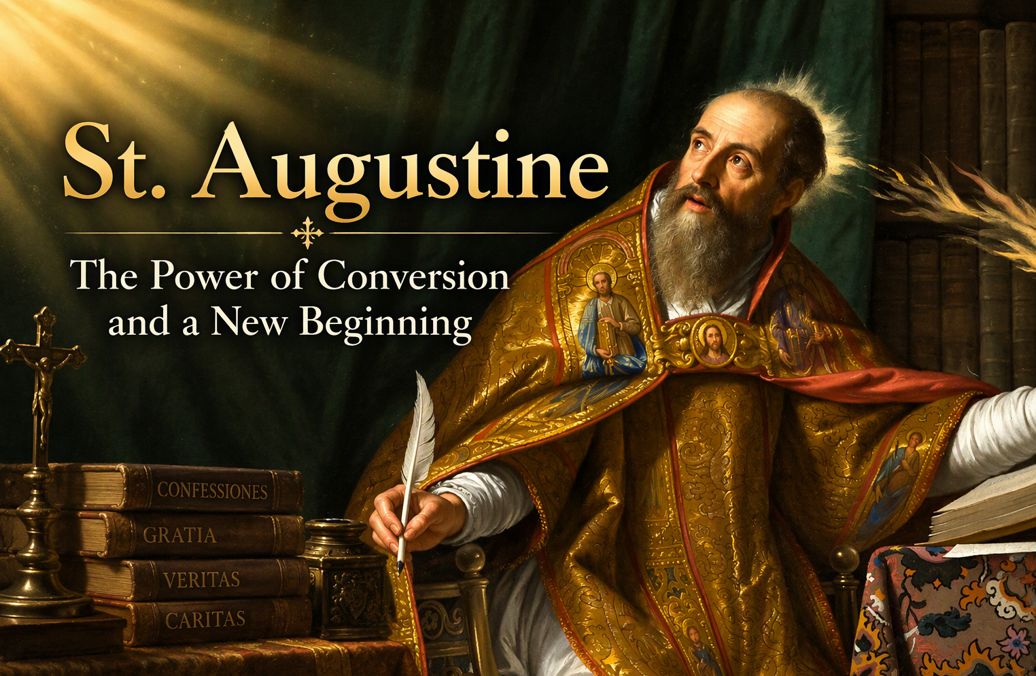
November 6, 2026: Can someone who has spent years pursuing the wrong things completely change their life? The story of St Augustine of Hippo offers one of Christianity's most inspiring answers: YES. Through repentance, faith and God's grace, even a deeply troubled heart can discover a new direction.


Augustine's journey was not simply a change of habits or outward behaviour. It was a profound transformation of his heart, desires and understanding of what gives life meaning. His story also reminds us that conversion is not always a single moment of change. It is often a journey in which we continually learn to turn towards God and grow in holiness.
Born in North Africa in AD 354, Augustine was intellectually gifted and ambitious. Although he was raised in the Christian faith through the influence of his mother, St. Monica, he spent much of his early life searching for happiness through worldly pleasures, intellectual pursuits and professional success.
He explored different philosophies and struggled with questions about truth, morality and the meaning of life. Although he recognised that some of his choices were leading him away from God, he found it difficult to abandon them.
In his famous work Confessions, Augustine recalls praying: "Grant me chastity and continence, but not yet."
His words reveal a conflict familiar to many people: wanting to change while remaining attached to the very things that prevent change.
Despite Monica's prayers and encouragement, Augustine's spiritual journey took many years. His search for truth eventually brought him to Milan, where the preaching and guidance of St. Ambrose helped him understand Christianity more deeply.
Augustine was not discovering Christianity for the first time. Rather, he was gradually returning to the Catholic faith in which he had been raised, recognising the truth he had once struggled to accept.
Around AD 386, Augustine experienced a decisive moment while sitting in a garden in Milan. Deeply distressed by his inner struggle, he heard a child's voice repeating, "Take up and read."
He opened St. Paul's Letter to the Romans and encountered a passage urging Christians to abandon sinful behaviour and put on the Lord Jesus Christ (Romans 13:13–14).
The words moved him profoundly. Augustine understood the passage as a personal call from God and recognised that he could no longer keep postponing his response.
This experience marked a decisive turning point in his life. However, it did not mean that his spiritual journey was suddenly complete. Rather, it was the beginning of a deeper commitment to Christ and a lifelong process of growing in faith and holiness.
(CLICK HERE to follow Catholic Connect and to stay updated with Catholic News & Content)
At Easter in AD 387, Augustine was baptised by St. Ambrose. He subsequently dedicated his life to serving the Church, becoming a priest and later Bishop of Hippo. He eventually emerged as one of the Catholic Church's most influential theologians.
His life demonstrates that a genuine conversion can begin with a powerful moment of grace, but its fruits continue to develop through years of faithfulness, prayer and perseverance.
Augustine's conversion illustrates a central Catholic teaching: human beings can be renewed through God's grace, while freely responding to His invitation.
The Church teaches that conversion begins with God's initiative. Grace comes first, awakening the human heart, preparing it to recognise the truth and inviting it to respond. However, this does not remove human freedom. Each person is called to cooperate freely with the grace God offers.
This means that neither willpower alone nor passive waiting is sufficient. We cannot save or transform ourselves independently of God, but we are also not passive participants in our spiritual lives. We must freely choose to turn away from sin and follow Christ.
Augustine's experience also reminds us that conversion involves the renewal of the inner person. It is not simply about changing outward habits. It means allowing God to reshape our desires, attitudes, decisions and understanding of what truly matters.
Importantly, conversion does not mean that temptation disappears or that a person becomes incapable of sin. Even after a profound spiritual awakening, Christians must continue striving for holiness, seeking forgiveness and relying on God's grace.
The sacraments also have an essential place in this journey. Baptism marks the beginning of new life in Christ, while the Sacrament of Penance offers the opportunity to receive God's forgiveness and return to Him when we fall into sin.
Augustine's life teaches us that conversion is not merely a moment to remember. It is a lifelong commitment to growing closer to God.
Augustine's journey offers practical encouragement to anyone who desires to change their life. These lessons are reflections inspired by his conversion and the Catholic understanding of spiritual growth.
Augustine's famous reflection captures the heart of his spiritual journey:
"You have made us for yourself, O Lord, and our heart is restless until it rests in you."
His life reminds us that our past need not determine our future. We may have spent years pursuing the wrong things, made serious mistakes or struggled repeatedly with sinful habits. Yet God's invitation to return to Him remains a source of hope.
However, Augustine's story should not encourage us to postpone repentance. His long struggle shows how easily the human heart can delay change. We should respond to God's grace today, rather than assuming that another opportunity will always come.
Nor does complete conversion mean becoming flawless overnight or escaping every temptation. It means allowing God to redirect our lives towards truth, holiness and love, and remaining faithful to Him through the challenges of everyday life.
Augustine's conversion was a decisive turning point, but his growth in faith continued throughout his life. His example encourages us to see conversion not as a destination reached in a single moment, but as an ongoing journey of surrender, renewal and perseverance.
A new beginning is possible, not because human beings are strong enough to overcome everything on their own, but because God's grace is greater than their weaknesses. When we freely respond to His invitation and continue walking with Him, even the most troubled heart can find a new direction.
By Catholic Connect Reporter
Read More:
1) What If You Are Called to Be a Saint? Finding Holiness in Everyday Life
2) The Communion of Saints: How Are We Connected to Those Who Have Gone Before Us?
3) Do You Have to Be Extraordinary to Become a Saint? The Catholic Teaching on Holiness?
4) St Ignatius of Loyola: The Five-Minute Practice That Can Bring You Closer to God
5) What Does the Bible Say About Becoming a Saint? Understanding the Call to Holiness


© 2026 CATHOLIC CONNECT POWERED BY ATCONLINE LLP