- 16 November, 2026
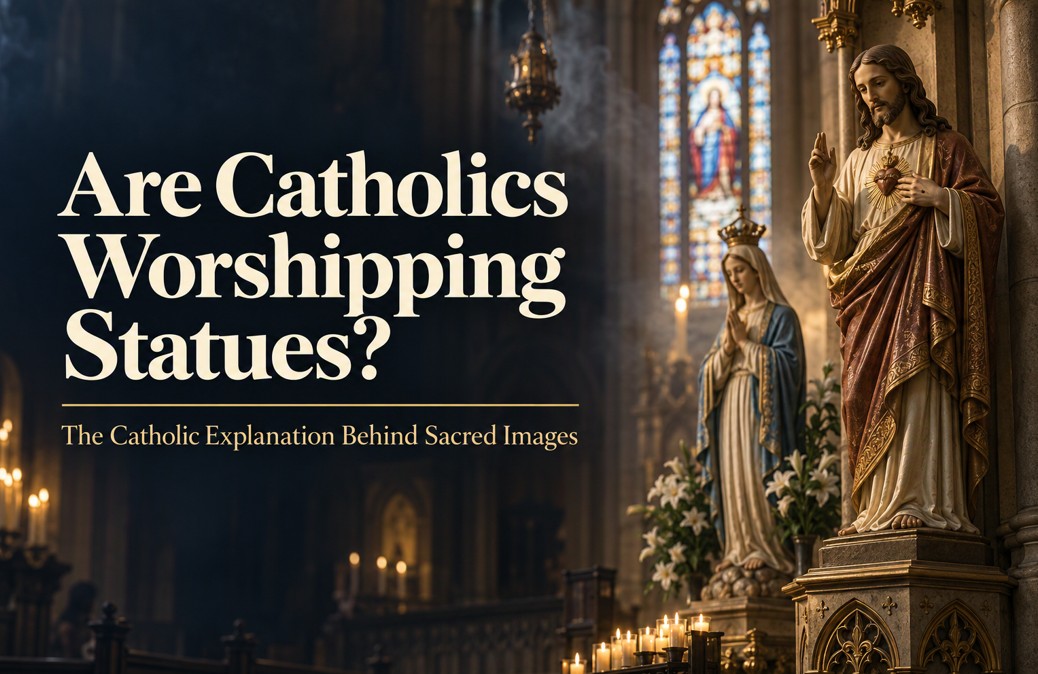
November 16, 2026: Walk into a Catholic church and you may see people kneeling before statues, lighting candles near images of Mary, or kissing a crucifix. To someone unfamiliar with Catholic tradition, these actions might look like idol worship. But is that what Catholics actually believe?

The Catholic Church makes an important distinction: worship belongs to God alone, while sacred images help believers remember, honour and draw closer to the people and mysteries they represent. Catholics do not worship statues as gods. Rather, the honour shown to a sacred image is directed towards the person represented, not the material object itself.
Catholic teaching distinguishes divine worship, known as latria, from the veneration given to Mary and the saints, traditionally called dulia. Adoration (latria) belongs to God alone: the Father, Son and Holy Spirit.
The First Commandment warns against idolatry: "You shall have no other gods before me" (Exodus 20:3). Catholics take this prohibition seriously. They do not believe that wood, stone or metal possesses divinity or supernatural power in itself.
The saints are honoured because of their faithfulness to God, not because they are gods. Mary receives a unique form of veneration called hyperdulia, reflecting her special place in salvation history. However, she is not worshipped, and her role remains entirely dependent upon and subordinate to Jesus Christ.
There is also an important qualification concerning images of Jesus. Since Christ is truly God, Catholics may adore Him while praying before an image or crucifix. However, their adoration is directed towards Christ, not towards the wood, stone or other material used to portray Him.
The distinction is fundamental: Catholics may worship Christ before an image of Him, but they do not worship the image itself.
Exodus 20:4–5 prohibits making idols and bowing down to worship them. Yet Scripture also records God commanding the creation of sacred images.
In Exodus 25:18–20, God instructs Moses to make two golden cherubim for the Ark of the Covenant. In Numbers 21:8–9, Moses is told to make a bronze serpent as an instrument through which the Israelites would receive healing.
These passages demonstrate that the Bible does not condemn every religious image. Rather, it condemns idolatry: treating a created object as a god or placing divine trust in something that is not God.
The story of the bronze serpent makes this distinction particularly clear. Although God initially commanded its creation, the Israelites eventually began misusing it as an object of worship. King Hezekiah therefore destroyed it (2 Kings 18:4).
The lesson is that an image can have a legitimate religious purpose, but it must never become an object of idolatry.
A statue can serve as a visual reminder, helping someone focus during prayer and reflect on the person represented.
A crucifix recalls Christ's sacrifice; an image of Mary recalls her faithfulness and response to God's grace; and a statue of a saint encourages believers to imitate a life of holiness.
The Catholic Church explains this principle in the Catechism of the Catholic Church:
"The honor rendered to an image passes to its prototype" (CCC 2132).
Here, prototype means the person or sacred reality represented by the image. In other words, the honour does not stop at the physical object but is directed towards the person portrayed.
The Catechism further explains that the veneration of sacred images is a "respectful veneration," not the adoration due to God alone.
This is comparable to keeping a photograph of someone we love. We may kiss it, hold it close or look at it with affection, but we do not believe that the photograph itself is the person. Our affection is directed towards the person represented.
Similarly, when Catholics kneel before a statue of Mary or kiss a crucifix, the gesture is intended to express devotion towards the person represented, not worship of the material object.
Christianity's use of sacred images is also rooted in the Incarnation. John 1:14 declares: "The Word became flesh."
In Jesus Christ, the invisible God entered human history and became visible in a real human body. God did not remain distant or invisible; He took on human nature and lived among us.
For Catholics, depicting Christ is therefore a way of affirming that He truly became man. Sacred images of Jesus do not attempt to capture God's invisible divine nature. Rather, they portray the Son of God who became visible through His human nature.
This is one reason why sacred art has such an important place in Catholic worship and devotion. Images can proclaim the Gospel, communicate biblical truths and direct the heart towards heavenly realities.
An important distinction must be made between praying before an image and praying to an image as though it were a living being.
Catholics do not believe that a statue is conscious, can hear prayers or possesses the power to answer requests. The physical image is not the object of their trust.
However, Catholics may pray before an image of Mary or a saint while asking the person represented to intercede for them. This is an expression of their belief in the communion of saints: that those who are united with Christ in heaven remain part of His Church.
For example, when Catholics pray before an image of Mary, they are not asking the statue to hear them. They are asking Mary to pray for them and bring their intentions before God.
The image serves as a visual reminder of the person to whom the prayer is directed. It is a devotional aid, not an independent source of spiritual power.
The Catholic Church does not approve of treating statues as magical objects or believing that touching an image automatically guarantees a miracle.
The Directory on Popular Piety and the Liturgy (2002) warns against treating sacred images as though they contain divine power in themselves or placing trust in them as if they were gods.
Authentic devotion must always lead believers towards God. A statue cannot replace prayer, faith, repentance or a personal relationship with Christ.
The distinction is important: lighting a candle before an image can be an expression of faith, but believing that the candle or statue automatically guarantees a miracle would be superstition.
Catholic teaching makes a clear distinction between worshipping God and honouring sacred images.
Catholics do not worship statues as gods. They venerate images because of the people and sacred realities those images represent. When they adore Christ before a crucifix or an image of Jesus, their adoration is directed towards Christ Himself, not the material object.
The Church's teaching is rooted in Scripture, the Incarnation and the understanding that sacred images can help believers contemplate the mysteries of faith.
Ultimately, sacred images are meant to point beyond themselves. Their purpose is not to replace God, but to help believers remember His saving work, honour the saints and grow closer to Jesus Christ.
By Catholic Connect Reporter
Read More on Sainthood:
1) What If You Are Called to Be a Saint? Finding Holiness in Everyday Life
2) The Communion of Saints: How Are We Connected to Those Who Have Gone Before Us?
3) Do You Have to Be Extraordinary to Become a Saint? The Catholic Teaching on Holiness?
4) St Ignatius of Loyola: The Five-Minute Practice That Can Bring You Closer to God
5) What Does the Bible Say About Becoming a Saint? Understanding the Call to Holiness
6) St. Augustine: The Power of Conversion and a New Beginning
7) St. Monica: The Mother Who Never Stopped Praying – A Story of Faith, Patience and Perseverance
8) St. Francis of Assisi: He Gave Up Everything to Discover What Truly Matters
9) Live Like St. Joseph: Discovering Holiness in Life’s Quietest Moments
10) Beyond Likes and Followers: Five Virtues for a Holier Digital Life
11) St. Maximilian Kolbe: What Could Make a Man Choose Death to Save a Stranger?
12) St. Teresa of Calcutta: In a World of AI Conversations, Are We Forgetting Human Connection?
13) Why Do Catholics Ask Saints to Pray for Them? The Meaning Behind This Belief
14) The Beauty of Small Things: How St. Thérèse of Lisieux Found a Path to Sainthood


© 2026 CATHOLIC CONNECT POWERED BY ATCONLINE LLP