- 17 October, 2026
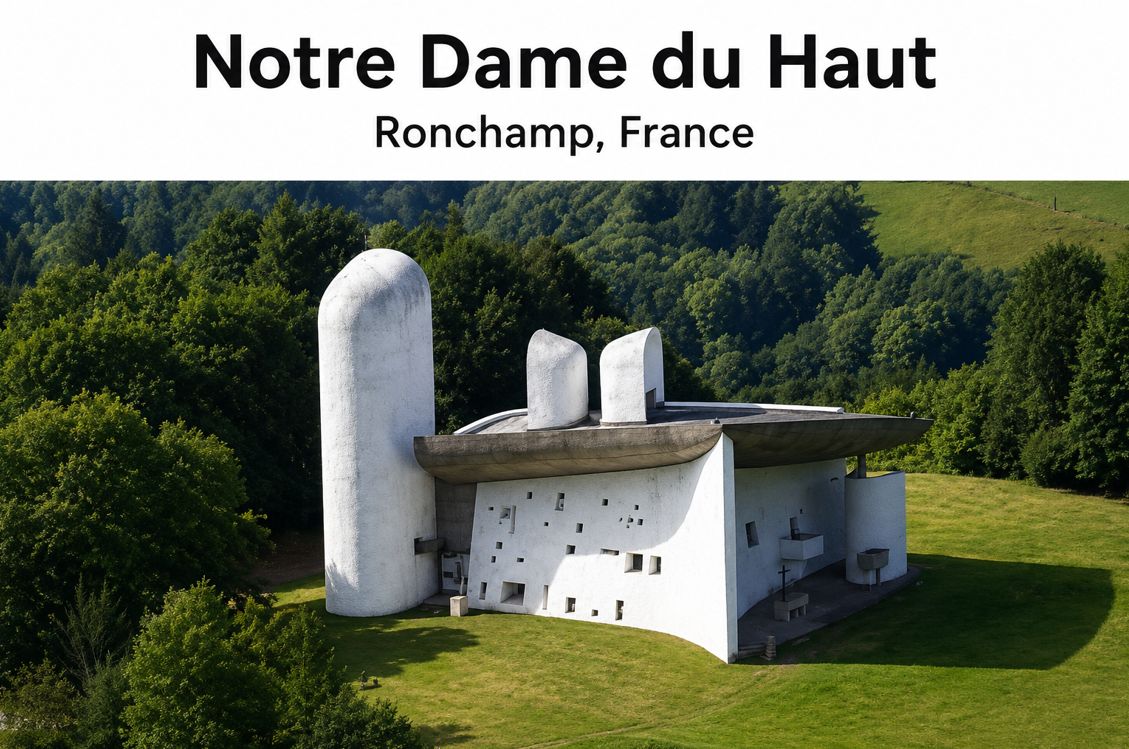
July 18, 2026: Some churches overwhelm us with soaring Gothic spires, glittering mosaics, or centuries of ornate decoration. Others speak in a quieter voice, inviting contemplation through simplicity rather than grandeur. Perched atop Bourlémont Hill in the peaceful countryside of eastern France, Notre-Dame du Haut in Ronchamp is one such place. At first glance, it hardly resembles a traditional church. Its thick white walls curve like sculpted stone, while an enormous dark roof appears to float effortlessly above them, as though caught by the wind.


Yet this extraordinary chapel has become one of the most influential sacred buildings of the twentieth century. Designed by the celebrated Swiss-French architect Le Corbusier and completed in 1955, Notre-Dame du Haut broke almost every convention of church architecture. Instead of relying on elaborate ornamentation, towering columns, or stained-glass masterpieces, it uses light, shadow, space, and silence to awaken the soul. Here, architecture itself becomes prayer, demonstrating that faith can be expressed not only through tradition but also through bold artistic vision.
The journey begins long before you reach the chapel itself. Notre-Dame du Haut stands alone on Bourlémont Hill, surrounded by rolling fields, forests, and wide-open skies. The climb toward the summit is slow and peaceful, allowing visitors to leave behind the noise of everyday life. As the chapel gradually comes into view, its unusual silhouette seems almost alive, rising naturally from the landscape rather than sitting upon it.
Unlike the symmetry of classical churches, every line here is intentionally irregular. The walls gently curve, the windows appear scattered almost at random, and the roof tilts dramatically like the wing of a great bird preparing for flight. Yet the apparent disorder conceals remarkable harmony. Every curve, every angle, and every opening has been carefully designed to guide light, shape space, and inspire reflection.
(CLICK HERE to follow Catholic Connect for regular News and Content)
The chapel feels less like a building imposed upon nature than one that has grown organically from the hill itself, becoming part of the landscape that surrounds it.
Perhaps the chapel's most striking feature is its remarkable roof.
Massive and sculptural, it resembles an enormous shell or the wing of an aircraft gently hovering above the white walls. Although it appears incredibly heavy, the roof never actually touches the walls. A narrow gap separates the two, allowing a delicate ribbon of daylight to stream into the interior.
This subtle architectural detail creates an astonishing illusion. The roof seems to float effortlessly above the chapel, giving the entire building a sense of lightness despite its solid concrete construction.
The symbolism is difficult to miss. The hovering roof suggests divine protection, sheltering those gathered beneath it while reminding worshippers that heaven is always close, even if unseen. It is a simple architectural gesture, yet one that fills the chapel with quiet wonder.
Stepping inside Notre-Dame du Haut is unlike entering any other church.
There are no vast stained-glass windows stretching from floor to ceiling. Instead, thick white walls are punctuated by dozens of irregular openings of different sizes and depths. These carefully crafted recesses, sometimes called "light cannons," capture sunlight from different directions throughout the day.
Some windows contain clear glass, while others are filled with small panes of vibrant red, blue, yellow, and green. As sunlight passes through them, colorful beams drift slowly across the white interior, changing hour by hour with the movement of the sun.
The effect is almost mystical.
Rather than flooding the chapel with brightness, the light arrives gently, creating pockets of illumination surrounded by soft shadow. The constantly shifting patterns give the impression that the building itself is alive, quietly responding to the rhythm of creation.
Here, light becomes the primary decoration. Instead of relying on elaborate carvings or gilded ornamentation, Le Corbusier allowed sunlight to become an ever-changing work of sacred art.
The simplicity of the interior invites visitors to slow their pace. Thick walls muffle outside sounds, creating an atmosphere of profound stillness. The gently curved surfaces soften echoes, allowing even whispered prayers to seem intimate and personal.
The altar stands with quiet dignity at the heart of the chapel, free from unnecessary decoration. Every architectural element directs attention toward worship rather than spectacle.
Scattered throughout the building are small side chapels, each receiving light from above through carefully positioned skylights. These secluded spaces offer moments of personal prayer, where the outside world seems wonderfully distant.
Le Corbusier understood that sacred architecture should do more than impress the eye. It should create an environment where silence itself becomes a form of prayer. At Ronchamp, every wall, shadow, and beam of light gently encourages contemplation.
When Notre-Dame du Haut was completed in 1955, many were astonished by its bold departure from traditional church design. Over time, however, it came to be recognized as one of the greatest achievements of modern architecture.
Today, the chapel is one of the seventeen works of Le Corbusier inscribed together as a UNESCO World Heritage Site. The peaceful hilltop has also grown into a place of retreat, with a graceful bell tower designed by Jean Prouvé and the nearby Monastery of Saint Clare and visitor facilities created by the renowned architect Renzo Piano. Despite these thoughtful additions,
the chapel remains the undisputed heart of the site, drawing pilgrims, architects, artists, and seekers from around the world.
Notre-Dame du Haut reminds us that sacred architecture is not confined to one style or one era. While medieval cathedrals speak through soaring stone vaults and brilliant stained glass, this remarkable chapel speaks through sculpted concrete, natural light, and profound simplicity.
Standing quietly within its white walls as shafts of colored sunlight drift across the sanctuary, it becomes clear that this is far more than an architectural landmark. It is a place where silence has been carefully designed, where light becomes a visible symbol of God's presence, and where every curve encourages the soul to look beyond the material world.
More than seventy years after its completion, Notre-Dame du Haut continues to inspire visitors from every corner of the globe. It proves that even in the modern age, architecture can still become a witness to faith—lifting hearts toward heaven not through grandeur alone, but through beauty, imagination, and the timeless language of light.
By Catholic Connect Reporter
Read more on Must-Visit Catholic Architectural and Historical Wonders:
How Did the Holy Family's House End Up in Italy?
Sumela Monastery: Where Faith Finds a Home on the Cliffs
Sanctuary of Monte Sant'Angelo: Descending into the Cave Where Heaven Touched Earth
The Church Where Heaven Touched Earth: Mount Tabor's Basilica of the Transfiguration
Meteora: The Monasteries That Seem to Hang Between Heaven and Earth
Monastery of Alcobaça: Portugal's Treasure of Love and Legacy
Las Lajas Sanctuary: Colombia's Breathtaking Church Between Cliffs and Sky
Church of Saint George, Lalibela: The Astonishing Church Carved from a Single Rock
Archbasilica of St John Lateran: Inside the Highest-Ranking Church in the Catholic Church
Saint Catherine's Monastery: The World's Oldest Living Christian Monastery
The Church of the Holy Sepulchre: Walking Through the Sacred Heart of Christianity
Inside St. Mark's Basilica: The Church That Glows Like Heaven
Notre-Dame Cathedral: The Gothic Masterpiece That Rose from the Ashes to Inspire the World
Milan Cathedral: Italy's Crown of Marble Reaching Towards Heaven
Chartres Cathedral: Where Stone, Light, and Heaven Meet
Montserrat Monastery: A 1,000-Year-Old Architectural Marvel in the Mountains
Inside the Sagrada Família: The Incredible Story of Gaudí's Greatest Masterpiece



© 2026 CATHOLIC CONNECT POWERED BY ATCONLINE LLP