- 17 October, 2026

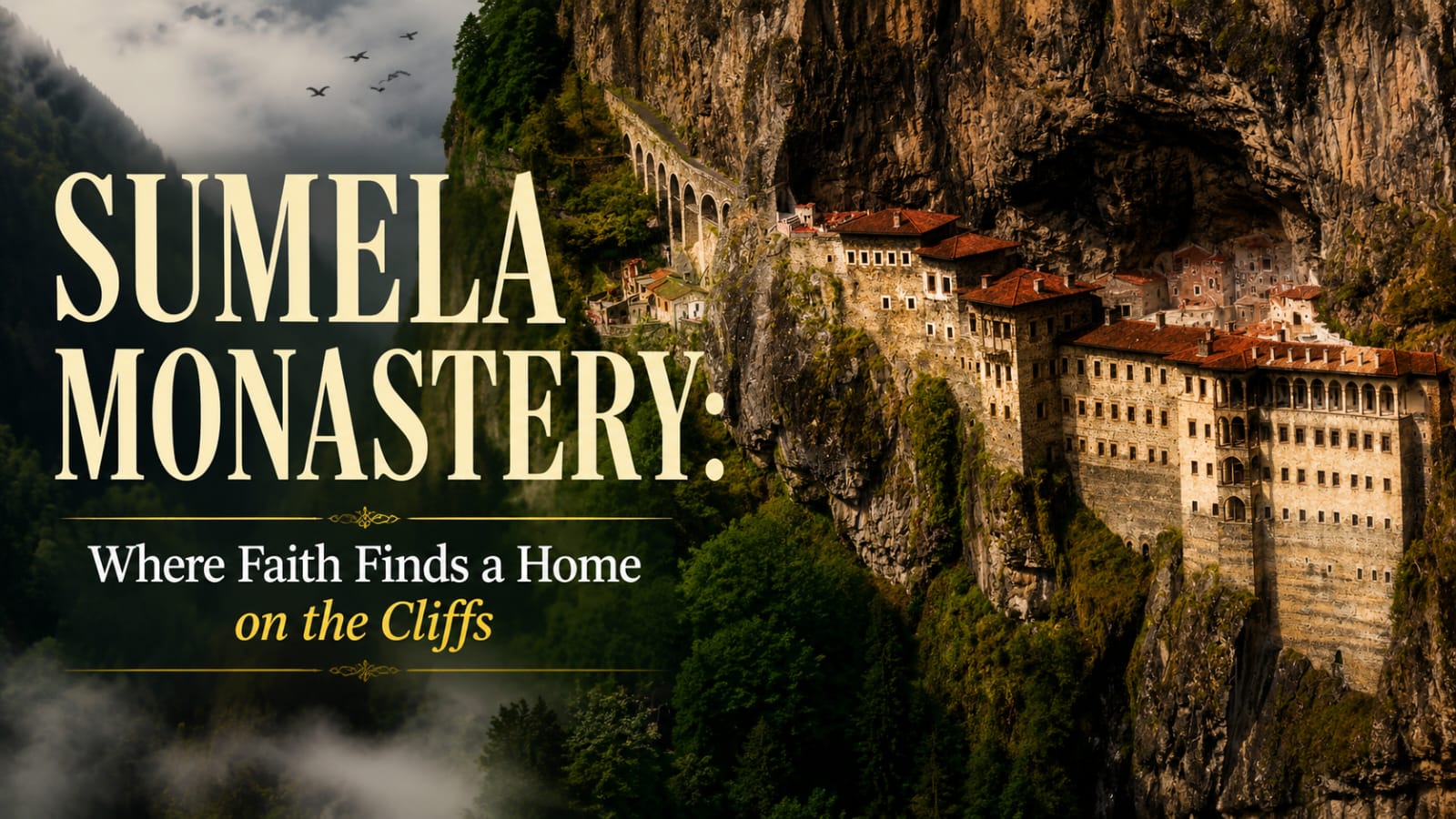
July 16, 2026: Some sanctuaries are built on mountains. Sumela Monastery is built into one. Suspended against a towering cliff in Türkiye's Pontic Mountains, this centuries-old sanctuary appears to defy gravity, standing as a breathtaking witness to faith, perseverance and human ingenuity. Long before visitors step inside its ancient walls, the journey itself begins to reveal why this remarkable monastery has captivated pilgrims and travellers for more than sixteen centuries.


A Journey to a Sanctuary Above the Valley
The path to Sumela Monastery is as much a part of the experience as the destination itself. As visitors make their way through the lush forests of Altındere Valley National Park, the sound of rushing streams and birdsong fills the mountain air. Then, almost without warning, the monastery emerges from the cliffs—its white walls seemingly becoming one with the rock face, rising nearly 300 metres above the valley floor at an elevation of about 1,200 metres above sea level. Suspended between the earth below and the sky above, it is a sight that leaves even seasoned travellers in awe.
Dedicated to the Virgin Mary, known locally as Meryem Ana, Sumela's story began around AD 386, when two Athenian monks, Barnabas and Sophronios, discovered a revered icon of the Virgin Mary inside a mountain cave. Believed to have been painted by St. Luke, the icon inspired them to establish a small sanctuary that, over the centuries, grew into one of Christianity's most remarkable mountain monasteries.
(CLICK HERE to follow Catholic Connect for regular News and Content)
A Sanctuary Shaped by Time
Every stone at Sumela bears the imprint of history. What began as a humble place of prayer was restored under Byzantine Emperor Justinian I and later transformed into a flourishing monastic centre by Emperor Alexios III of the Empire of Trebizond, whose patronage helped shape much of the monastery seen today.
When the Ottoman Empire conquered Trabzon in 1461, Sumela's story took an unexpected turn. Rather than fading into history, the monastery was placed under the protection of Sultan Mehmed II, with successive sultans renewing its privileges. Their support allowed this Christian sanctuary to continue as a centre of prayer, learning and monastic life for centuries.
The monastery fell silent only after the population exchange between Greece and Türkiye in 1923. Left abandoned for decades, its walls gradually weathered the passage of time until extensive restoration efforts began to safeguard this extraordinary heritage.
Where Stone Tells the Story of Faith
Crossing into the monastery is like stepping into another century. Nearly 70 rooms unfold across multiple levels around a quiet courtyard, their walls carved into the mountain itself. Narrow stairways lead to chapels, kitchens, a library, student dormitories and monks' quarters, offering a glimpse into the daily rhythm of a community that once lived and prayed high above the valley.
At the heart of the complex lies the Rock Church, a natural cave transformed into a sacred place of worship. Its walls and ceilings are adorned with intricate frescoes portraying scenes from the life of Christ, the Virgin Mary and the saints. Though softened by time, the colours still draw the eye, preserving centuries of faith within the shelter of the mountain.
Nearby, the graceful aqueduct clings to the cliff, once carrying fresh mountain water throughout the monastery. The striking white monks' residence, with its red-tiled roof, wooden balconies and Ottoman-inspired interior details, appears to project from the rock itself—a remarkable blend of architecture and nature that continues to astonish visitors.
A Legacy Preserved for the Future
Today, Sumela Monastery stands not only as one of Christianity's most remarkable mountain sanctuaries but also as an enduring symbol of cultural heritage. Since 2000, it has been included on UNESCO's World Heritage Tentative List, recognising its outstanding universal value. In recent years, Türkiye has undertaken extensive conservation work to stabilise the surrounding cliffs, restore the historic aqueduct and carefully preserve the monastery's treasured frescoes, reflecting the country's ongoing efforts to secure full UNESCO World Heritage status.
High above the Altındere Valley, where the mountains meet the clouds and silence lingers within ancient stone walls, Sumela Monastery continues to tell a story of faith, resilience and hope. More than sixteen centuries after its humble beginnings, it remains a place where history is not merely remembered—it is experienced, one step at a time.
Read more Stories:
Sanctuary of Monte Sant'Angelo: Descending into the Cave Where Heaven Touched Earth
The Church of the Holy Sepulchre: Walking Through the Sacred Heart of Christianity
Archbasilica of St John Lateran: Inside the Highest-Ranking Church in the Catholic Church
Church of Saint George, Lalibela: The Astonishing Church Carved from a Single Rock
Las Lajas Sanctuary: Colombia's Breathtaking Church Between Cliffs and Sky
Meteora: The Monasteries That Seem to Hang Between Heaven and Earth
The Church Where Heaven Touched Earth: Mount Tabor's Basilica of the Transfiguration
Milan Cathedral: Italy's Crown of Marble Reaching Towards Heaven
Inside St. Mark's Basilica: The Church That Glows Like Heaven
Notre-Dame Cathedral: The Gothic Masterpiece That Rose from the Ashes to Inspire the World
Chartres Cathedral: Where Stone, Light, and Heaven Meet
Montserrat Monastery: A 1,000-Year-Old Architectural Marvel in the Mountains
Inside the Sagrada Família: The Incredible Story of Gaudí's Greatest Masterpiece
By Catholic Connect Reporter





© 2026 CATHOLIC CONNECT POWERED BY ATCONLINE LLP