- 17 October, 2026

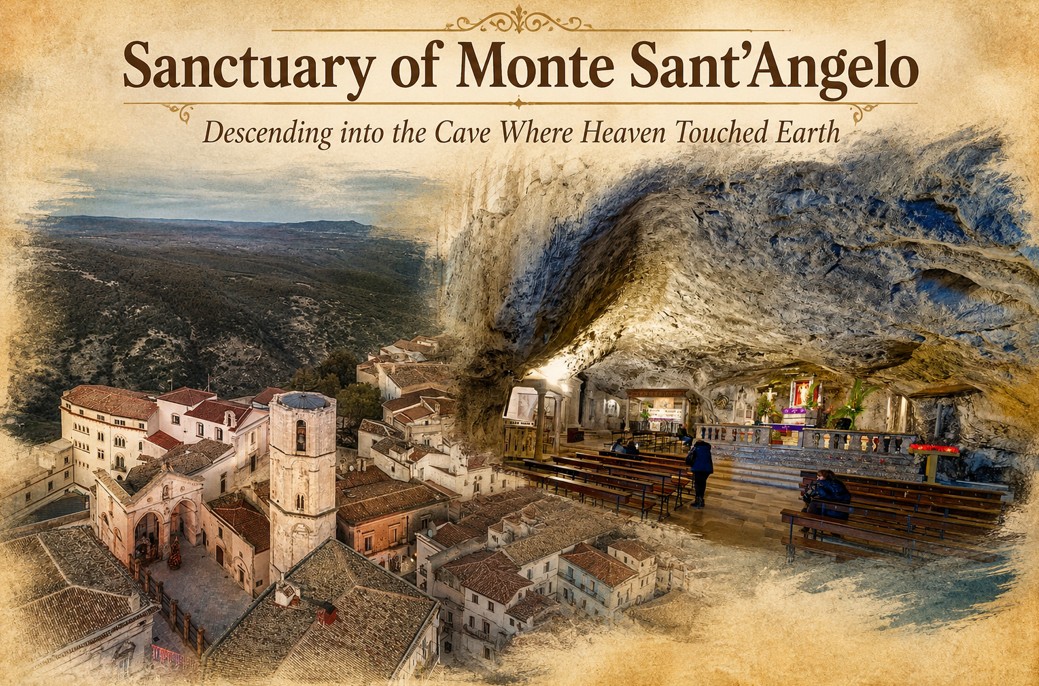
July 15: 2026:Some churches reach toward heaven with soaring domes and towering spires. Others are hidden deep within the earth, inviting pilgrims to descend before they ascend in faith. The Sanctuary of Saint Michael the Archangel in Monte Sant'Angelo, Italy, belongs to the latter. Perched high on the rugged cliffs of the Gargano Peninsula overlooking the Adriatic Sea, this extraordinary sanctuary is unlike any other Christian shrine in the world. Its greatest treasure is not a magnificent cathedral or an ornate altar built by human hands, but a natural limestone cave that, according to ancient Christian tradition, was chosen by heaven itself.


For more than 1,500 years, pilgrims have climbed the mountain only to descend into its depths, following the same path walked by saints, emperors, popes, crusaders, and ordinary believers seeking the protection and intercession of Saint Michael the Archangel. Here, nature and architecture merge into a single act of worship, creating one of Christianity's most remarkable pilgrimage destinations.
The story of the sanctuary begins in AD 490, when tradition holds that Saint Michael the Archangel appeared within a cave on Mount Gargano. Over the following centuries, several additional apparitions were reported, establishing the grotto as one of the most revered shrines dedicated to the leader of God's heavenly armies.
Unlike most churches, this sanctuary was never built to contain a sacred relic or commemorate the life of a saint. Instead, it was built around the cave itself, which has long been venerated as holy ground. According to tradition, Saint Michael declared that the grotto had been consecrated not by human hands but by the presence of the angels themselves. That belief has drawn countless pilgrims to this mountain sanctuary for over fifteen centuries.
(CLICK HERE to follow Catholic Connect for regular News and Content)
Today, the Sanctuary of Monte Sant'Angelo is recognized as a UNESCO World Heritage Site, included among the remarkable Longobard monuments of Italy. Yet its greatest significance cannot be measured by history alone. It is a place where generations of believers have come seeking courage, healing, protection, and a deeper awareness of God's presence.
Approaching the sanctuary, visitors are greeted by a magnificent Romanesque bell tower and an impressive stone portal that reflects the craftsmanship of medieval Italy. The weathered façade speaks of centuries of devotion, welcoming each pilgrim much as it welcomed travelers during the Middle Ages.
But unlike most churches, entering the sanctuary is only the beginning of the journey.
Before reaching the sacred grotto, visitors descend an ancient staircase of eighty-six broad stone steps. With every step downward, the daylight slowly fades, replaced by the cool stillness of the mountain. The sounds of the bustling town disappear behind you, creating an atmosphere of silence and anticipation.
It is an unusual experience. Most churches invite worshippers to lift their eyes upward toward lofty ceilings. Monte Sant'Angelo first asks pilgrims to humble themselves by descending into the earth, a powerful reminder that the path to God often begins with humility. The staircase itself becomes part of the pilgrimage, preparing both heart and mind for the sacred encounter that awaits below.
At the bottom of the staircase, the sanctuary opens into the natural limestone grotto. Here, architecture does not dominate nature—it embraces it.
Instead of polished marble walls or carefully carved columns, rough stone ceilings arch overhead, their irregular shapes formed not by craftsmen but by the patient work of creation itself. The cave glows softly beneath hanging lamps, flickering candles, and golden liturgical furnishings that illuminate the ancient rock with a warm, reverent light.
The contrast is striking. Ornate altars, graceful arches, and beautiful sacred artwork blend seamlessly with the rugged cave walls, creating a space where heaven and earth seem to meet. Every surface reminds visitors that this sanctuary was not imposed upon the mountain but lovingly woven into it.
Standing within the grotto, one senses an atmosphere unlike that of any conventional cathedral. The silence is deeper, the air cooler, and the surroundings more intimate. It feels less like entering a grand building and more like stepping into one of the earliest places of Christian worship, where believers gathered in caves to pray during times of persecution.
Throughout the centuries, the sanctuary has welcomed an extraordinary procession of pilgrims. Popes have knelt here in prayer. Medieval kings sought Saint Michael's protection before embarking on great journeys. Crusaders paused here to ask the Archangel's guidance before sailing to the Holy Land. Even today, thousands of pilgrims continue to make the climb each year, many carrying personal intentions known only to God.
Despite its fame, the sanctuary has retained an atmosphere of quiet devotion rather than spectacle. The faithful come not simply to admire an architectural masterpiece but to encounter a sacred place where countless generations have prayed before them.
The architecture itself encourages this spirit of reflection. Rather than overwhelming visitors with grandeur, it gently leads them into silence, allowing the cave's natural beauty to become an instrument of prayer.
The Sanctuary of Monte Sant'Angelo reminds us that some of Christianity's holiest places are not defined by soaring domes or glittering mosaics, but by the sacred events they commemorate. Here, nature becomes part of the architecture, and architecture becomes an expression of faith.
Every stone step, every weathered arch, every flickering candle, and every rough limestone wall speaks of humanity's enduring desire to draw closer to God. The sanctuary's unique design teaches a profound spiritual lesson: before rising toward heaven, we must first descend in humility.
Leaving the grotto and climbing back into the sunlight, pilgrims often emerge with more than photographs or memories. They carry with them a renewed sense of peace and courage, inspired by the enduring witness of Saint Michael and by a sanctuary where, according to ancient tradition, heaven once touched the earth.
More than fifteen centuries after its founding, Monte Sant'Angelo remains one of the world's most extraordinary Christian pilgrimage sites—a place where the mountain itself has become a cathedral, and where faith continues to echo through living stone.
By Catholic Connect Reporter
Read more on Must-Visit Catholic Architectural and Historical Wonders:
The Church Where Heaven Touched Earth: Mount Tabor's Basilica of the Transfiguration
Meteora: The Monasteries That Seem to Hang Between Heaven and Earth
Monastery of Alcobaça: Portugal's Treasure of Love and Legacy
Las Lajas Sanctuary: Colombia's Breathtaking Church Between Cliffs and Sky
Church of Saint George, Lalibela: The Astonishing Church Carved from a Single Rock
Archbasilica of St John Lateran: Inside the Highest-Ranking Church in the Catholic Church
Saint Catherine's Monastery: The World's Oldest Living Christian Monastery
The Church of the Holy Sepulchre: Walking Through the Sacred Heart of Christianity
Inside St. Mark's Basilica: The Church That Glows Like Heaven
Notre-Dame Cathedral: The Gothic Masterpiece That Rose from the Ashes to Inspire the World
Milan Cathedral: Italy's Crown of Marble Reaching Towards Heaven
Chartres Cathedral: Where Stone, Light, and Heaven Meet
Montserrat Monastery: A 1,000-Year-Old Architectural Marvel in the Mountains
Inside the Sagrada Família: The Incredible Story of Gaudí's Greatest Masterpiece




© 2026 CATHOLIC CONNECT POWERED BY ATCONLINE LLP