- 17 October, 2026

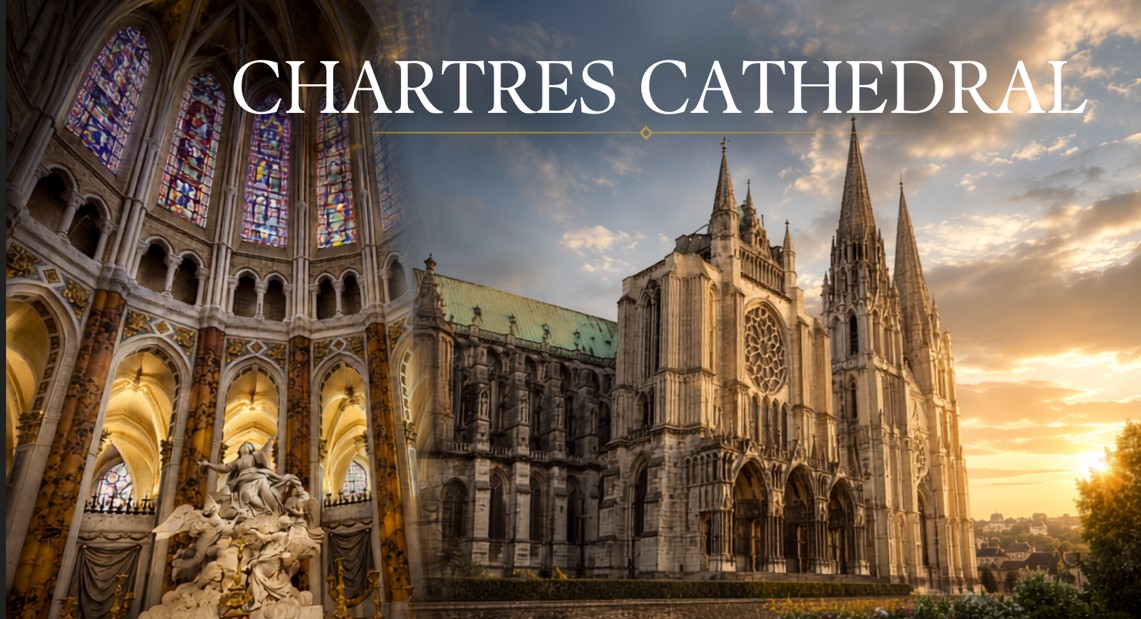
France, July 3, 2026 : Few places in the Christian world inspire awe quite like Chartres Cathedral. Rising majestically above the peaceful French countryside, its twin spires have guided pilgrims, worshippers, and travelers for more than eight centuries. Long before its bells come into view, they dominate the skyline, pointing heavenward as if inviting every passerby to lift their eyes—and their hearts—to God.


Located about 80 kilometers southwest of Paris, Chartres Cathedral is one of the greatest masterpieces of High Gothic architecture. Constructed largely between 1194 and 1220 after a devastating fire destroyed much of an earlier church, it remains astonishingly intact.
Declared a UNESCO World Heritage Site in 1979, the cathedral is celebrated not only for its architectural brilliance but also for preserving one of the world's finest collections of medieval stained glass.
Yet history alone cannot explain the cathedral's enduring power. Chartres is a place to be experienced. Every soaring pillar, every sculpted doorway, and every shaft of colored light tells a story of faith. Walking through its doors feels less like entering a building and more like stepping into a prayer carved in stone.
The journey begins outside, where the cathedral's magnificent façade immediately commands attention. Two towering spires rise above the town, each distinct in design. One reflects the solid simplicity of the Romanesque period, while the other reaches skyward with the graceful elegance of Gothic architecture. Together, they reveal how generations of believers continued building upon the faith of those who came before them.
(CLICK HERE to follow Catholic Connect for regular News and Content)
As you approach the western entrance, known as the Royal Portal, the intricate stone carvings begin to reveal themselves. Kings, queens, prophets, apostles, and saints stand quietly along the doorways, their calm expressions welcoming pilgrims into a sacred space. Far more than decoration, these sculptures served as visual lessons in Scripture for medieval Christians, many of whom could not read. Every figure, every fold of a robe, and every carefully carved face proclaims the story of God's salvation.
Even before stepping inside, it becomes clear that this cathedral was designed not simply to impress the eye, but to lift the soul.
Crossing the threshold is an unforgettable experience. The vast interior opens before you in breathtaking proportions. Slender columns soar effortlessly toward ribbed vaults high overhead, drawing the eye upward until the ceiling almost seems to disappear into heaven.
Then comes the light.
More than 150 stained-glass windows transform ordinary sunlight into an ever-changing display of brilliant sapphire, ruby, emerald, and gold. The cathedral preserves nearly 2,500 square meters of original thirteenth-century stained glass, making it one of the most complete collections of medieval glass anywhere in the world.
The most celebrated feature is the legendary "Chartres Blue." This extraordinary deep cobalt hue possesses a remarkable luminosity that has fascinated artists, historians, and scientists for centuries. Even today, no modern reproduction quite captures its unique brilliance. As sunlight pours through these windows, the entire cathedral seems to glow from within, wrapping visitors in an atmosphere of serenity and wonder.
For medieval worshippers, these windows were far more than beautiful works of art. They were the Bible in color. Scenes from the lives of Christ, the Blessed Virgin Mary, the prophets, apostles, and saints unfolded in vivid detail, allowing even the illiterate to contemplate the story of salvation. Every pane became a sermon illuminated by God's own light.
The extraordinary openness of the cathedral was made possible by one of the greatest engineering innovations of the Middle Ages: the flying buttress.
These elegant stone supports, visible around the cathedral's exterior, carry the tremendous weight of the roof outward rather than directly onto the walls. This revolutionary design allowed architects to build higher than ever before while replacing heavy masonry with enormous windows.
The result is an interior flooded with light, one of the defining characteristics of Gothic architecture. Medieval theologians regarded light as a symbol of God's presence, so the cathedral itself became a visual expression of divine grace. At Chartres, architecture and theology work together in perfect harmony, reminding visitors that beauty can become a pathway to prayer.
Hidden within the cathedral floor lies one of its most intriguing treasures—a circular stone labyrinth dating from the early thirteenth century.
Unlike a maze, the labyrinth has only one path. It twists and turns before finally reaching the center, symbolizing the spiritual journey of every Christian. During the Middle Ages, pilgrims who could not safely travel to Jerusalem often walked this labyrinth slowly in prayer as a symbolic pilgrimage.
Standing at its entrance today, it becomes easy to understand why this ancient practice continues to resonate. The winding path reflects life's own journey, filled with unexpected turns, moments of uncertainty, and periods when the destination seems far away. Yet every step ultimately leads toward the center, just as every faithful life is called to move closer to God.
The labyrinth reminds visitors that faith is not always a straight road, but one walked patiently with trust.
Perhaps the greatest wonder of Chartres Cathedral is not found in any single window, sculpture, or architectural innovation. It is found in the remarkable unity of the whole.
Everything within the cathedral serves a purpose. The towering ceilings lift the eyes toward heaven. The sculpted saints bear witness to lives transformed by grace. The stained glass fills the sanctuary with radiant light that changes hour by hour, reminding worshippers that God's presence continually renews creation. Every measurement, proportion, and artistic detail reflects the medieval conviction that beauty itself can lead the human heart toward its Creator.
Standing quietly beneath the immense vaults as colored light dances across ancient stone, visitors quickly realize that Chartres was never intended to be merely admired. It was built to inspire worship.
More than eight centuries after its construction, Chartres Cathedral remains one of Christianity's greatest architectural treasures—not because it is old, but because it continues to accomplish what its builders intended. It invites every person who enters to pause, to wonder, and to experience a glimpse of heaven through the timeless language of stone, glass, light, and faith.
By Catholic Connect Reporter
Read more
Montserrat Monastery: A 1,000-Year-Old Architectural Marvel in the Mountains
Inside the Sagrada Família: The Incredible Story of Gaudí's Greatest Masterpiece








© 2026 CATHOLIC CONNECT POWERED BY ATCONLINE LLP