- 23 July, 2026

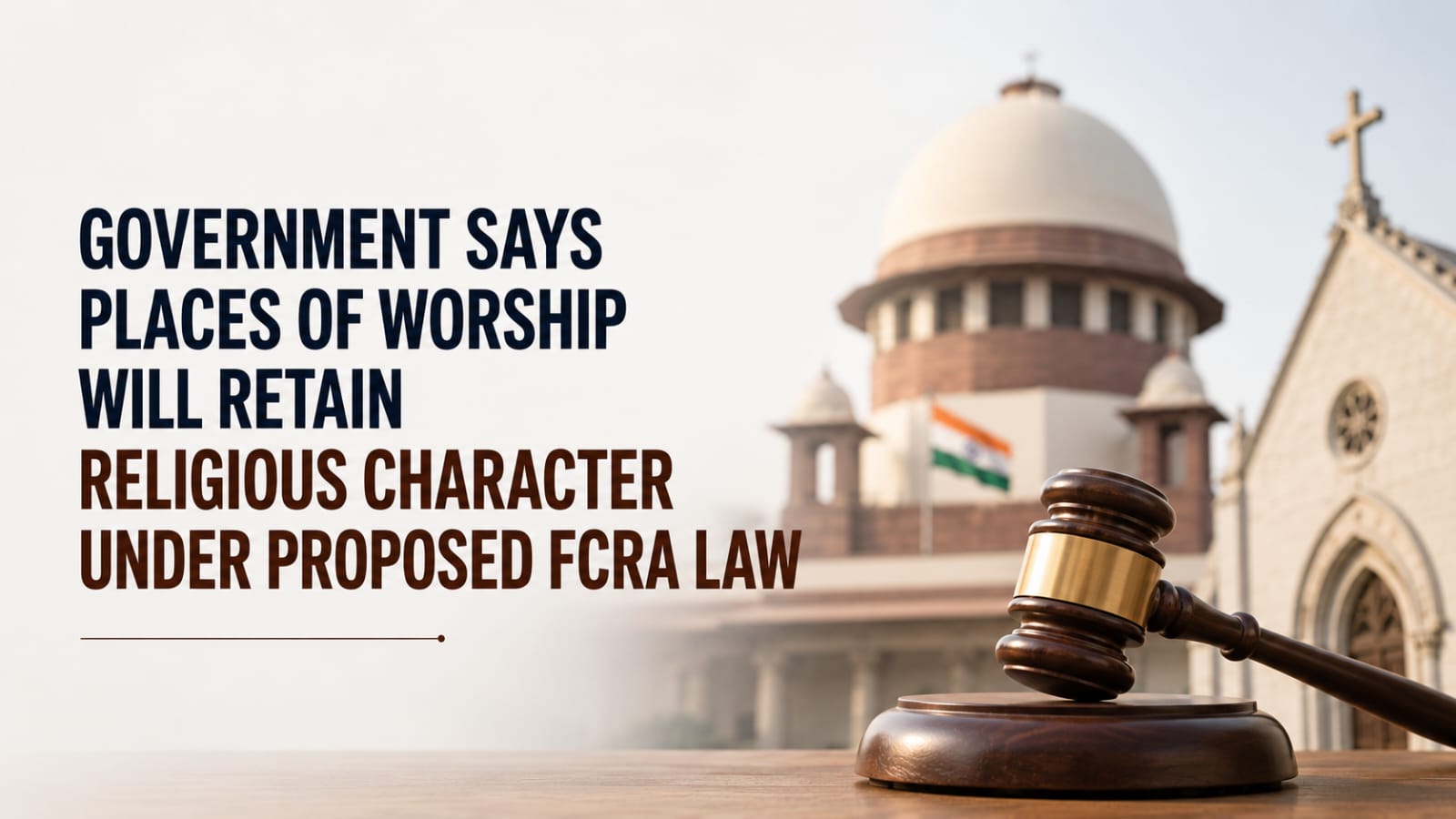
NEW DELHI, July 23, 2026: The Union government has sought to allay concerns among minority institutions, including Christian organisations, over the proposed Foreign Contribution (Regulation) Amendment Bill, 2026, saying that places of worship will retain their religious character even if the legislation comes into force.


The Press Information Bureau (PIB), in a clarification issued on July 22, said the designated authority proposed under the Bill would retain the religious character of places of worship "in all cases."
The clarification comes amid concerns over provisions in the Bill, introduced in the Lok Sabha on March 25, that would empower a designated authority to take over, manage or dispose of assets created from foreign contributions after an organisation's Foreign Contribution (Regulation) Act (FCRA) registration is suspended, cancelled or not renewed. The Bill remains listed for consideration during the ongoing Monsoon Session of Parliament.


Under the proposed legislation, the designated authority would have powers similar to those of a civil court and could order the transfer or sale of assets to the government or another body.
Responding to concerns that the proposed amendments could enable the government to seize NGO assets, the PIB said the authority would deal only with assets created from foreign contributions and only after an organisation's registration had lawfully ceased.
"The designated authority manages only assets created from foreign contributions, and only once an organisation's registration has lawfully ceased," the PIB said in a background note. It added that the vesting of such assets would initially be provisional and that they could be fully restored if the organisation's registration were renewed.
The PIB further stated that places of worship would retain their religious character by law and that orders issued by the designated authority could be revised and appealed before a District Judge.
The clarification was issued as part of a PIB "myth and fact" note addressing concerns surrounding the proposed FCRA amendments.
The government also sought to distinguish the cancellation or non-renewal of FCRA registration from allegations of wrongdoing. According to the PIB, some cancellations or non-renewals are administrative in nature and may result from failure to file annual returns, renew registration before expiry or maintain designated bank accounts. It added that courts retain the power to review cancellation decisions.
The PIB said around 16,200 associations were registered under the FCRA in 2024–25 and received approximately ₹22,963 crore in foreign contributions.
Responding to concerns that the FCRA disproportionately targets NGOs and religious organisations, the government said similar laws in other countries also regulate entities such as lobbyists, public relations firms, think tanks, universities and companies operating at the direction of foreign principals.
The clarification follows concerns raised by the Catholic Bishops' Conference of India (CBCI) over the proposed amendments and the FCRA Amendment Rules, 2026, notified on June 22.
On July 10, Union Home Minister Amit Shah reportedly assured the CBCI that the proposed legislation was not directed against Christian NGOs, which receive just under 15 per cent of total foreign contributions. The CBCI had sought a meeting with the Home Minister to convey its concerns over the proposed Bill and the amended Rules.
The proposed amendments have drawn close attention from Christian organisations, which have called for greater clarity and safeguards to ensure that regulatory measures do not adversely affect the Church's social, educational, charitable and developmental work.
Courtesy: The Hindu





© 2026 CATHOLIC CONNECT POWERED BY ATCONLINE LLP