- 23 July, 2026
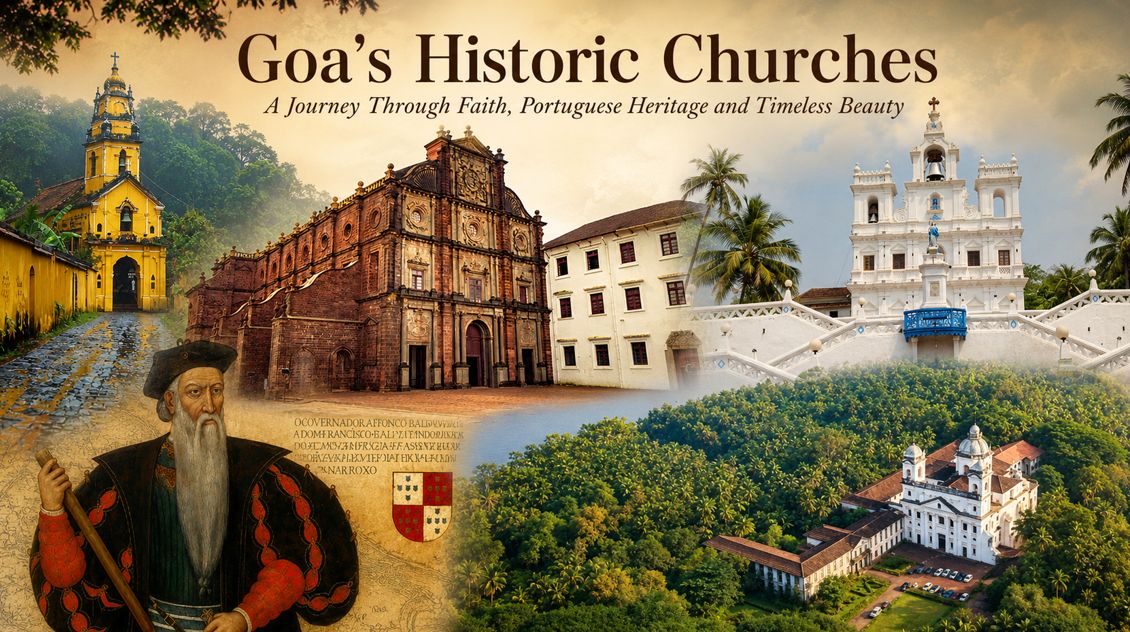
Goa, July 22, 2026: Golden beaches, swaying coconut palms and colourful Portuguese-style homes often define Goa in the minds of travellers. Yet beyond its celebrated coastline lies another treasure that has shaped the state's identity for more than four centuries—its magnificent churches.


Scattered across Old Goa, Panjim and picturesque villages, these sacred landmarks stand as enduring witnesses to the spread of Christianity, the arrival of the Portuguese, and the remarkable growth of the Catholic faith in India.
Their soaring towers, ornate altars and centuries-old bells tell stories of missionaries, saints, emperors, sailors and ordinary believers whose faith transformed Goa into one of Asia's most significant centres of Catholicism.
Today, these churches are not merely historical monuments. They remain living places of worship where prayer, tradition and community continue to flourish, preserving a unique spiritual heritage that attracts pilgrims and visitors from around the world.


The history of Christianity in Goa is inseparable from the arrival of the Portuguese in 1510 under Afonso de Albuquerque. Following the conquest of Goa, the Portuguese established the territory as the capital of their Eastern empire, making it both a political headquarters and an important centre for Christian growth.
Missionaries belonging to religious orders such as the Jesuits, Franciscans, Dominicans and Augustinians soon arrived, building churches, schools, seminaries and charitable institutions throughout the region. Their efforts helped shape Goa into what was often described as the "Rome of the East."
Catholicism gradually became deeply rooted in Goan society, influencing architecture, music, education, literature, festivals and everyday life. Even today, this remarkable blend of Indian traditions and Portuguese heritage gives Goa a cultural identity unlike any other part of the country.
(CLICK HERE to follow Catholic Connect for regular News and Content)
Walking through Old Goa is like stepping into a living museum of Christian history.
Recognised as a UNESCO World Heritage Site, Old Goa was once among the largest and wealthiest cities in Asia.
Although much of the old city disappeared after epidemics and political changes in the eighteenth century, its magnificent churches continue to stand as monuments to faith and artistic brilliance.
Each church reflects a different chapter of Goa's Catholic story while preserving architectural styles that range from Gothic and Renaissance to Baroque and Corinthian.
Among Goa's oldest surviving churches, the Church of Our Lady of the Rosary occupies a peaceful hill overlooking the Mandovi River.
According to tradition, Afonso de Albuquerque vowed to build a chapel here after successfully conquering Goa.
The church combines Gothic and Manueline architectural influences, making it distinctly different from many later Portuguese churches.
Its simple elegance, ancient stone walls and panoramic views create an atmosphere of quiet reflection that continues to attract pilgrims and history enthusiasts alike.
Situated across the Mandovi River in the village of Reis Magos, this historic church once served as an important missionary centre during Portuguese rule.
Dedicated to the Three Wise Men, the church became closely associated with missionary work among local communities. Restored in recent years, it remains a symbol of Goa's early evangelisation and offers visitors a glimpse into the state's colonial past.
No church in Goa is more famous than the Basilica of Bom Jesus.
Built in magnificent Baroque style, its dark laterite façade has become one of India's most recognisable Christian landmarks. Behind its imposing exterior lies one of Catholicism's greatest treasures—the incorrupt mortal remains of St Francis Xavier, one of the Church's greatest missionaries.
Pilgrims from every continent visit the Basilica to pray before the saint whose missionary journeys carried the Gospel across Asia. Every ten years, his relics are displayed publicly during an exposition that draws millions of faithful.
Beyond its spiritual importance, the Basilica also houses intricate gilded altars, beautiful paintings and remarkable examples of seventeenth-century sacred art.
Standing proudly in the heart of Panjim, the Church of Our Lady of the Immaculate Conception is perhaps Goa's most photographed church.
Its magnificent white façade and sweeping zigzag staircase dominate the city skyline.
Originally built for Portuguese sailors arriving safely into Goa's harbour, the church became a place where mariners offered prayers of thanksgiving before beginning their journeys inland. Today its iconic bell tower continues to ring across Panjim, reminding residents of the city's rich Catholic heritage.
Directly opposite the Basilica of Bom Jesus stands the majestic Se Cathedral, one of the largest churches in Asia.
Built to commemorate the Portuguese conquest of Goa, the cathedral was dedicated to St Catherine of Alexandria, whose feast coincided with the victory in 1510.
Its vast interior reflects the grandeur of the Portuguese Empire at its height. Visitors are captivated by its soaring arches, elaborate chapels and the famous Golden Bell, regarded as one of the finest church bells in Asia.
The cathedral remains an active centre of worship, hosting major diocesan celebrations throughout the liturgical year.
Adjacent to Se Cathedral is the Church of St Francis of Assisi, renowned for its artistic splendour.
The church beautifully combines Manueline architecture with richly decorated Baroque interiors. Delicate frescoes, intricate wood carvings and paintings depicting the life of St Francis continue to inspire visitors centuries after they were created.
The adjoining archaeological museum further enriches the experience by preserving artefacts from Goa's remarkable past.
Inspired by St Peter's Basilica in Rome, the Church of St Cajetan is one of Goa's finest examples of Corinthian architecture.
Its majestic dome, graceful pillars and harmonious proportions transport visitors to Renaissance Europe while remaining firmly rooted in Indian soil.
The church reflects the ambition of the Theatine Fathers, who sought to create a sacred space worthy of Rome itself.
Located in the bustling coastal town of Calangute, St Alex Church reflects the continued growth of Catholic communities beyond Old Goa.
Its twin towers and elegant white façade continue to serve one of Goa's vibrant parish communities.
The Church of Mae De Deus in Saligao offers something distinctly different.
Unlike many earlier Portuguese churches, it embraces Neo-Gothic architecture with pointed arches, soaring spires and intricate stained-glass windows.
When illuminated after sunset, the church appears almost ethereal, making it one of Goa's most visually stunning places of worship.
Although admired for their architecture, Goa's churches are far more than tourist attractions.
Every Sunday, families continue to gather for Holy Mass. Feast days fill church compounds with music, processions and traditional celebrations that have been passed down for generations.
Christmas, Easter, parish feasts and the Feast of St Francis Xavier remain central to Goan Catholic life, drawing together people of every age in joyful expressions of faith.
The churches also continue their centuries-old mission through schools, charitable institutions and social outreach, reflecting the Gospel values upon which many of them were founded.
Goa's churches represent one of the finest examples of how faith, culture and history can exist in beautiful harmony.
Their stone walls have witnessed empires rise and fall, generations come and go, and countless prayers offered in hope, gratitude and devotion. Yet their true significance lies not simply in their age or architectural grandeur, but in the living faith they continue to nurture.
For pilgrims, they are sacred spaces where Christ is encountered in prayer and the sacraments. For historians, they preserve an extraordinary chapter of India's past. For travellers, they reveal a side of Goa far richer than its beaches alone.
In every bell that rings, every candle that flickers and every Mass that is celebrated, Goa's historic churches continue to proclaim a timeless message—that faith, when rooted in hope and sustained through generations, becomes a legacy capable of shaping an entire culture.
By Catholic Connect Reporter
© 2026 CATHOLIC CONNECT POWERED BY ATCONLINE LLP