- 15 July, 2026

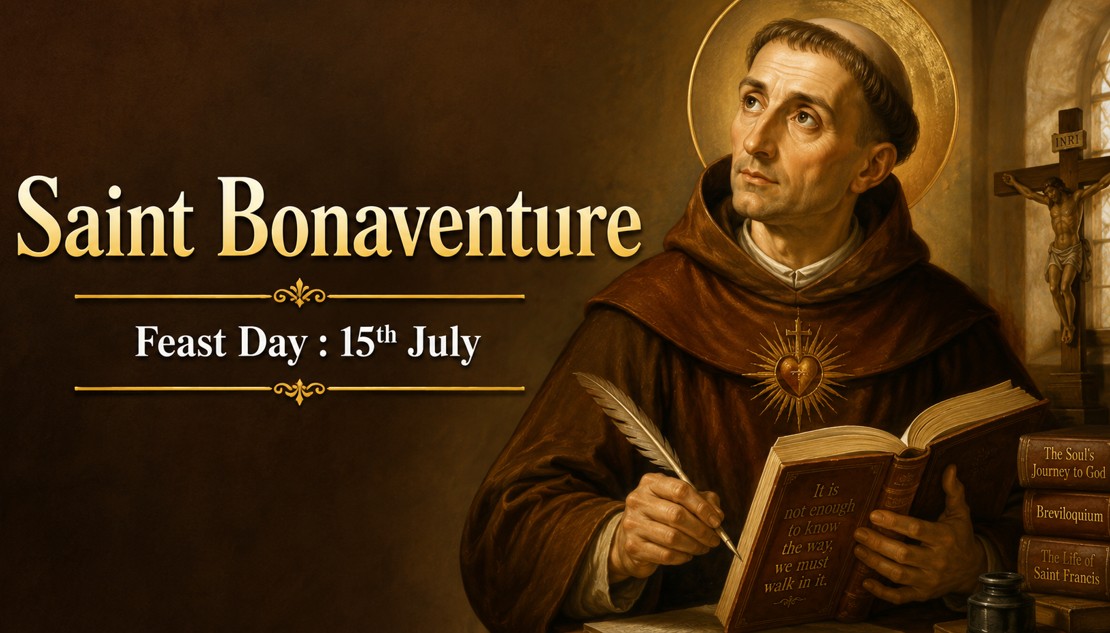
Italy, July 15, 2026: Why is Saint Bonaventure remembered as one of the greatest theologians and spiritual masters in Catholic history? Discover the inspiring story of the brilliant Franciscan scholar whose profound love for Christ, leadership of the Franciscan Order, and extraordinary writings earned him the title "Seraphic Doctor" and a lasting place among the Church's greatest saints.


Feast Day: 15 July
Born: c. 1217, Bagnoregio, Papal States (present-day Italy)
Died: 15 July 1274, Lyon, Kingdom of France
Canonized: 1482 by Pope Sixtus IV


Declared a Doctor of the Church: 1588 by Pope Sixtus V
Patron of: Bagnoregio, theologians, Franciscan scholars, and those seeking wisdom in faith
Known For: Minister General of the Franciscan Order, Doctor of the Church, theologian, philosopher, spiritual writer, and biographer of Saint Francis of Assisi
Title: Seraphic Doctor
Throughout the history of the Church, few saints have combined intellectual brilliance with deep humility as perfectly as Saint Bonaventure.
A gifted theologian, philosopher, bishop, and cardinal, Bonaventure believed that knowledge without love was incomplete. For him, the highest wisdom was not merely understanding God with the mind but loving Him with the whole heart.
His writings helped shape Catholic theology for centuries, while his gentle leadership preserved unity within the growing Franciscan Order during one of its most challenging periods.
Today, he remains one of the Church's greatest teachers and spiritual guides.
(CLICK HERE to follow Catholic Connect for regular News and Content)
Bonaventure was born around 1217 in Bagnoregio, Italy, and was baptized Giovanni di Fidanza.
According to long-standing Franciscan tradition, he became seriously ill as a young child.
His mother sought the prayers of Saint Francis of Assisi, who reportedly prayed for the boy's recovery.
After Giovanni was miraculously healed, Saint Francis is said to have exclaimed, "O buona ventura!" ("O good fortune!" or "What good fortune!"), a phrase traditionally associated with the origin of the name Bonaventure.
Whether historical or devotional in origin, the story reflects the close spiritual bond Bonaventure would later have with the Franciscan family.
Bonaventure pursued higher studies at the renowned University of Paris, one of medieval Europe's greatest centers of learning.
There he excelled in philosophy and theology, becoming one of the brightest scholars of his generation.
Despite his academic success, he chose to enter the Franciscan Order, embracing the ideals of poverty, humility, and service taught by Saint Francis.
He believed that scholarship should always lead people closer to Christ.
As a professor of theology at Paris, Bonaventure quickly earned widespread admiration for his clarity, wisdom, and holiness.
Unlike many scholars who emphasized intellectual debate alone, Bonaventure taught that theology must deepen one's relationship with God.
His lectures inspired countless students to pursue both learning and holiness.
He became a close contemporary of Saint Thomas Aquinas, and together they are regarded as two of the greatest theologians of the thirteenth century.
In 1257, Bonaventure was elected Minister General of the Franciscan Order.
The Franciscans had grown rapidly after the death of Saint Francis, but disagreements had arisen over how faithfully to observe the founder's ideals of poverty.
With remarkable wisdom and patience, Bonaventure guided the order through these challenges.
He promoted unity, encouraged authentic Franciscan spirituality, and emphasized that obedience, humility, and charity should always prevail over division.
His leadership earned him the title of the Order's "Second Founder."
Among Bonaventure's most influential works is the "Major Life of Saint Francis" (Legenda Maior).
Commissioned by the Franciscans, this biography became the official account of Saint Francis' life for centuries.
More than a historical record, it presented Francis as a model of complete conformity to Christ.
The work helped preserve the authentic spirit of the Franciscan movement and remains an important spiritual classic today.
Saint Bonaventure authored numerous theological and mystical works that continue to inspire Christians.
Among his best-known writings are:
His writings teach that every stage of creation points toward God and that prayer, contemplation, humility, and charity lead the soul into deeper union with Christ.
For Bonaventure, true wisdom was inseparable from holiness.
Recognizing his wisdom and virtue, Pope Gregory X appointed Bonaventure as Cardinal Bishop of Albano in 1273.
According to a cherished tradition, papal messengers arrived while Bonaventure was washing dishes in the monastery.
Rather than interrupting his humble work, he reportedly asked them to hang the cardinal's hat on a nearby tree until he finished.
The story beautifully illustrates the humility that characterized his entire life.
Bonaventure played an important role at the Second Council of Lyons in 1274, where efforts were made to promote reconciliation between the Eastern and Western Churches.
He worked tirelessly for unity within the Church and faithfully served the Pope during the council.
However, while the council was still in session, Bonaventure became seriously ill.
He died peacefully on 15 July 1274 in Lyon, leaving behind a remarkable legacy of holiness and scholarship.
Bonaventure's reputation for sanctity continued to grow after his death.
In 1482, Pope Sixtus IV canonized him.
More than a century later, in 1588, Pope Sixtus V declared him a Doctor of the Church, honoring his immense contribution to Catholic theology.
He became known as the "Seraphic Doctor," reflecting the burning love for God that filled both his writings and his life.
The life of Saint Bonaventure offers enduring lessons for every Christian:
His example reminds believers that true learning transforms not only the mind but also the heart.
More than seven centuries after his death, Saint Bonaventure remains one of the Church's greatest theologians and spiritual masters.
He was a brilliant scholar who remained humble, a gifted leader who sought peace, and a Franciscan who never lost sight of Christ's call to simplicity and love.
From the lecture halls of medieval Paris to churches and universities around the world, his life proclaims a timeless truth:
The highest wisdom is not simply knowing about God, but allowing His love to transform every thought, every action, and every moment of life.
To know about more saints please visit the spiritual section.
By Catholic Connect Reporter
Saint Bonaventure, Saint Bonaventure feast day, Seraphic Doctor, Saint Bonaventure biography, Doctor of the Church, Franciscan saints, Minister General of the Franciscans, Itinerarium Mentis in Deum, Major Life of Saint Francis, Catholic theologians, medieval saints, July saints, Saint Bonaventure writings, University of Paris theologian, Catholic saints

© 2026 CATHOLIC CONNECT POWERED BY ATCONLINE LLP