- 17 October, 2026

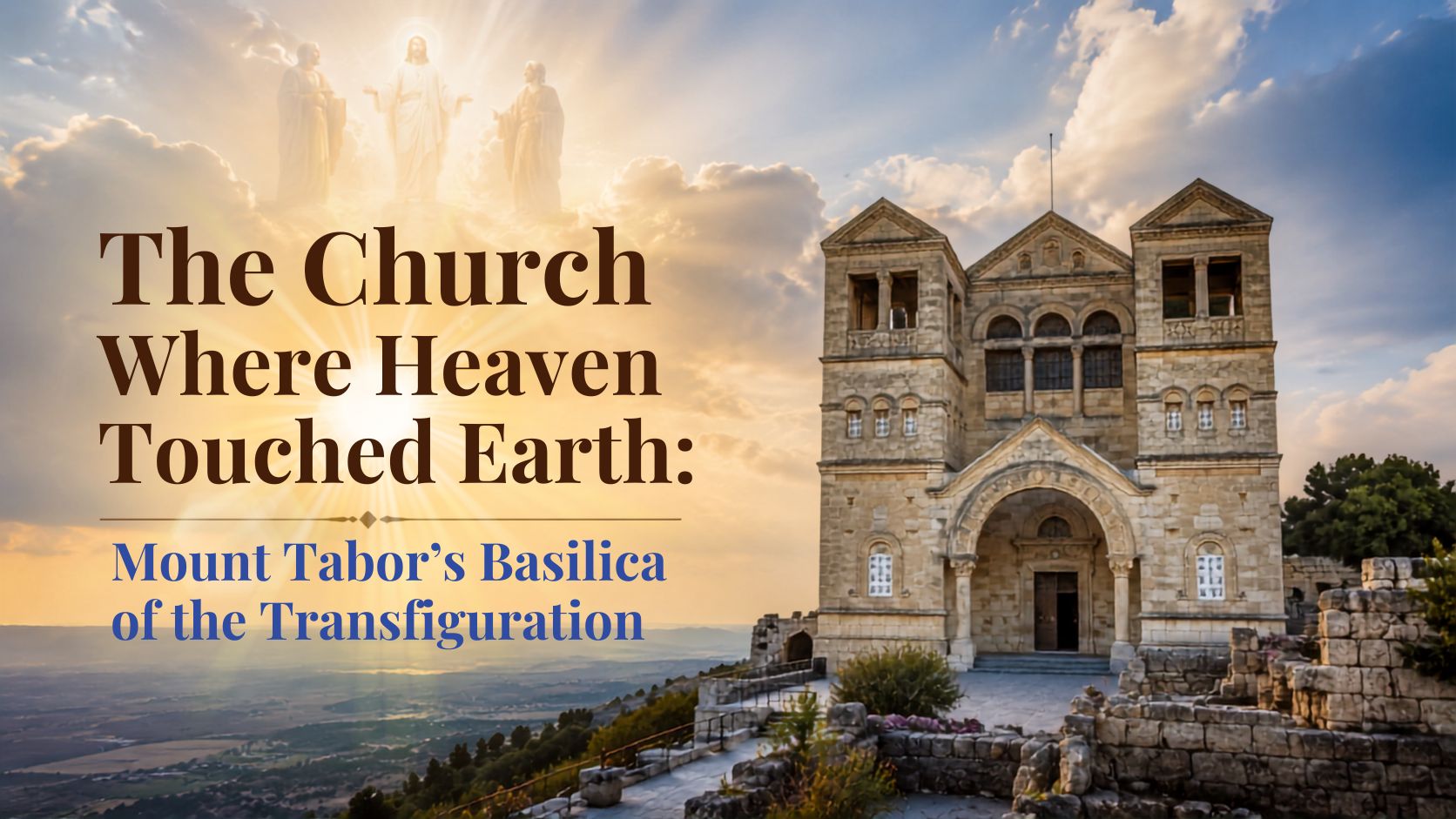
July 14: 2026: Rising above the fertile Jezreel Valley, Mount Tabor appears almost like an island of stone amid a sea of green. For centuries, pilgrims have climbed its winding slopes, believing this to be the mountain where Jesus was transfigured before Peter, James and John, revealing His divine glory. At its summit stands one of the Holy Land's most captivating churches—a place where architecture, history and Scripture seem to merge into a single experience. The Church of the Transfiguration is not merely built on a sacred site; it is designed to help visitors enter the Gospel story itself.


A Church Built to Reflect Light
Completed in 1924, the basilica was designed by the celebrated Italian architect Antonio Barluzzi, whose churches across the Holy Land are renowned for turning biblical events into physical spaces.
From a distance, the church resembles a medieval fortress, with two imposing towers guarding its façade. Yet as you step inside, the mood changes dramatically. The cool stone walls, graceful arches and soaring ceilings gently draw the eye towards the sanctuary, where a magnificent golden mosaic depicts Christ clothed in dazzling white, flanked by Moses and Elijah.
When sunlight streams through carefully positioned alabaster windows, the sanctuary is bathed in a soft golden glow. Barluzzi intentionally designed this play of light to echo the brilliance described in the Gospel: "His face shone like the sun, and His clothes became as white as the light." Rather than simply reading about the Transfiguration, visitors experience something of its atmosphere.
(CLICK HERE to follow Catholic Connect for regular News and Content)
Towers with a Story
The church's two symmetrical towers are more than architectural features. They symbolically honour Moses and Elijah, the two great figures of the Old Testament who appeared beside Christ during the Transfiguration. Together they represent the Law and the Prophets, both finding their fulfilment in Jesus. Standing between them, the basilica itself becomes a visual proclamation of the Gospel.
History Beneath the Stones
The present church is only the latest chapter in nearly sixteen centuries of Christian worship. Beneath its floors lie the remains of Byzantine churches dating back to the fourth and fifth centuries. Crusaders later constructed another sanctuary here before it eventually fell into ruin.
Visitors descending into the crypt encounter fragments of ancient walls, weathered foundations and archaeological remains that quietly testify to generations of believers who journeyed to this mountain long before modern roads reached its summit. Every layer of stone tells a story of faith surviving wars, empires and changing centuries.
Three Tents Remembered in Stone
One subtle detail often escapes first-time visitors. After witnessing Christ's glory, Peter exclaimed, "Lord, it is good for us to be here," offering to build three tents—one each for Jesus, Moses and Elijah. Barluzzi echoed this moment by incorporating three chapels into the church's design. The central sanctuary honours Christ, while the side chapels are dedicated to Moses and Elijah, allowing Peter's spontaneous suggestion to find lasting architectural expression.
A View Worth Climbing For
Stepping outside, pilgrims are greeted by sweeping panoramas of Galilee stretching towards Nazareth, Mount Carmel and the distant hills of Samaria. Early Christians often regarded mountains as places where heaven and earth met. Standing atop Mount Tabor, with cool breezes carrying the scent of pine and wildflowers, it becomes easier to understand why. The silence itself feels prayerful.
More Than a Monument
The Church of the Transfiguration is more than an architectural masterpiece or archaeological treasure. Every tower, mosaic, window and beam of light has been carefully crafted to proclaim a single truth—that Christ revealed His divine glory here, strengthening His disciples before the journey to Calvary.
For pilgrims today, the basilica offers the same invitation it has for centuries: to leave the noise of the world behind, climb the mountain, and encounter the One whose glory continues to transform hearts long after the descent.
Read more on Must-Visit Catholic Architectural and Historical Wonders:
Meteora: The Monasteries That Seem to Hang Between Heaven and Earth
Monastery of Alcobaça: Portugal's Treasure of Love and Legacy
Las Lajas Sanctuary: Colombia's Breathtaking Church Between Cliffs and Sky
Church of Saint George, Lalibela: The Astonishing Church Carved from a Single Rock
Archbasilica of St John Lateran: Inside the Highest-Ranking Church in the Catholic Church
Saint Catherine's Monastery: The World's Oldest Living Christian Monastery
The Church of the Holy Sepulchre: Walking Through the Sacred Heart of Christianity
Inside St. Mark's Basilica: The Church That Glows Like Heaven
Notre-Dame Cathedral: The Gothic Masterpiece That Rose from the Ashes to Inspire the World
Milan Cathedral: Italy's Crown of Marble Reaching Towards Heaven
Chartres Cathedral: Where Stone, Light, and Heaven Meet
Montserrat Monastery: A 1,000-Year-Old Architectural Marvel in the Mountains
Inside the Sagrada Família: The Incredible Story of Gaudí's Greatest Masterpiece


© 2026 CATHOLIC CONNECT POWERED BY ATCONLINE LLP