- 25 September, 2026

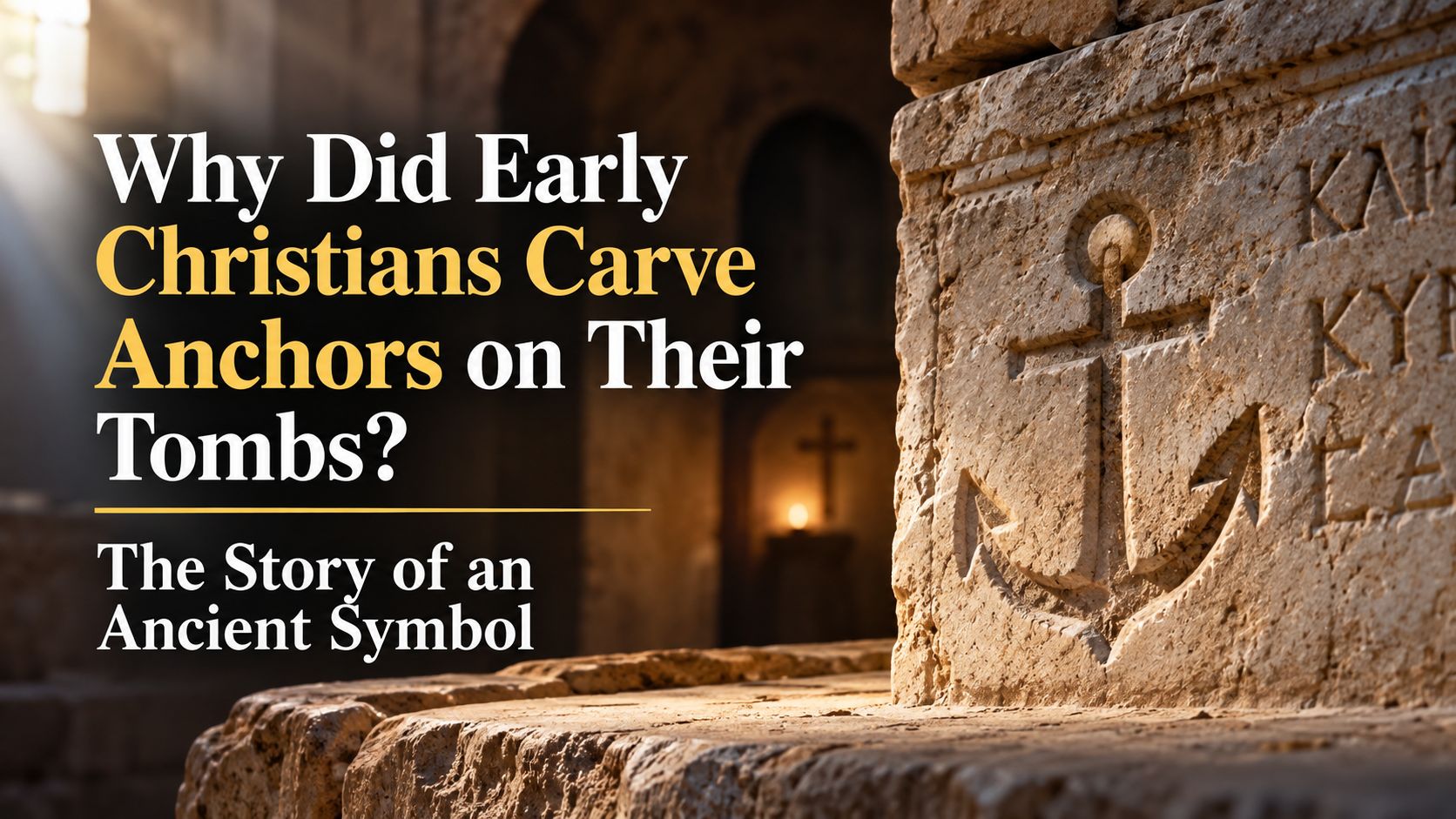
Sep 25, 2026: Imagine walking through an ancient Roman cemetery and noticing a small anchor carved into a tombstone. Among the inscriptions marking the resting places of Christians, this familiar nautical object appears repeatedly. Why would a community that believed in the Resurrection choose an anchor to mark the resting place of its dead?


The answer lies in a remarkable connection between an everyday object, a passage from Scripture and the earliest expressions of Christian hope.
An anchor that pointed beyond the grave
The anchor was already a familiar object in the ancient Mediterranean world. For sailors, it held a vessel steady when winds and currents threatened to carry it away. Early Christians drew on this familiar image to express a spiritual truth.

The Letter to the Hebrews provides the biblical connection: “We have this hope as an anchor for the soul, firm and secure” (Hebrews 6:19). The passage speaks of God's unchanging promise and the hope believers have through Jesus Christ, who has entered the heavenly sanctuary on their behalf.
(CLICK HERE to follow Catholic Connect and to stay updated with Catholic News & Content)
The image offered a powerful way to express Christian faith. Just as a ship's anchor holds it steady, Christian hope rests on God's faithfulness. The anchor was not simply a symbol of surviving life's difficulties; it pointed towards the hope of salvation and life with God beyond death.
What an ancient tomb reveals
One of the most fascinating aspects of the anchor is where it appears. The symbol has been found on funerary inscriptions in Rome, particularly in the catacombs of Priscilla, Domitilla and Callixtus.
Some examples date to the second and third centuries, when Christianity was still a relatively small community within the Roman Empire.
One particularly revealing example is an epitaph preserved in the Vatican Museums. It bears an anchor followed by a short Greek inscription addressed to a woman named Clodianè: “Clodianè, (may) your soul (be) in peace.”
There is something moving about this simple combination. The inscription does not offer a lengthy explanation of Christian belief. A name, a prayer for peace and an anchor communicate the hope that the deceased rests in God's peace.
Other funerary inscriptions associated the anchor with expressions such as spes in Christo, meaning “hope in Christ”, and spes in Deo, meaning “hope in God”. The anchor also appeared alongside the fish, another early Christian symbol associated with Jesus Christ.
These carvings offer a glimpse into how early Christians expressed their faith and their hope in eternal life.
Was the anchor also a reference to the Cross?
The anchor's shape offers another intriguing possibility. Its upright shaft and crossbar can resemble a cross, and some scholars have considered whether this resemblance contributed to its adoption in early Christian art.
However, not every anchor carved on a tomb should be understood as a concealed Cross. Its established association with hope and salvation remains central to its meaning, while the possible connection to the Cross depends on the particular representation.
The ancient symbol ultimately tells a story of faith that looked beyond death. For early Christians, the anchor marked more than a grave: it expressed confidence that their lives and their future rested in Christ.
Thousands of years later, its message remains relevant. Christian hope does not mean that the storms of life will disappear. It means that even in uncertainty, the soul has somewhere firm to rest.
By Catholic Connect Reporter
Read More:
1) Why Is the Pelican a Symbol of Christ? The Christian Meaning Explained
2) Why Are the Four Gospels Represented by a Man, Lion, Ox and Eagle?
3) Why Is the Rooster a Symbol in Christian Art?
4) Why Do Peacocks Appear in Early Christian Tombs?
5) Why Does a Phoenix Appear in Christian Art?
6) Why Does a Pomegranate Appear in Christian Art?
7) A.M., AM or M? What Do These Mysterious Marian Letters Mean?
8) Why Is Mary Sometimes Shown With a Star?
9) What Does an Anchor Have to Do with Christianity?
10) Why Is a Ship One of Christianity’s Oldest Symbols?
11) Why Does the Grapevine Appear in Christian Art? Its Meaning Explained
12) Why Do Palm Branches Appear in Christian Art?
13) Why Do the Letters “IHS” Appear in Catholic Churches?
14) What is the Chi-Rho (ΧΡ)? The Ancient Symbol for Christ Explained
15) When Mary Looked to Heaven: The Curious Meaning Behind the Virgin’s Upward Gaze
16) Why Do Alpha and Omega Appear in Christian Art?
17) What Does the Eye Inside a Triangle Mean in Christian Art?
18) The Strange ‘Weapons’ of Christ: Why the Instruments of His Passion Appear Together
19) Why Does a Unicorn Appear in Medieval Christian Art?
20) The Mystery Behind Mary’s Enclosed Garden
21) Why Does a Scroll Appear in So Many Christian Images?
22) Why Does Jacob’s Ladder Appear in Christian Art? The Heavenly Stairway That Points to Christ
22) Why Does an Olive Branch Appear in Christian Art? The Biblical Symbol of Peace and Hope







© 2026 CATHOLIC CONNECT POWERED BY ATCONLINE LLP