- 30 September, 2026

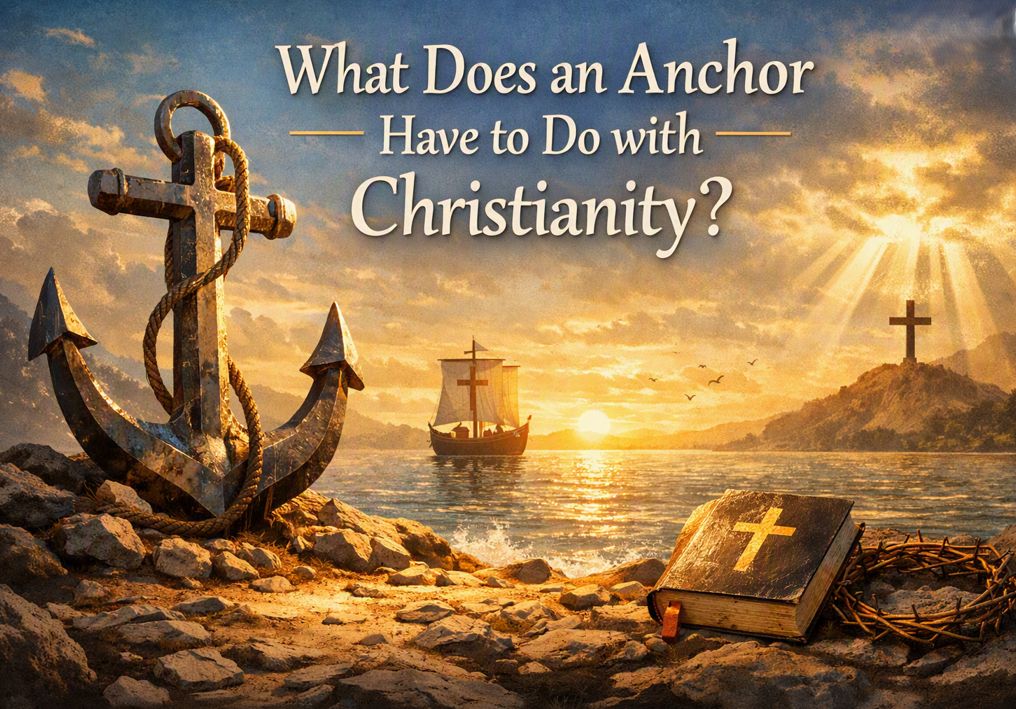
September 9, 2026: An ordinary nautical object became one of the earliest and most meaningful symbols of Christianity. The anchor represented stability, safety and, above all, hope in Christ. For early Christians, it offered a powerful image: just as an anchor prevents a ship from drifting during a storm, Christian hope keeps the soul secure amid the trials of life and the uncertainty of death.


The strongest biblical foundation for the Christian anchor is found in the Letter to the Hebrews. Hebrews 6:19 declares: “We have this hope as an anchor for the soul, firm and secure.” The passage presents Christian hope not as mere optimism, but as something firmly grounded in God's promises.
The imagery was especially meaningful for Christians who experienced persecution, suffering and the prospect of death. The anchor suggested that, despite the storms of earthly life, the believer's ultimate hope and security rest with God.
(CLICK HERE to follow Catholic Connect and to stay updated with Catholic News & Content)
The passage in Hebrews develops the image even further. Christian hope is anchored securely in Christ, through whom God has given us the promise of salvation. Christ has gone before His people into the heavenly sanctuary, giving Christian hope a firm foundation beyond the uncertainties of this present life.
By the second and third centuries, the anchor appeared in Christian funerary art and inscriptions, particularly in the Roman catacombs. It could be carved into tombs or included alongside brief inscriptions expressing peace, faith or hope.
The anchor was particularly suited to funerary symbolism. Death could be understood as the end of an earthly voyage, while Christian hope pointed towards eternal life and resurrection. The image could therefore express the conviction that the believer's hope was not lost or drifting, but firmly grounded in God's promises.
Examples of anchor imagery have been found in Christian catacomb contexts associated with Priscilla, Domitilla and Callixtus. Such evidence demonstrates the importance of the anchor within the symbolic language of early Christian funerary art, even though the precise intention behind every individual example cannot always be established.
The anchor also possessed a form that could evoke the Cross. Its vertical shaft and crossbar-like elements could give it a distinctly Christian appearance.
In the earliest period, large, explicit representations of the Cross were uncommon, although Christians certainly knew and revered the Cross. Early Christian art frequently employed symbolic and indirect imagery. The anchor could therefore function as a discreet Christian image, particularly in funerary contexts.
However, the evidence does not establish that the anchor was deliberately adopted as a secret substitute for the Cross. Its primary Christian significance was more directly connected with hope and steadfastness, especially in light of the imagery of Hebrews 6:19.
Some early Christian examples combine the anchor with other recognisable Christian symbols. These combinations contributed to a broader visual language through which Christians could express aspects of their faith and hope without lengthy inscriptions.
The anchor's symbolism did not disappear as Christianity became more publicly established. It continued in later Christian art and devotional tradition, where it remained a fitting image of hope, steadfastness and confidence in God's promises.
In later Catholic devotional tradition, the anchor became particularly associated with the theological virtue of hope. Alongside other traditional symbols—such as the cross associated with faith and the heart associated with charity—the anchor could form part of a visual representation of the Christian virtues.
This should be understood as a development in Christian devotional and artistic tradition rather than as a universal or officially prescribed Catholic rule of iconography.
The anchor also became associated with St. Clement of Rome. According to a later martyrdom tradition, Clement was tied to an anchor and thrown into the sea. This story contributed to the anchor becoming one of the saint's identifying attributes in later Christian art. The tradition concerning his martyrdom, however, should be distinguished from the much earlier and independently established Christian symbolism of the anchor itself.
The enduring power of the anchor lies in its simplicity. Everyone understands what an anchor does: it keeps a vessel from being carried away.
Christianity transformed that everyday experience into a profound theological image. Human life may be compared to a voyage through a stormy sea, while Christian hope is anchored securely in Christ, through whom God has given us the promise of salvation.
The early Christian anchor therefore expresses a simple but powerful message: the believer is not adrift. Christian hope is not merely wishful thinking. It is confidence grounded in God and directed towards the promise of eternal life.
For Christians, the anchor became a fitting image of the hope that holds firm through suffering, uncertainty and even death. Its message remains compelling precisely because of its simplicity: amid the storms of this life, Christian hope is anchored in Christ and in the promise of salvation.
By Catholic Connect Reporter
Read More:
1) Why Is the Pelican a Symbol of Christ? The Christian Meaning Explained
2) Why Are the Four Gospels Represented by a Man, Lion, Ox and Eagle?
3) Why Is the Rooster a Symbol in Christian Art?
4) Why Do Peacocks Appear in Early Christian Tombs?
5) Why Does a Phoenix Appear in Christian Art?
6) Why Does a Pomegranate Appear in Christian Art?
7) A.M., AM or M? What Do These Mysterious Marian Letters Mean?









© 2026 CATHOLIC CONNECT POWERED BY ATCONLINE LLP