- 22 September, 2026

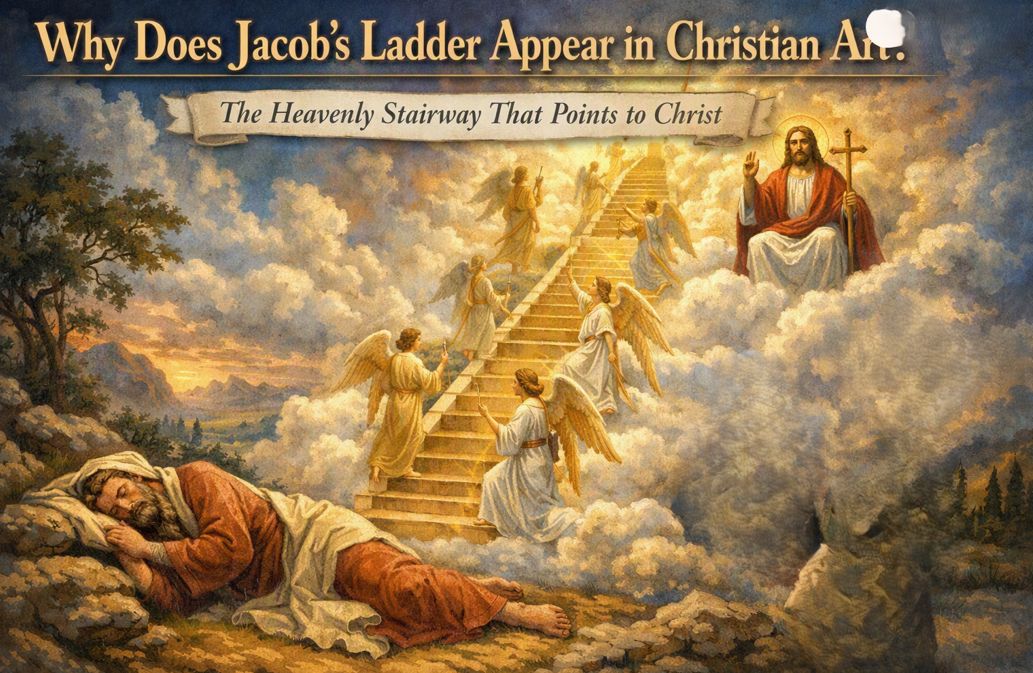
September 22, 2026: Few images are as striking as a ladder stretching from earth towards heaven, with angels ascending and descending its steps. Known as Jacob’s Ladder, this vision comes from Genesis 28:10–22. For Christians, the image came to symbolise God’s presence and revelation—and ultimately Christ as the Mediator between God and humanity.


Fleeing from his brother Esau, Jacob stops for the night and rests his head on a stone. He dreams of a ladder, or stairway, “set up on the earth” whose top reaches heaven. Angels ascend and descend upon it, while the Lord stands above it and reaffirms the promises made to Abraham and Isaac.
God promises Jacob descendants, land and protection, assuring him: “I am with you and will keep you wherever you go” (Genesis 28:15).
When Jacob awakens, he declares, “Surely the Lord is in this place” (Genesis 28:16). He names it Bethel, meaning “house of God”.

The vision reveals God’s presence, faithfulness and care.
(CLICK HERE to follow Catholic Connect and to stay updated with Catholic News & Content)
The Christian connection appears in the Gospel of John. Speaking to Nathanael, Jesus says: “You will see heaven opened, and the angels of God ascending and descending upon the Son of man” (John 1:51).
The wording recalls Jacob’s vision. Christian tradition therefore read Jacob’s Ladder typologically: the event was real in its setting, while also foreshadowing a reality fulfilled in Christ.
The ladder is not another name for Jesus. Rather, it points towards what is fulfilled in Him. In the Incarnation, the eternal Son truly assumes human nature and enters human history. Christ is the Mediator between God and humanity, through whom reconciliation with the Father is accomplished.
The ladder becomes a figure of Christ: in Him, heaven and earth meet.
Its form lends itself to visual storytelling, with Jacob below, heaven above, and angels moving between the two.
In Christian art, the ladder may appear as a simple structure or an imposing staircase surrounded by angels and heavenly light.
Jacob’s Ladder acquired another meaning: the soul’s ascent towards God through prayer, virtue and holiness. This symbolism is associated with St. John Climacus, whose Ladder of Divine Ascent describes spiritual progress using the image of a ladder.
Jacob’s dream concerns God’s presence and reaffirmed promises; the ladder as stages of spiritual growth is a later Christian application.
Jacob discovers, “Surely the Lord is in this place.”
For Christians, this revelation points to Christ. The eternal Son assumes human nature and enters history; through His Incarnation, Passion and Resurrection, He accomplishes reconciliation between God and humanity.
What Jacob saw in a dream therefore becomes, in Christian interpretation, an Old Testament figure fulfilled in Christ: the One through whom heaven and earth meet, God reveals Himself fully, and the way to the Father is opened.
By Catholic Connect Reporter
Read More:
1) Why Is the Pelican a Symbol of Christ? The Christian Meaning Explained
2) Why Are the Four Gospels Represented by a Man, Lion, Ox and Eagle?
3) Why Is the Rooster a Symbol in Christian Art?
4) Why Do Peacocks Appear in Early Christian Tombs?
5) Why Does a Phoenix Appear in Christian Art?
6) Why Does a Pomegranate Appear in Christian Art?
7) A.M., AM or M? What Do These Mysterious Marian Letters Mean?
8) Why Is Mary Sometimes Shown With a Star?
9) What Does an Anchor Have to Do with Christianity?
10) Why Is a Ship One of Christianity’s Oldest Symbols?
11) Why Does the Grapevine Appear in Christian Art? Its Meaning Explained
12) Why Do Palm Branches Appear in Christian Art?
13) Why Do the Letters “IHS” Appear in Catholic Churches?
14) What is the Chi-Rho (ΧΡ)? The Ancient Symbol for Christ Explained
15) When Mary Looked to Heaven: The Curious Meaning Behind the Virgin’s Upward Gaze
16) Why Do Alpha and Omega Appear in Christian Art?
17) What Does the Eye Inside a Triangle Mean in Christian Art?
18) The Strange ‘Weapons’ of Christ: Why the Instruments of His Passion Appear Together
19) Why Does a Unicorn Appear in Medieval Christian Art?
20) The Mystery Behind Mary’s Enclosed Garden




© 2026 CATHOLIC CONNECT POWERED BY ATCONLINE LLP