
- 14 September, 2026

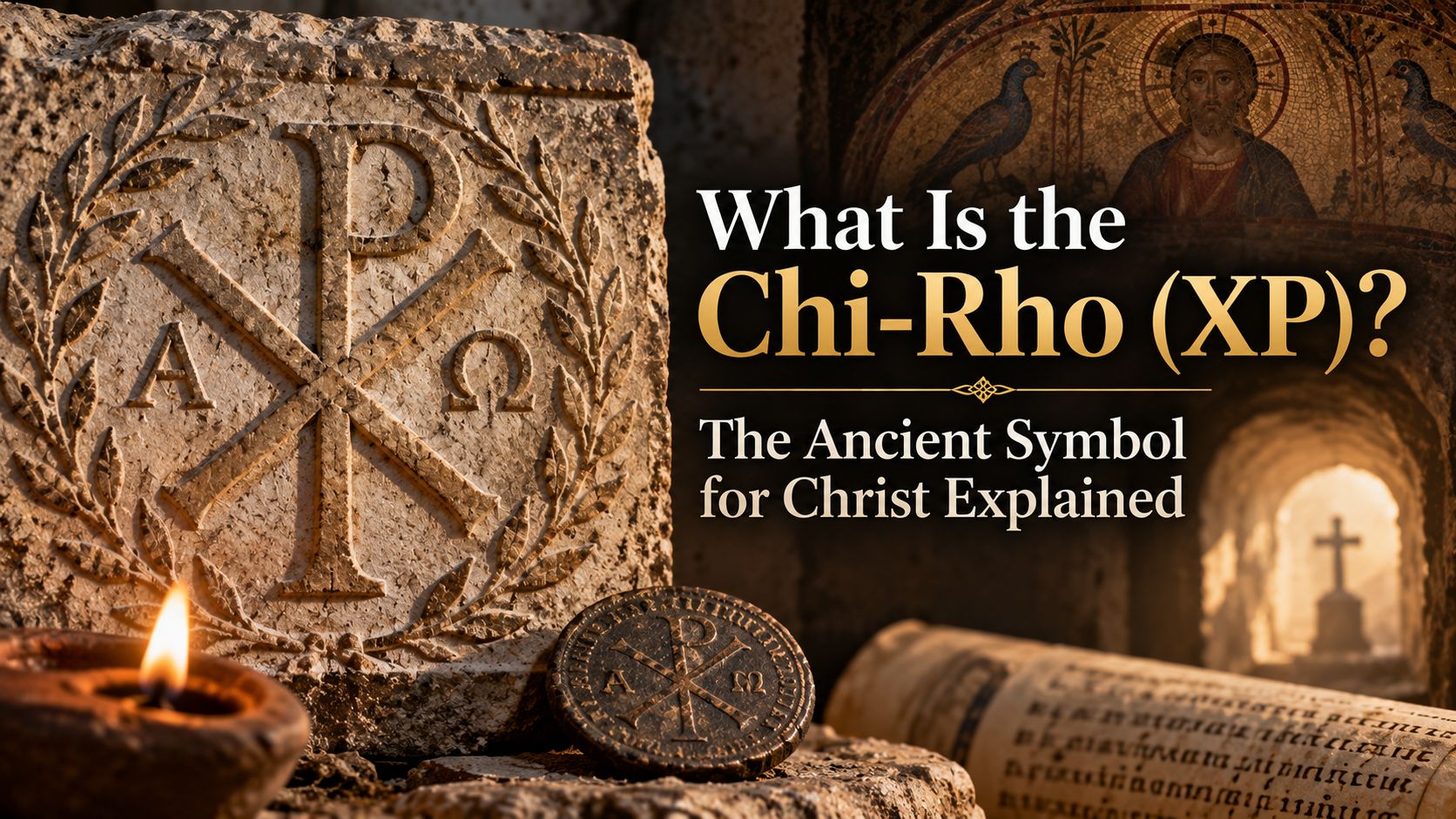
September 14, 2026: Before the Cross became the unmistakable symbol of Christianity, Christians were already finding ways to proclaim Christ through signs. One of the most enduring was remarkably simple: two Greek letters joined together — ΧΡ.

At first glance, it can look like an enigmatic ancient symbol. But its meaning is hidden in plain sight. Χ (Chi) and Ρ (Rho) are the first two letters of Χριστός (Christos), the Greek word for “Christ,” meaning “Anointed One.” Joined together, they form the Chi-Rho, one of the best-known Christograms of early Christianity.
It was not simply a decorative design. The two letters could function as a compact way of identifying Christ, especially in a world where Christian symbols appeared on objects, buildings and monuments.

(CLICK HERE to follow Catholic Connect and to stay updated with Catholic News & Content)
The Chi-Rho became particularly prominent in the fourth century, when it acquired a powerful association with the Roman Emperor Constantine.
According to the Christian historian Eusebius of Caesarea, Constantine experienced a divine sign before his confrontation with his rival Maxentius in 312. Eusebius later described Constantine's vision of a cross of light and the words “by this conquer,” followed by a nocturnal experience in which Christ instructed him to use the heavenly sign as a protection. Constantine subsequently used a Christian symbol on the military standard associated with his army.
The exact historical details surrounding Constantine's experience have been debated by historians, but the association between Constantine and the Chi-Rho became enormously important for Christian history and art.
The symbol soon appeared far beyond an imperial or military setting.
Archaeological objects show just how widely the Chi-Rho was used. A Byzantine stone lintel dating approximately to 400–550 has a Christogram formed from Chi and Rho, accompanied by Alpha and Omega. The Chi-Rho was found across regions reached by Christianity, from Gaul in western Europe to Egypt.
It appeared on funerary monuments too. A Byzantine funerary stele from Egypt, dating to the seventh or eighth century, bears the Chi-Rho together with Alpha and Omega.
The Christogram also found its way onto objects Christians encountered in everyday life. A late Roman or Byzantine gold brooch incorporates the Chi-Rho into its Christian imagery, alongside Alpha and Omega. Coins of the Byzantine emperors likewise carried the emblem, including representations of it atop the imperial standard.
And there is another detail worth noticing. The Chi-Rho is sometimes surrounded by a wreath or accompanied by Alpha and Omega. These combinations could reinforce themes of Christ’s victory and God’s eternity. The Alpha and Omega — the first and last letters of the Greek alphabet — are linked to the imagery of Revelation, where God declares, “I am the Alpha and the Omega.”
That helps explain why the symbol endured. It could be placed on stone, metal, coins, funerary monuments and objects of devotion, while saying something immediately recognisable to those who knew its meaning.
To modern eyes, ΧΡ may look like a mysterious ancient emblem.
To the early Christians who encountered it, it could be much simpler — and much more profound.
Two Greek letters. One name. Christ.
By Catholic Connect Reporter
Read More:
1) Why Is the Pelican a Symbol of Christ? The Christian Meaning Explained
2) Why Are the Four Gospels Represented by a Man, Lion, Ox and Eagle?
3) Why Is the Rooster a Symbol in Christian Art?
4) Why Do Peacocks Appear in Early Christian Tombs?
5) Why Does a Phoenix Appear in Christian Art?
6) Why Does a Pomegranate Appear in Christian Art?
7) A.M., AM or M? What Do These Mysterious Marian Letters Mean?
8) Why Is Mary Sometimes Shown With a Star?
9) What Does an Anchor Have to Do with Christianity?
10) Why Is a Ship One of Christianity’s Oldest Symbols?
11) Why Does the Grapevine Appear in Christian Art? Its Meaning Explained
12) Why Do Palm Branches Appear in Christian Art?
13) Why Do the Letters “IHS” Appear in Catholic Churches?





© 2026 CATHOLIC CONNECT POWERED BY ATCONLINE LLP