- 16 September, 2026

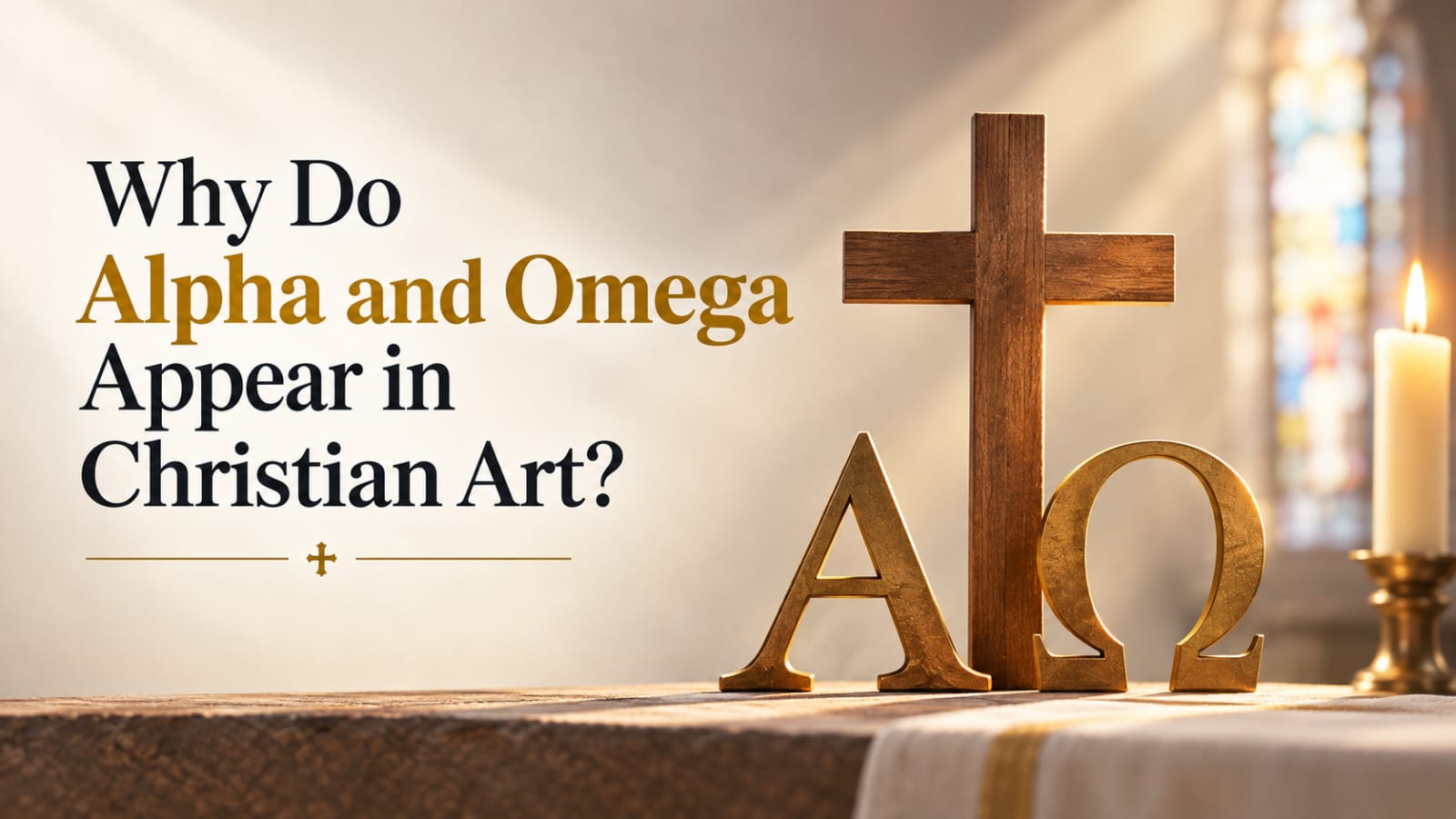
September 16, 2026: Few symbols in Christian art are as simple yet as profound as the Greek letters Alpha and Omega.

The first and last letters of the Greek alphabet, Alpha (Α) and Omega (Ω), appear in crosses, mosaics, frescoes, church decorations and liturgical objects. But why are these two letters so closely associated with Jesus Christ?
Their meaning comes especially from the Book of Revelation, where Christ says: “I am the Alpha and the Omega, the first and the last, the beginning and the end” (Revelation 22:13).

The same title is associated with God and Christ in Revelation 1:8 and 21:6.
Together, the letters proclaim Christ as the beginning and the end of all things. But their meaning goes beyond simply marking the beginning and the end.
(CLICK HERE to follow Catholic Connect and to stay updated with Catholic News & Content)
More Than the Beginning and the End
Alpha represents the beginning, while Omega represents the end.
Together, they express Christ’s eternity and divinity. Everything comes from Christ and finds its fulfillment in him.
The symbolism does not merely mean that Christ existed at the beginning of history and will remain at its end. It also proclaims that Christ is present throughout history and sustains all creation.
In this way, two simple letters become a concise visual proclamation of who Christ is.
When Did Christians Begin Using the Symbol?
Early Christians began using Alpha and Omega as a symbol of Christ from approximately the fourth century.
The letters appeared in different forms of Christian art. They were sometimes placed beside the cross, within a circle or triangle, or together with the monogram of Christ.
They also appeared in inscriptions, frescoes, mosaics, signet rings and church decorations.
In some ancient artworks, Alpha and Omega were placed on either side of the risen Christ. They were also shown in the halo of the Lamb, recalling Christ as the Lamb of God and the victorious Lord.
The same two letters could therefore connect Christ's identity, Resurrection and eternal lordship within a single image.
Why Do Alpha and Omega Appear on the Paschal Candle?
The symbolism becomes especially important during the Easter liturgy.
At the Easter Vigil, the priest prepares the Paschal candle by cutting a cross into it. Alpha is placed above the cross and Omega below it, while the current year is marked between the arms of the cross.
The accompanying words proclaim Christ as “the Beginning and the End” and affirm that “all time belongs to him.”
The arrangement brings together Christ's Cross, Resurrection and lordship over time.
The Paschal candle therefore becomes a liturgical expression of the same truth represented by the two Greek letters: Christ is the beginning and the end, while all time belongs to him.
Christ and the Mystery of Time
The image also connects Christ’s death and Resurrection with his lordship over time.
Pope John Paul II explains that Christ’s Incarnation and Resurrection embrace every year, day and moment, making time part of God’s saving plan.
The Alpha and Omega therefore point beyond a simple beginning-and-end sequence. They express Christ’s presence and lordship throughout history.
From the first moment to the last, and through every moment in between, the symbolism directs attention to Christ.
Why Are These Two Letters Still Used?
Perhaps the power of Alpha and Omega lies in their simplicity.
Two letters are enough to express a profound Christian confession: Christ is eternal, divine and victorious over death. He is the beginning and the end, and he is present throughout history.
Whenever artists place Alpha and Omega beside a cross, within a sacred image or in a church decoration, the symbols invite the viewer to remember that everything comes from Christ and finds its fulfillment in him.
The same message appears in the Easter Vigil, when Alpha and Omega are placed on the Paschal candle and all time is proclaimed as belonging to Christ.
Perhaps that is why these ancient letters continue to appear in Christian art. They do not simply mark the first and last letters of an alphabet. In Christian symbolism, they point to the One who is the beginning, the end and present in every moment between them.
By Catholic Connect Reporter
Read More:
1) Why Is the Pelican a Symbol of Christ? The Christian Meaning Explained
2) Why Are the Four Gospels Represented by a Man, Lion, Ox and Eagle?
3) Why Is the Rooster a Symbol in Christian Art?
4) Why Do Peacocks Appear in Early Christian Tombs?
5) Why Does a Phoenix Appear in Christian Art?
6) Why Does a Pomegranate Appear in Christian Art?
7) A.M., AM or M? What Do These Mysterious Marian Letters Mean?
8) Why Is Mary Sometimes Shown With a Star?
9) What Does an Anchor Have to Do with Christianity?
10) Why Is a Ship One of Christianity’s Oldest Symbols?
11) Why Does the Grapevine Appear in Christian Art? Its Meaning Explained
12) Why Do Palm Branches Appear in Christian Art?
13) Why Do the Letters “IHS” Appear in Catholic Churches?
14) What is the Chi-Rho (ΧΡ)? The Ancient Symbol for Christ Explained
15) When Mary Looked to Heaven: The Curious Meaning Behind the Virgin’s Upward Gaze





© 2026 CATHOLIC CONNECT POWERED BY ATCONLINE LLP