- 17 September, 2026
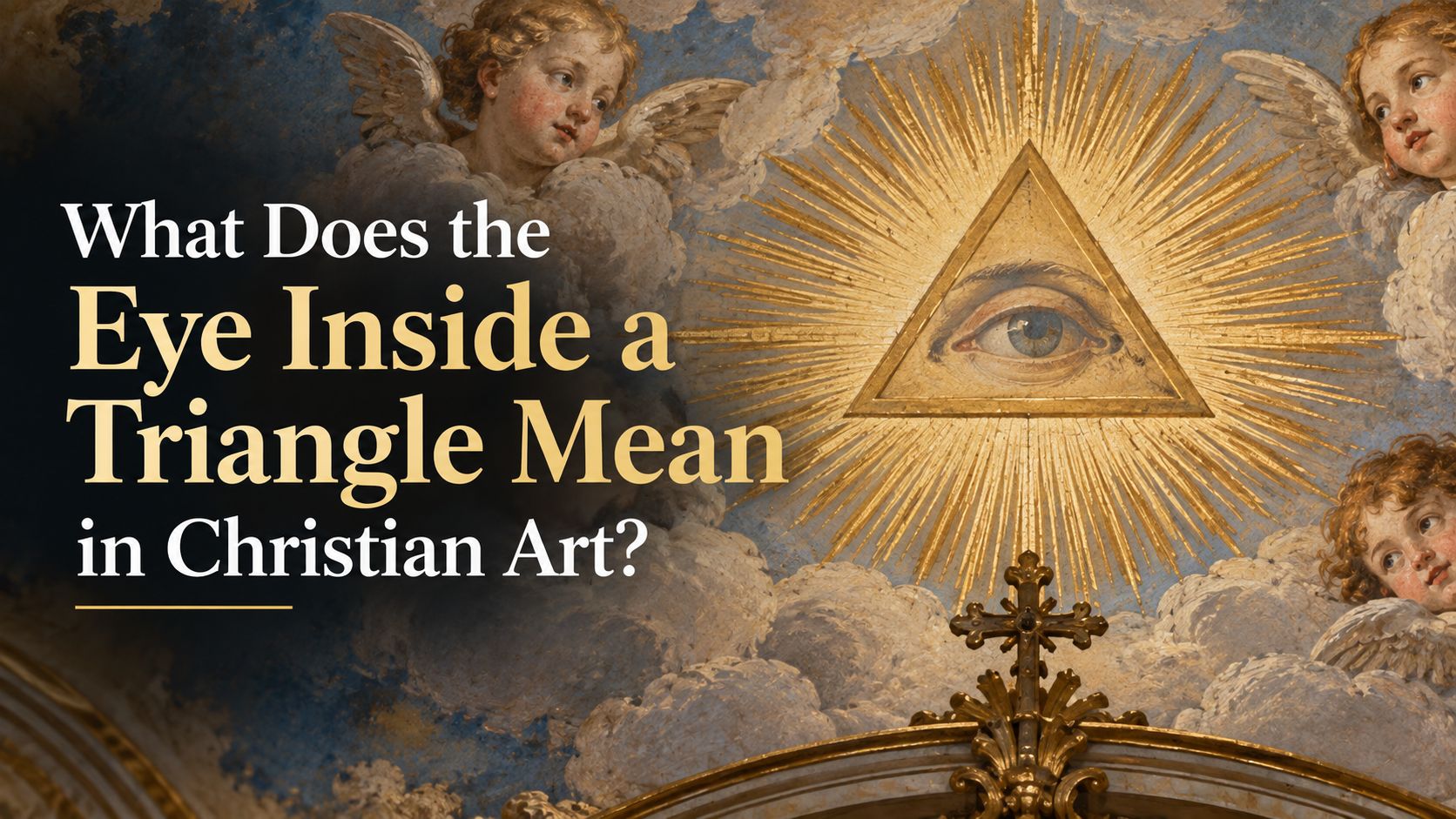
Sep 17, 2026: Look closely at some Catholic paintings, church ceilings and architectural details, and you may notice a striking image: a single eye enclosed within a triangle, sometimes surrounded by rays of light. Known as the Eye of Providence, this symbol developed in Christian art to express God’s divine knowledge and providence, while the triangle points to the mystery of the Holy Trinity.

The two elements have distinct histories. The triangle had already been used in Christian art as a visual reference to the Trinity — Father, Son and Holy Spirit. Christian artists also used triangular forms and triangular halos in representations associated with the Trinity. The eye, meanwhile, drew on the biblical language of God seeing and knowing all things. Proverbs speaks of the “eyes of the Lord” being everywhere, while the Psalms repeatedly describe God’s attentive gaze over humanity.
What emerged in Renaissance Europe was the combination of these ideas into a single visual emblem. The eye within a triangle became increasingly recognisable in Christian art from the 16th century onwards, particularly in religious painting and decoration. One well-known early example appears in Jacopo Pontormo’s Supper at Emmaus, painted in 1525, where an eye within a triangle appears above Christ.

(CLICK HERE to follow Catholic Connect and to stay updated with Catholic News & Content)
The imagery became particularly prominent during the late Renaissance and Baroque periods. The eye could be surrounded by rays of light or clouds, reinforcing associations with divine glory and God's all-seeing knowledge. In this context, the triangle was not simply a decorative frame: its three sides provided a concise visual reference to the three Persons of the Trinity.
The symbol subsequently appeared in church architecture, altarpieces, paintings, pulpits and other forms of Christian decoration. It can still be found in Catholic and other Christian settings today. Its meaning, however, depends on its context, and it should not automatically be interpreted through modern associations with other organisations or popular conspiracy theories. The symbol has a documented history in Christian art that predates its later uses elsewhere.
So, the next time you see an eye inside a triangle in a church, look beyond the striking image. The eye speaks of God's all-seeing knowledge and providence; the triangle points to the Father, Son and Holy Spirit. Together, they form a compact visual expression of a central Christian belief: the one God revealed as the Holy Trinity.
By Catholic Connect Reporter
1) Why Is the Pelican a Symbol of Christ? The Christian Meaning Explained
2) Why Are the Four Gospels Represented by a Man, Lion, Ox and Eagle?
3) Why Is the Rooster a Symbol in Christian Art?
4) Why Do Peacocks Appear in Early Christian Tombs?
5) Why Does a Phoenix Appear in Christian Art?
6) Why Does a Pomegranate Appear in Christian Art?
7) A.M., AM or M? What Do These Mysterious Marian Letters Mean?
8) Why Is Mary Sometimes Shown With a Star?
9) What Does an Anchor Have to Do with Christianity?
10) Why Is a Ship One of Christianity’s Oldest Symbols?
11) Why Does the Grapevine Appear in Christian Art? Its Meaning Explained
12) Why Do Palm Branches Appear in Christian Art?
13) Why Do the Letters “IHS” Appear in Catholic Churches?
14) What is the Chi-Rho (ΧΡ)? The Ancient Symbol for Christ Explained
15) When Mary Looked to Heaven: The Curious Meaning Behind the Virgin’s Upward Gaze





© 2026 CATHOLIC CONNECT POWERED BY ATCONLINE LLP