- 27 June, 2026

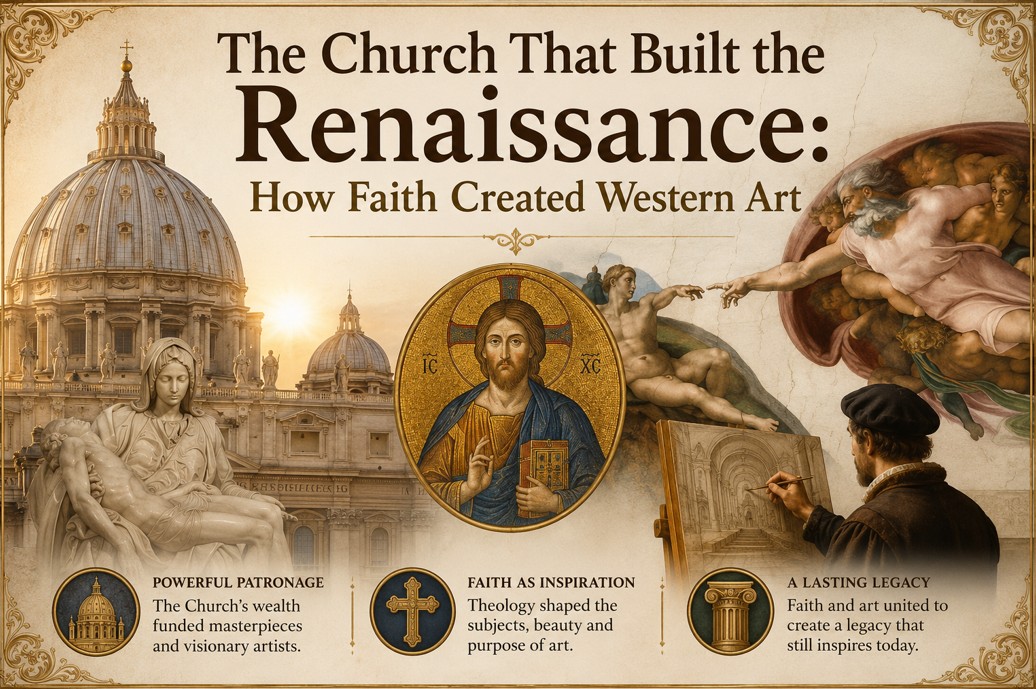
June 27, 2026: “Without the Church, would we even have the Renaissance?” It is a question that challenges the way we view one of history’s greatest cultural movements. The Renaissance is often remembered as a celebration of human creativity, individual genius, and classical ideas.


Yet behind many of its greatest masterpieces stood an institution with extraordinary influence, and a powerful vision: the Catholic Church. Through vast patronage and a theology that shaped artistic expression, the Church became one of the greatest forces behind the birth of Western art.
During the Renaissance, the Catholic Church was one of Europe’s resourceful and most influential institutions. Its resources allowed artists to take on ambitious projects that would have been impossible for private patrons alone. Churches, cathedrals, and papal buildings became vast canvases where painters, sculptors, and architects could transform religious ideas into visual experiences.
The papacy became one of the greatest supporters of artistic innovation. Leaders such as Pope Julius II commissioned some of the most famous works in Western history, including the decoration of the Sistine Chapel by Michelangelo. These projects were not simply acts of decoration; they were statements of faith, power, and cultural ambition.


While wealthy families such as the Medici family supported artists and intellectuals, the scale of Church commissions was unmatched. The Church could finance enormous fresco cycles, monumental sculptures, and grand architectural projects that shaped the appearance of European cities.
The Catholic Church did not only provide resources for art; it also provided the ideas that shaped what artists created. Religious beliefs influenced the subjects, styles, and emotional impact of Renaissance masterpieces.
One important theological idea was the Incarnation — the belief that God became human through Jesus Christ. This encouraged artists to explore the human body, facial expressions, and natural beauty as ways of understanding the divine. The result was a movement away from the symbolic, less realistic style of much medieval art towards greater realism, perspective, and emotional depth.
Artists were encouraged to create works that helped worshippers connect with biblical stories and saints. Paintings of the Virgin Mary, Christ’s suffering, and scenes from Scripture were designed not only to be admired but to inspire devotion.
The Church’s influence continued beyond the Renaissance. During the Counter-Reformation, Catholic leaders recognised that art could communicate religious messages with extraordinary power. The Council of Trent encouraged artists to create works that were clear, emotionally powerful, and spiritually inspiring.
This approach helped shape the dramatic style of the Baroque period, where artists used movement, intense emotion, and theatrical compositions to strengthen religious experience.
The Renaissance was shaped by many forces — classical learning, wealthy families, scientific curiosity, and individual creativity. However, the Catholic Church provided something unique: the resources to support extraordinary artistic achievement and the theological framework that gave those works meaning.
Without the Church’s patronage, many of the masterpieces that define Western art may never have existed. Its influence can still be seen today in the world’s most admired paintings, sculptures, and buildings — reminders that faith was not only a subject of Renaissance art, but one of its greatest creators.
By Catholic Connect Reporter
Read More:
The Secret Behind the World’s Greatest Music? It Was Written for the Catholic Mass
The Hidden Catholic Codes in History’s Greatest Paintings That Most People Never Notice
© 2026 CATHOLIC CONNECT POWERED BY ATCONLINE LLP