- 21 June, 2026

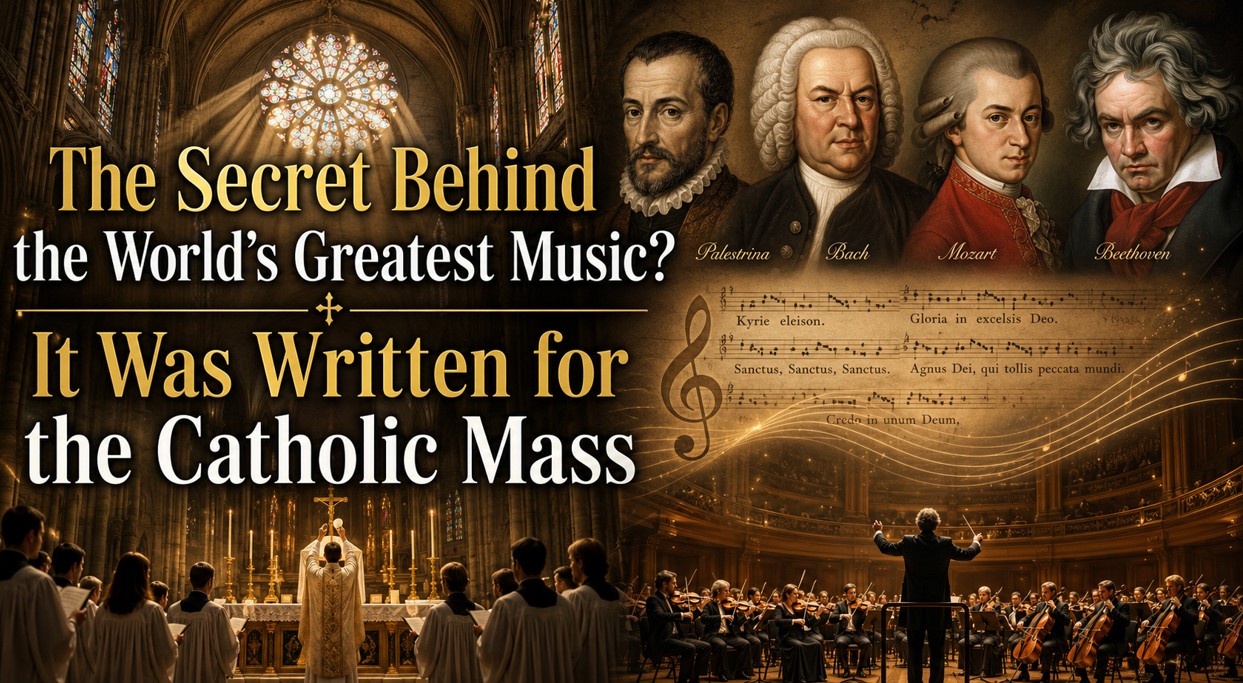
June 21, 2026: Walk into a grand concert hall anywhere in the world and listen to an orchestra perform a masterpiece by Bach, Mozart, or Beethoven. What many people don't realize is that the roots of much of this music stretch back not to royal palaces or modern theaters—but to the Catholic Mass.

Long before music became entertainment, it was worship.
For centuries, the Catholic Church was the largest patron of music in the Western world. It funded composers, trained musicians, built acoustically magnificent cathedrals, and inspired works that continue to move audiences hundreds of years later.
In a very real sense, some of the world's greatest music exists because the Church wanted to help people encounter the beauty of God.


Before the rise of public concert halls, cathedrals were the most impressive performance spaces in Europe.
These enormous stone structures created unique acoustics. A single voice could echo for seconds, filling the entire building. To complement these spaces, composers began creating increasingly sophisticated forms of sacred music.
One of the most important developments was polyphony—the weaving together of multiple independent vocal lines into a single harmonious composition.
Composers such as Giovanni Pierluigi da Palestrina mastered this art. Their music transformed the prayers of the Mass—the Kyrie, Gloria, Credo, Sanctus, and Agnus Dei—into soaring works of beauty that elevated worship beyond mere words.
This wasn't simply artistic expression. It required extraordinary mathematical precision. The careful balancing of voices, rhythms, and harmonies helped establish many of the rules that would later form the foundation of Western musical theory.
The Church wasn't just using music.
It was helping invent it.
As Europe entered the Enlightenment, music gradually expanded beyond liturgical settings.
Composers began creating sacred works intended not only for worship but also for public performance. The techniques developed for church music found new life in concert halls, opera houses, and royal courts.
The dramatic storytelling of sacred oratorios inspired operas. The structural complexity of Mass settings influenced symphonies and concertos. The intricate counterpoint perfected in churches became the language of classical music itself.
Far from disappearing, the musical legacy of the Mass spread throughout Western culture.
The concert hall was built upon foundations first laid in the sanctuary.
(CLICK HERE to follow Catholic Connect for regular News and Content)
No composer better represents this connection than Johann Sebastian Bach.
Today, Bach is widely regarded as one of the greatest musical minds in human history. Yet much of his work was written in service to the Church.
As Cantor of St. Thomas Church in Leipzig, Germany, Bach composed hundreds of sacred cantatas, choral works, and liturgical pieces. His music combined technical brilliance with profound spiritual depth.
His crowning achievement, the Mass in B Minor, is often considered one of the greatest compositions ever written.
The work brings together centuries of musical development. It blends the intricate polyphony of Renaissance church music with the energy and emotion of the Baroque era. It is both intellectually complex and deeply moving.
More than four centuries after the traditions that inspired it began, Bach demonstrated just how far sacred music could go.
He transformed the music of the Mass into a timeless masterpiece that still captivates audiences today.
The Church's contribution to music goes far beyond preserving old compositions.
It helped establish the idea that beauty matters.
Sacred music was never intended merely to entertain. Its purpose was to lift the human heart toward something greater—to inspire wonder, reflection, and awe.
That vision shaped generations of composers and gave rise to some of humanity's most enduring artistic achievements.
The next time you hear a choir sing in a cathedral or an orchestra perform Bach in a concert hall, remember this:
Much of Western music was born from the desire to worship.
The harmonies that fill our concert halls today first echoed through cathedral walls. The masterpieces admired by millions were often written for the Mass.
And behind centuries of musical innovation stood a Church that believed beauty itself could be a pathway to truth.
The result is one of the greatest artistic legacies the world has ever known.
By Catholic Connect Reporter
© 2026 CATHOLIC CONNECT POWERED BY ATCONLINE LLP