- 27 June, 2026

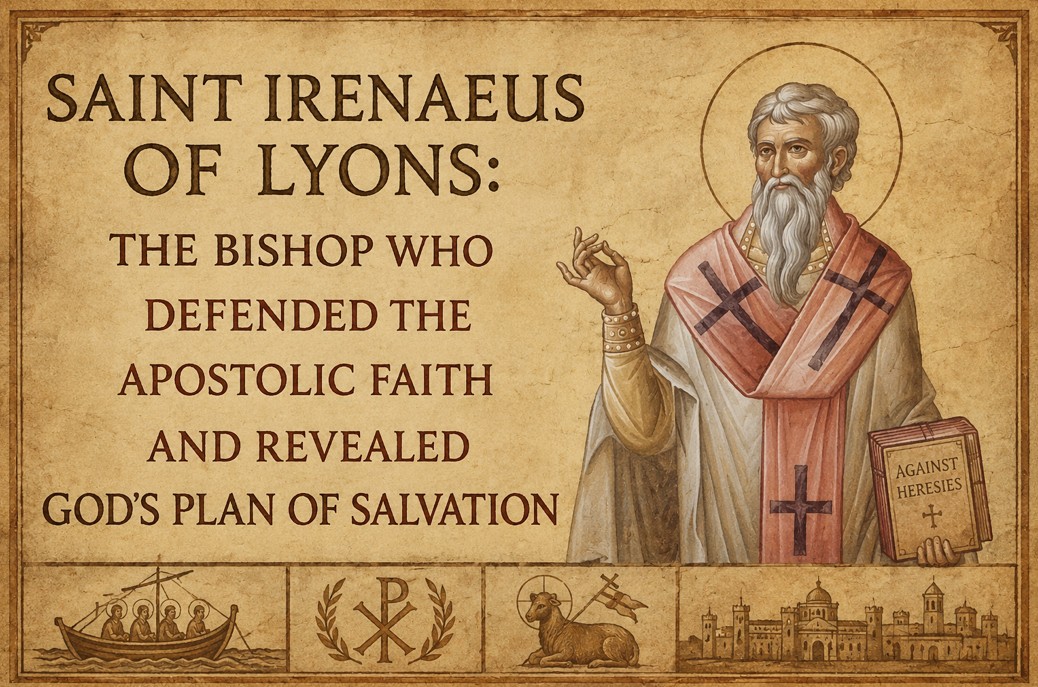
France, June 28, 2026: Why is Saint Irenaeus of Lyons remembered as one of the greatest defenders of Christianity in the early Church? Discover the extraordinary story of the bishop, theologian, and Church Father who fought against heresies, preserved the teachings of the Apostles, explained God’s plan of salvation, and became a bridge between the first Christians and later generations.


Feast Day: 28 June
Born: Around 130 AD, Smyrna (modern-day Izmir, Turkey)
Died: Around 202 AD, Lyons, Gaul (modern-day France)
Canonized: Ancient recognition by the Church


Declared Doctor of the Church: 21st January 2022 by Pope Francis
Patron of: The defence of Christian doctrine, theologians, and those seeking unity in faith
Known For: Fighting Gnosticism, preserving apostolic tradition, writing Against Heresies, and teaching the unity of Scripture and salvation history
Title: Doctor of the Church and Father of Christian Theology
Few saints stand so close to the earliest generations of Christianity as Saint Irenaeus of Lyons.
Born only a few decades after the Apostles, Irenaeus became one of the most important witnesses to the faith handed down by the first followers of Jesus.
At a time when many false teachings threatened the Christian community, he defended the truth about Christ, creation, Scripture, and salvation.
His writings became a foundation for Christian theology and helped the Church preserve the teachings received from the Apostles.
Through his wisdom and courage, Saint Irenaeus showed that protecting the faith also means protecting the hope and salvation offered by Christ.
(CLICK HERE to follow Catholic Connect for regular News and Content)
Saint Irenaeus was born around 130 AD in Smyrna, a major Christian centre in Asia Minor.
As a young man, he was blessed to learn from those who had direct connections with the Apostles.
He was especially influenced by Saint Polycarp of Smyrna, who himself had been taught by the Apostle John according to early Christian tradition.
Through Polycarp, Irenaeus received a living connection to the earliest preaching of the Church.
This experience shaped his lifelong mission: to preserve and pass on the authentic faith received from the Apostles.
Irenaeus later travelled to Gaul, an area that is now modern-day France.
There he became a priest in the Christian community of Lyons.
The Church in Lyons faced many challenges, including persecution and confusion caused by false teachings.
When Saint Pothinus died during persecution under the Roman Empire, Irenaeus became the second Bishop of Lyons around 177 AD.
As bishop, he worked tirelessly to strengthen believers and protect the unity of the Church.
The greatest challenge of Saint Irenaeus’s ministry was the spread of Gnosticism.
Gnostic groups claimed to possess secret knowledge that was supposedly higher than the teachings of the Apostles.
Some taught that the material world was evil and that salvation came through hidden spiritual knowledge rather than through Christ.
Irenaeus strongly opposed these ideas because they rejected important truths of Christianity:
His famous work Against Heresies became one of the earliest major Christian writings defending orthodox belief.
Saint Irenaeus taught that Christians must remain connected to the teachings of the Apostles.
He argued that the true faith could be recognised through:
He emphasised that Christianity was not based on secret teachings hidden from ordinary believers but on the public proclamation of Jesus Christ given to the whole Church.
His writings provide valuable evidence about the beliefs and practices of early Christianity.
One of Saint Irenaeus’s greatest theological contributions was his teaching about Christ restoring humanity.
He explained that Jesus came to undo the damage caused by sin and restore human beings to communion with God.
Irenaeus described Christ as the One who “recapitulates” or gathers all things together in Himself.
Through His obedience, Jesus healed the disobedience of Adam and brought humanity back into God’s plan.
This teaching became an important foundation for later Christian understanding of salvation.
Saint Irenaeus also developed one of the earliest Christian reflections comparing Mary with Eve.
He explained that just as Eve’s disobedience contributed to humanity’s fall, Mary’s obedience to God’s plan played a role in the coming of salvation through Christ.
Through this comparison, Irenaeus showed how God’s plan unfolds through human cooperation with divine grace.
This teaching became an important part of later Christian reflection on the role of the Virgin Mary.
Saint Irenaeus was not only a defender of truth but also a promoter of peace.
During disagreements in the Church, including debates about the date of Easter, he encouraged dialogue and unity.
He believed that Christians should preserve both faithfulness to truth and love for one another.
His approach showed that defending doctrine and seeking reconciliation are not opposites but responsibilities of Christian leadership.
Saint Irenaeus continued serving the Church of Lyons until his death around 202 AD.
Ancient traditions state that he may have suffered martyrdom during the persecution of Emperor Septimius Severus, though historical details about his death remain uncertain.
The Church honoured him as a faithful shepherd who gave his life in service of Christ and His people.
For centuries, Saint Irenaeus was recognised as one of the greatest Fathers of the early Church.
On 21st January 2022, Pope Francis declared him a Doctor of the Church, giving him the title “Doctor of Unity.”
This recognition highlighted his important role in preserving Christian truth and promoting unity among believers.
His writings continue to guide theologians, scholars, and Christians seeking to understand the foundations of the faith.
The central message of Saint Irenaeus’s life was that God has always been working to restore humanity.
He taught that creation, Scripture, Christ’s Incarnation, and the Church are all part of one divine plan.
For Irenaeus, Christianity was not a collection of separate ideas but a beautiful story of God’s love reaching humanity through Jesus Christ.
The life of Saint Irenaeus teaches important lessons:
Saint Irenaeus reminds believers that authentic faith is a gift received, preserved, and shared with future generations.
In a world filled with competing ideas and confusion about truth, Saint Irenaeus remains a powerful witness.
He was a bishop who defended Christianity, a theologian who explained God’s plan, and a shepherd who protected his people during difficult times.
From the ancient churches of Smyrna and Lyons to Christians around the world today, his voice continues to proclaim the beauty of the apostolic faith.
Saint Irenaeus teaches a timeless truth:
The faith received from Christ and the Apostles is a treasure meant to be faithfully preserved and joyfully shared.
To know about more saints please visit the spiritual section.
By Catholic Connect Reporter
Saint Irenaeus of Lyons, Saint Irenaeus feast day, Doctor of the Church, Church Fathers, early Christian saints, Against Heresies, apostolic tradition, Gnosticism, Catholic theologians, Fathers of the Church, saints of June, defenders of faith, Bishop of Lyons, early Christianity

© 2026 CATHOLIC CONNECT POWERED BY ATCONLINE LLP