- 10 August, 2026

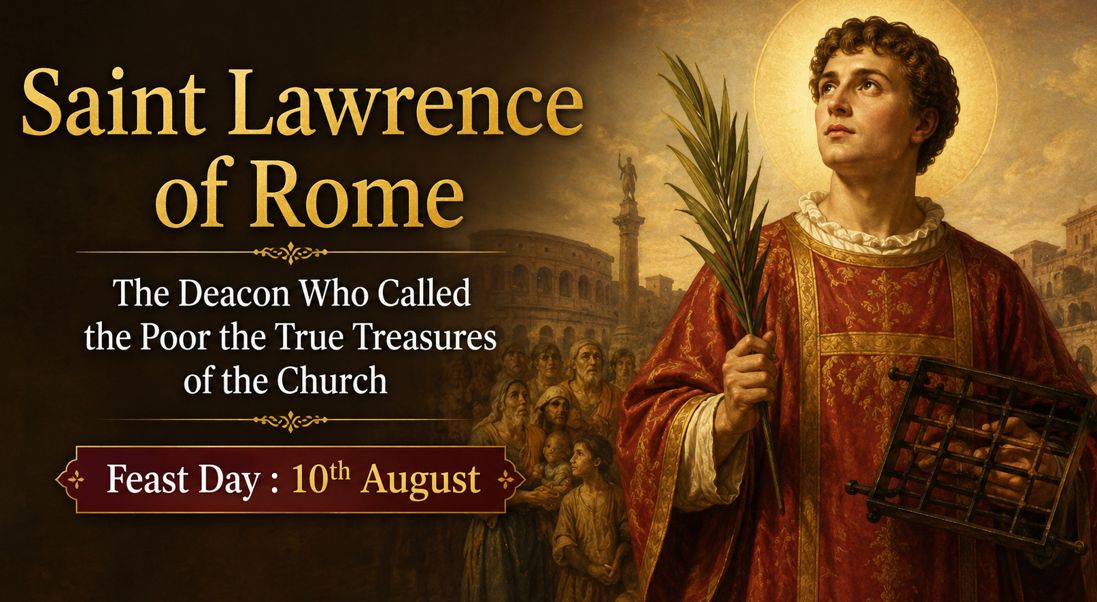
August 10, 2026: Why is Saint Lawrence of Rome remembered as one of the greatest deacons and martyrs of the early Church? Discover the inspiring story of the third-century Roman deacon who served Pope Sixtus II, dedicated himself to the poor, courageously faced persecution under Emperor Valerian, and gave his life for Christ in the year 258.


Feast Day: 10 August
Born: Traditionally believed to have been born in Spain, although details of his early life remain uncertain
Died: 10 August 258, Rome
Role: Deacon and Archdeacon of the Roman Church


Served Under: Pope Sixtus II
Martyrdom: During the persecution of Emperor Valerian
Known For: Service to the poor, Christian charity, martyrdom, and the famous tradition of identifying the poor as the true treasures of the Church
Patron of: Deacons, the poor, cooks, and several groups associated with his traditional martyrdom
Title: Deacon and Martyr
Saint Lawrence's feast was already recorded in the Roman calendar of martyrs by the fourth century, demonstrating how quickly his witness became deeply rooted in the memory of the Church.
Few saints of the early Roman Church have left such a powerful image of Christian charity as Saint Lawrence.
He was a deacon of the Roman Church during the third century and served closely with Pope Sixtus II. He was responsible for important charitable responsibilities within the Christian community, particularly the care and distribution of resources to the poor.
(CLICK HERE to follow Catholic Connect and to stay updated with Catholic News & Content)
His life became a remarkable testimony to the meaning of Christian service.
When Roman authorities demanded that the Church surrender its treasures, Lawrence did not point to gold, silver, or possessions.
Instead, according to the ancient tradition preserved especially by Saint Ambrose, he presented the poor.
These, he declared through his actions, were the true treasures of the Church.
The story has remained one of the most powerful expressions of Christian charity in the history of the Church.
The details surrounding Saint Lawrence's early life are uncertain.
A longstanding tradition places his birthplace in Spain, possibly in the region of Aragon, and says that he later studied in Zaragoza. According to this tradition, Lawrence encountered the future Pope Sixtus II during his studies.
The two eventually travelled to Rome, where their friendship and shared commitment to the Christian faith continued.
The Vatican notes that later historical research has questioned some details of these traditions. What is firmly established is that Lawrence was a real historical figure, a prominent deacon of the Roman Church, and a martyr who died during the persecution of Emperor Valerian in 258.
Lawrence became one of the principal deacons of Rome.
His ministry was not simply administrative.
The office of a deacon was deeply connected with service—service to the Church, service to the Eucharistic community, service to the bishop, and especially service to those in need.
Lawrence therefore became closely associated with the Church's charitable work.
He helped distribute the resources of the Christian community to the poor and vulnerable.
His ministry reveals an important truth about the early Church: Christian charity was not an optional activity added to the Gospel.
It was part of the Church's identity.
The Vatican has described Lawrence as a particularly powerful example of the deacon's ministry of charity and service to the poor.
In the year 257, Sixtus II became Bishop of Rome.
Lawrence served as one of his deacons and is traditionally identified as the chief or archdeacon of the Roman Church.
Their relationship was one of close ecclesial service.
But the peace of the Roman Christian community would soon be shattered.
Emperor Valerian intensified persecution against Christians.
An imperial decree ordered bishops, priests, and deacons to be executed.
The persecution soon reached the leaders of the Church in Rome.
On 6 August 258, Pope Sixtus II was arrested while celebrating the Eucharist in the cemetery of Callixtus.
He was executed together with several of his deacons.
Lawrence remained alive for several more days.
According to the ancient tradition, this brief interval became significant.
The Roman authorities expected Lawrence, as a leading administrator of the Church's resources, to reveal where the Church's wealth was kept.
Instead, Lawrence prepared to give them an entirely different answer.
His final ministry would become a powerful testimony to Christian charity.
One of the most famous traditions concerning Saint Lawrence tells of his confrontation with the Roman authorities.
They demanded that he hand over the treasures of the Church.
Lawrence was given time to gather them.
He distributed whatever resources could be distributed to the poor.
Then he brought the poor and needy before the authorities.
According to the tradition preserved by Saint Ambrose, Lawrence identified them as the treasures of the Church.
The meaning of this gesture was profound.
For Lawrence, the Church's wealth was not ultimately found in material possessions.
It was found in human beings created in the image of God.
Centuries later, the same witness continued to be highlighted by the popes. Pope Leo XIV, reflecting on Saint Lawrence and the teaching of Saint Ambrose, recalled that the poor are the treasures in whom Christ desires to show Himself.
The story of Saint Lawrence challenges every generation of Christians.
The world often measures wealth through money, possessions, influence, and power.
Lawrence points toward a radically different understanding.
The poor are not merely recipients of charity.
They possess an extraordinary dignity because they are loved by God.
The Church's care for them is therefore not simply humanitarian work.
It is an expression of the Gospel.
Pope Francis similarly reflected on Saint Lawrence's example, emphasizing that the weakest and most vulnerable members of the Christian community are among the Church's greatest treasures.
Saint Lawrence's martyrdom cannot be separated from his ministry.
He did not simply become a martyr because he happened to hold a position within the Roman Church.
His martyrdom completed the life of service that he had already been living.
As a deacon, he served the poor.
As a Christian, he served Christ.
As a martyr, he gave his entire life to Christ.
The Vatican therefore describes Lawrence as a powerful example of the connection between diakonia, the ministry of service, and martyrdom.
Saint Lawrence was executed on 10 August 258.
Ancient tradition, especially the account associated with Saint Ambrose, describes his martyrdom by burning on a gridiron.
The famous story tells that Lawrence endured his suffering with remarkable courage and even displayed a spirit of holy joy.
However, historical scholarship cautions that the more detailed accounts of the manner of his execution were written later and cannot all be independently verified.
What is firmly established is that Lawrence was a historical Roman deacon who was martyred during the persecution of Valerian on 10 August 258.
His martyrdom became one of the most memorable stories of courage in the early Church.
The memory of Saint Lawrence spread rapidly throughout the Christian world.
His feast was already included in the fourth-century Roman calendar of martyrs.
His burial place was remembered along the Via Tiburtina, in the area associated with the Catacomb of Cyriaca.
Pope Damasus later built a basilica dedicated to him, and several churches in Rome were placed under his patronage.
By late antiquity, devotion to Lawrence had become especially strong in Rome.
His name therefore became permanently associated with the Christian identity of the city.
Christian art traditionally depicts Saint Lawrence holding or standing beside a gridiron.
The symbol recalls the traditional account of his martyrdom.
Yet the gridiron represents more than physical suffering.
For Christians, it has become a symbol of a disciple who remained faithful to Christ even when faith demanded the ultimate sacrifice.
Lawrence's true victory was not the avoidance of suffering.
It was his refusal to allow suffering to separate him from Christ.
Saint Lawrence has a special importance for the diaconate.
A deacon is called to serve.
The word diakonia expresses service, and the Church has traditionally connected the diaconate with service of the Word, the liturgy, and charity.
Lawrence embodies this vocation in a particularly powerful way.
He served the bishop.
He served the Eucharistic community.
He served the poor.
And finally, he gave his life in witness to Christ.
The Holy See has repeatedly presented Lawrence as a model for deacons, especially those dedicated to serving people who are poor and vulnerable.
Saint Lawrence's example remains especially relevant in a world where millions continue to experience poverty, hunger, homelessness, loneliness, and exclusion.
His message is not simply:
"Give something to the poor."
It is deeper: See the dignity of the poor.
Lawrence teaches Christians to recognize Christ in those whom society may overlook.
His witness calls the Church to place charity at the heart of Christian life.
Pope Francis described this lesson clearly when reflecting on Lawrence: the Church's greatest wealth is found in its weakest members.
The life of Saint Lawrence offers several powerful lessons.
Serve before seeking recognition : Lawrence's ministry was centered on service rather than status.
See Christ in the poor : He reminds us that people in need are not obstacles but persons of immeasurable dignity.
Use material possessions for charity : The Church's resources exist ultimately for the mission of Christ and the service of humanity.
Remain faithful under pressure : Lawrence refused to abandon his faith when persecution threatened his life.
Understand Christian leadership as service : His life shows that true Christian authority is expressed through self-giving love.
Do not fear sacrificial love : Lawrence's martyrdom demonstrates the depth of a love that is willing to give everything to Christ.
Saint Lawrence of Rome lived almost eighteen centuries ago, yet his message remains remarkably contemporary.
The questions he raises are questions every generation must answer:
What do we consider valuable?
Who do we consider important?
How do we treat the poor?
What are we willing to sacrifice for our faith?
And what does it mean to serve Christ?
Lawrence's answer was given through his life.
The Church's treasure is not ultimately gold.
It is people.
The greatness of Christian leadership is not power.
It is service.
And the deepest expression of Christian love is the willingness to give oneself completely to God and neighbor.
Saint Lawrence remains one of the great witnesses to the unity of charity and martyrdom.
He served the poor before persecution came.
He continued serving them when the authorities demanded the Church's wealth.
And finally, he offered his own life as a witness to Christ.
His story reminds Christians that holiness is not simply about enduring suffering.
It is about learning to love.
Lawrence's life began in service and ended in sacrifice, but the central theme remained the same:
Love of Christ expressed through love of others.
Saint Lawrence invites us to look again at the people whom society often overlooks.
The poor.
The lonely.
The sick.
The forgotten.
The vulnerable.
The people without power or influence.
Perhaps the greatest lesson of Lawrence is that these are not merely people who need our help.
They are people through whom Christ invites us to encounter Him.
May Saint Lawrence teach us to recognize the true treasures of the Church.
May he inspire deacons, priests, religious, and lay Christians to serve with humility.
May he give courage to those who suffer for their faith.
And may his witness lead us to understand that Christian charity is not weakness, but one of the greatest expressions of love.
Saint Lawrence of Rome was a deacon, servant of the poor, faithful disciple, and courageous martyr.
His life unfolded during one of the most dangerous periods of the early Church, yet he remained faithful to the mission entrusted to him.
When the authorities demanded the Church's treasures, he showed them the poor.
When persecution threatened him, he remained faithful.
When his life was demanded, he gave it to Christ.
Nearly eighteen centuries later, his witness continues to challenge the Church and the world.
Saint Lawrence reminds us that the true treasures of the Church are not possessions but people, and that the greatest Christian wealth is found in love given generously to God and to those most in need.
May his example inspire us to serve with courage, give with generosity, defend human dignity, and remain faithful to Christ in every circumstance.
Saint Lawrence of Rome, deacon and martyr, pray for us.
To know about more saints please visit the spiritual section.
By Catholic Connect Reporter
Saint Lawrence of Rome, Saint Lawrence, Saint Lawrence feast day, Saint Lawrence martyr, Saint Lawrence deacon, Saint Lawrence of Rome biography, Saint Lawrence and the poor, treasures of the Church, Saint Lawrence martyrdom, Saint Lawrence August 10, Roman martyrs, Pope Sixtus II, Emperor Valerian, Catholic saints, saints of Rome, deacon saints, patron saint of deacons, Catholic martyrs, early Christian martyrs, Christian charity, Catholic charity, saints who served the poor, Saint Lawrence gridiron, Saint Lawrence prayer, Saint Lawrence spiritual reflection

© 2026 CATHOLIC CONNECT POWERED BY ATCONLINE LLP