
- 09 August, 2026
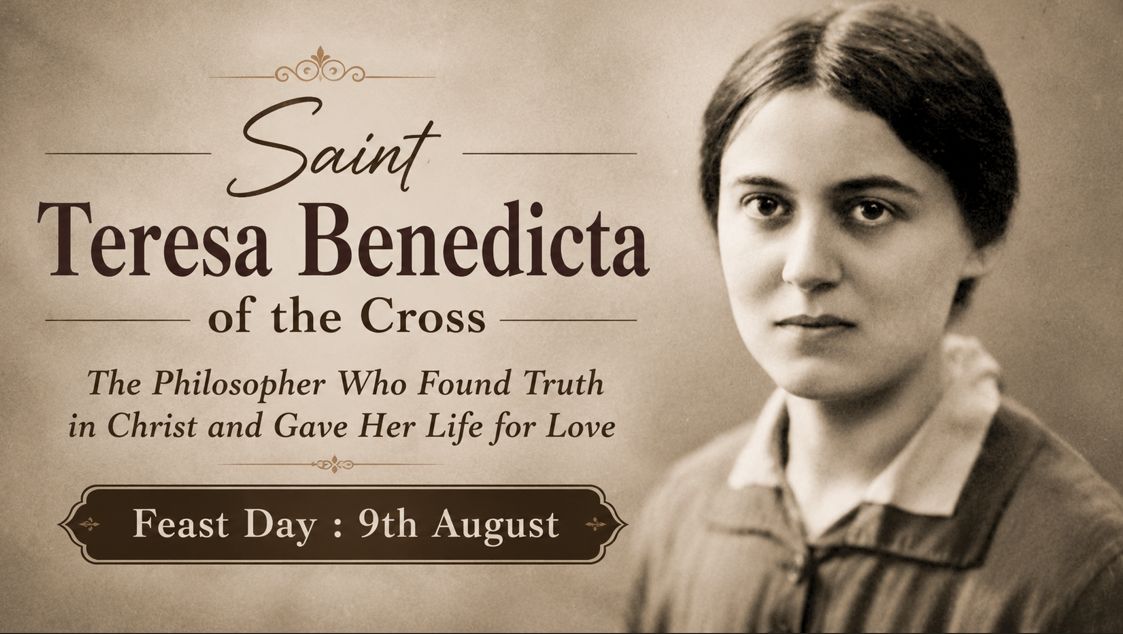
August 9, 2026: Why is Saint Teresa Benedicta of the Cross—better known as Edith Stein—one of the most remarkable saints of the modern era? Discover the extraordinary journey of the brilliant Jewish philosopher who searched passionately for truth, became a Catholic, entered the Carmelite order, and ultimately gave her life at Auschwitz during the Nazi persecution.


Feast Day: 9 August
Born: 12 October 1891, Breslau, Germany (now Wrocław, Poland)
Died: 9 August 1942, Auschwitz, German-occupied Poland
Birth Name: Edith Stein


Religious Name: Teresa Benedicta of the Cross
Canonized: 11 October 1998 by Pope John Paul II
Patron of: Europe
Known For: Philosophy, conversion to Catholicism, Carmelite spirituality, writings on truth and the human person, and martyrdom at Auschwitz
Title: Virgin and Martyr; Co-Patroness of Europe
Few modern saints have lived a journey as extraordinary as Saint Teresa Benedicta of the Cross.
Born Edith Stein into a Jewish family, she became one of the outstanding philosophers of her generation. Her passionate search for truth eventually led her from a period of abandoning religious practice to an encounter with Christianity and, ultimately, conversion to Catholicism.
She later entered the Discalced Carmelite Order and took the name Teresa Benedicta of the Cross.
Her life ended tragically during the Nazi persecution, when she was deported to Auschwitz and murdered in 1942.
Yet the story of Edith Stein is not simply a story of persecution and death. It is a story of intellectual courage, spiritual searching, conversion, compassion, and a profound love for the Cross of Christ.
Edith Stein was born on 12 October 1891 into an observant Jewish family in Breslau.
From an early age, she demonstrated extraordinary intellectual ability. She eventually pursued philosophy and became deeply interested in questions concerning truth, human consciousness, knowledge, and the nature of the human person.
As a young woman, Edith stopped praying and described herself as having lost her faith in God.
Yet her search for truth never disappeared.
Her intellectual journey would eventually lead her toward a profound encounter with Christianity.
Edith studied philosophy and became associated with Edmund Husserl, the founder of phenomenology.
She completed her doctoral work and became known for her intellectual abilities. She was deeply interested in understanding human experience and the mystery of the person.
Her philosophical work was not merely an academic exercise.
For Edith, the search for truth was ultimately a search for reality itself.
Her intellectual journey prepared the way for the spiritual transformation that would change her life forever.
One of the most important moments in Edith Stein's spiritual journey came when she read the autobiography of Saint Teresa of Ávila.
The experience profoundly affected her.
The witness of Teresa's life and her relationship with God convinced Edith that she had encountered the truth she had been seeking.
Her intellectual search had led her to a deeper spiritual discovery.
On 1 January 1922, Edith Stein was baptized into the Catholic Church.
Her conversion did not mean abandoning her intellectual life.
Instead, her faith became the foundation for a new understanding of philosophy, human dignity, suffering, and the meaning of life.
After her conversion, Edith continued her work as a teacher and writer.
She taught philosophy and education and became an important Catholic intellectual.
Her writings explored the dignity of the human person, the nature of womanhood, education, empathy, freedom, and the relationship between philosophy and Christian faith.
She believed that intellectual formation should ultimately serve the human person.
Her life demonstrated that faith and reason need not be enemies.
For Edith Stein, the search for truth could ultimately lead the human person toward God.
Edith had long desired to enter the Carmelite order.
On 14 October 1934, she finally entered the Discalced Carmelite monastery in Cologne. She received the religious habit and later took the religious name Teresa Benedicta of the Cross.
The name she chose was deeply significant.
The Cross became the central symbol of her spirituality.
She believed that following Christ meant accepting not only His glory but also participating in His suffering.
For Edith, the Cross was not a symbol of defeat.
It was the path of sacrificial love.
The rise of Nazism brought increasing danger to Edith Stein and other people of Jewish ancestry.
Anti-Jewish persecution intensified throughout Germany. In 1938, Edith and her sister Rosa, who had also converted to Catholicism and entered religious life, were transferred from Cologne to the Carmelite monastery in Echt, Netherlands, in an attempt to protect them.
But the Nazi occupation of the Netherlands eventually placed them in danger as well.
Edith understood that her Jewish heritage had made her a target.
Yet she continued to trust in Christ.
Teresa Benedicta increasingly understood her own suffering in connection with Christ's Cross.
She did not seek suffering for its own sake. Instead, she believed that love could transform suffering into an offering made for others.
Her spirituality became one of profound self-giving.
The woman who had spent years searching intellectually for the meaning of truth now understood truth through the person of Christ.
Her life became a witness to the words of St. Paul: "Far be it from me to glory except in the Cross of our Lord Jesus Christ."
Those words were later chosen by Pope John Paul II in his homily at her canonization.
On 2 August 1942, Edith and her sister Rosa were arrested by the Nazis.
They were deported with many other Jewish prisoners.
They eventually arrived at Auschwitz.
On 9 August 1942, Teresa Benedicta of the Cross and Rosa were murdered in the Nazi extermination camp. Vatican sources identify 9 August 1942 as the day of Edith Stein's death.
Her life ended in violence, but the witness she left behind became a message of hope and reconciliation.
Pope John Paul II beatified Edith Stein in Cologne in 1987.
Eleven years later, on 11 October 1998, he canonized her in Rome.
In 1999, Pope John Paul II proclaimed Edith Stein, together with Saints Bridget of Sweden and Catherine of Siena, as a Co-Patroness of Europe.
Her patronage carries a powerful message.
She was born Jewish, became a Catholic, entered the Carmelite Order, and died alongside countless other victims of Nazi persecution.
Her life stands as a call to reject hatred, racism, intolerance, and every attack against human dignity.
Saint Teresa Benedicta of the Cross occupies a unique place in the history of the Church.
She remained deeply conscious of her Jewish heritage even after becoming Catholic.
Pope John Paul II described her as both a daughter of Israel and a faithful daughter of the Church. Her story has therefore become an important symbol of the relationship between Jews and Christians.
Her life reminds Christians that human beings must never be reduced to race, nationality, ideology, or social identity.
Every person possesses an incomparable dignity.
The life of Edith Stein offers several powerful lessons.
She teaches that an honest search for truth should never be feared.
She reminds Christians that faith and reason can work together rather than stand in opposition.
She teaches that suffering can be united with Christ when it is embraced with love rather than hatred.
And she reminds the world of the terrible consequences of racism and religious hatred.
Her life challenges Catholics to seek truth, defend human dignity, reject prejudice, and remain faithful to Christ even in difficult circumstances.
Saint Teresa Benedicta of the Cross remains one of the most compelling witnesses of twentieth-century Christianity.
She was a philosopher who became a believer, a seeker who became a disciple, an intellectual who became a contemplative nun, and a woman who transformed suffering into an offering of love.
Her life crossed boundaries that often divide people—Jewish and Christian, philosophy and theology, reason and faith, suffering and hope.
Her martyrdom at Auschwitz remains a painful reminder of humanity's capacity for hatred.
But her life also reveals something greater: the power of truth, faith, forgiveness, and sacrificial love.
From the classrooms of philosophy to the silence of the Carmelite monastery and finally to the darkness of Auschwitz, Saint Teresa Benedicta of the Cross remained committed to the truth she had spent her life seeking.
Her witness continues to speak to a world still searching for meaning: Seek the truth. Defend human dignity. Reject hatred. And never be afraid to follow Christ, even when the road leads through the Cross.
To know about more saints please visit the spiritual section.
By Catholic Connect Reporter
Saint Teresa Benedicta of the Cross, Edith Stein, Saint Edith Stein, Edith Stein feast day, August 9 feast day, Carmelite saints, Catholic saints, Jewish convert saints, Catholic philosophers, Edith Stein biography, Auschwitz martyr, Patroness of Europe, Co-Patroness of Europe, Teresa Benedicta of the Cross, Discalced Carmelites, Catholic martyrs, saints of Europe, Christian philosophy

© 2026 CATHOLIC CONNECT POWERED BY ATCONLINE LLP