- 20 September, 2026
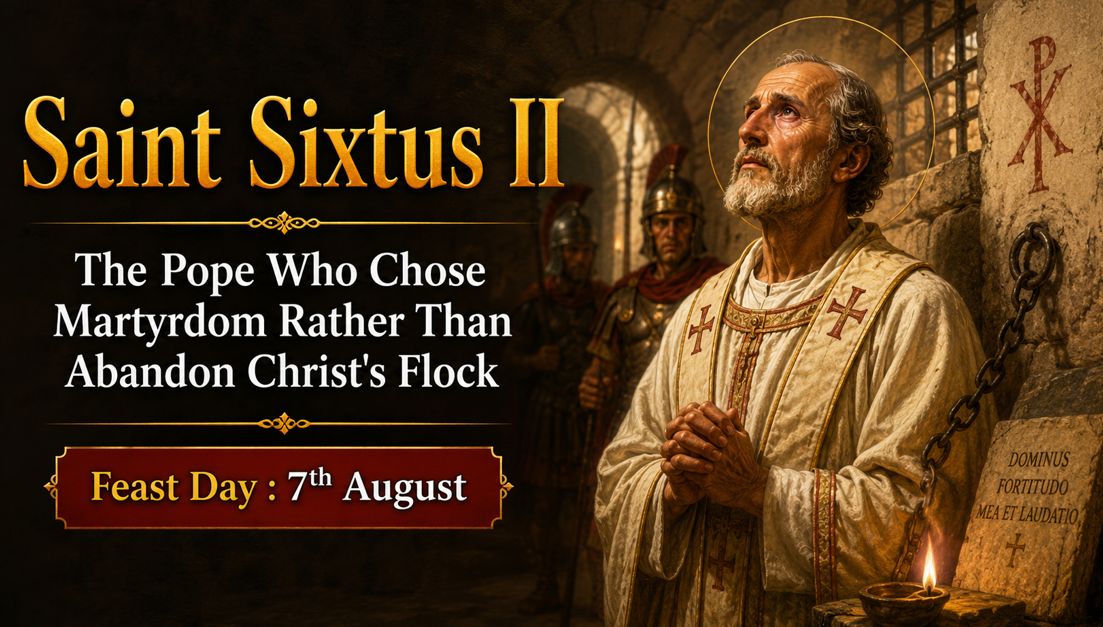
Rome, August 7, 2026 : Why is Saint Sixtus II remembered as one of the Church's greatest martyr Popes? Discover the inspiring story of the bishop of Rome who courageously celebrated the Eucharist during one of Christianity's fiercest persecutions and willingly gave his life for Christ alongside his faithful deacons.


Feast Day: 7 August
Papacy: AD 257 – 258
Born: Traditionally believed to have been of Greek origin
Died: 6 August AD 258, Rome

Patron of: Invoked as a protector of the Church during times of persecution
Known For: His martyrdom during the persecution of Emperor Valerian and his close association with St. Lawrence
Title: Pope and Martyr
Throughout the history of the Catholic Church, many Popes have been called to lead during difficult times. Few, however, faced such immediate danger as Saint Sixtus II, who shepherded the Church during the brutal persecution ordered by Emperor Valerian.
Rather than flee or abandon his people, Sixtus continued celebrating the sacred mysteries and encouraging the faithful. His steadfast courage ultimately led him to martyrdom, making him one of the Church's most revered early Popes.
More than seventeen centuries later, his witness remains a powerful reminder that faithfulness to Christ is worth every sacrifice.
(CLICK HERE to follow Catholic Connect and to stay updated with Catholic News & Content)
Saint Sixtus II became Pope in AD 257. He succeed Pope Stephen I.
Although his papacy lasted only about one year, it came at a critical moment in the Church's history. Christians throughout the Roman Empire were facing increasing hostility as Emperor Valerian sought to weaken the growing Christian community.
In AD 258, Valerian issued a decree specifically targeting bishops, priests, and deacons. Christian leaders were ordered to offer sacrifices to the Roman gods or face execution.
Knowing the danger, he refused to abandon his mission.
Despite the imperial decree, he continued to celebrate the Holy Eucharist and minister to the faithful.
According to ancient accounts, he gathered with Christians in the Catacombs of Saint Callixtus, where believers often met in secret to pray and celebrate the sacraments.
Even under the constant threat of arrest, he remained committed to strengthening his people through the Word of God and the Eucharist.
His courage inspired countless Christians to remain faithful despite the growing persecution.
On 6 August AD 258, Roman soldiers discovered Pope Sixtus II while he was preaching and celebrating the sacred liturgy in the Catacombs of Saint Callixtus.
He was arrested immediately.
Rather than being taken away for a lengthy trial, the Pope was condemned on the spot. According to ancient Christian tradition, he was beheaded while seated in his bishop's chair, offering the ultimate witness of fidelity to Christ.
Four of the deacons serving with him were also executed that same day, sharing in their bishop's martyrdom.
Their sacrifice strengthened the faith of the early Church and became a lasting testimony of Christian courage.
One of the most beloved traditions connected with Saint Sixtus II concerns his meeting with his faithful deacon, Saint Lawrence.
As the Pope was being led to execution, Lawrence reportedly followed him in sorrow and asked: "Father, where are you going without your deacon?"
According to tradition, Sixtus lovingly replied: "I do not leave you, my son. In three days you shall follow me."
Those words proved prophetic.
Three days later, on 10 August, Saint Lawrence himself was martyred after refusing to surrender the Church's spiritual treasures, declaring instead that the poor were the true treasure of the Church.
The witness of Sixtus and Lawrence became one of the most inspiring chapters in early Christian history.
The martyrdom of Saint Sixtus II deeply moved Christians throughout the Roman Empire.
His name was included in the ancient Roman Canon of the Mass, now known as Eucharistic Prayer I, where he continues to be remembered alongside other great martyrs of the early Church.
His tomb in the Catacombs of Saint Callixtus became an important place of pilgrimage for generations of believers who came to honor the Pope who gave everything for Christ.
Saint Sixtus II never led armies or held earthly power.
His greatness came through his willingness to remain with his flock even when death was certain. He demonstrated that authentic Christian leadership is measured not by authority but by sacrificial love.
His brief papacy left an enduring mark on the Church because he lived the Gospel he preached.
The life of Saint Sixtus II reminds Christians that faith sometimes requires courage in the face of opposition.
Although most believers today may never face physical persecution, they are still called to remain faithful amid ridicule, misunderstanding, or cultural pressure.
His example teaches Catholics to place Christ above every earthly fear, remain devoted to the Eucharist, and lead others through humble service rather than personal ambition.
Like him, every Christian is called to witness to the Gospel with steadfast faith and unwavering hope.
More than seventeen centuries after his martyrdom, he continues to inspire Christians around the world.
His life demonstrates that the Church has been built not only through great preaching and wise leadership but also through the faithful witness of those willing to surrender everything for Christ.
From the hidden catacombs beneath ancient Rome to churches throughout the world, he remains a powerful example of courage, sacrifice, and unwavering trust in God.
His martyrdom reminds every believer that the greatest victory is not found in preserving one's life, but in remaining faithful to Christ until the very end.
To know about more saints please visit the spiritual section.
By Catholic Connect Reporter
Saint Sixtus II, Pope Saint Sixtus II, Saint Sixtus II feast day, Catholic martyrs, early Church, Pope martyr, Emperor Valerian persecution, Saint Lawrence, Catacombs of Saint Callixtus, Roman martyrs, Catholic saints, early Popes, August 7 feast day, Catholic Church history



© 2026 CATHOLIC CONNECT POWERED BY ATCONLINE LLP