- 20 September, 2026

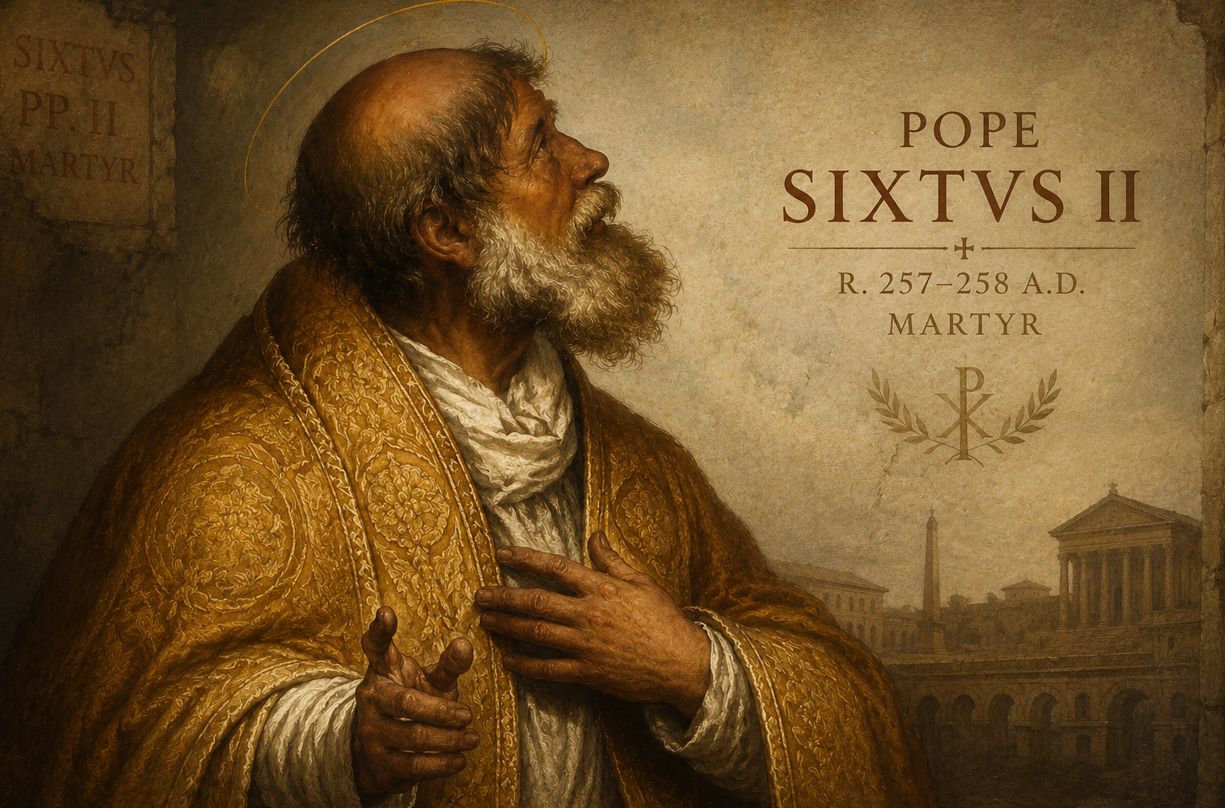
June 11, 2026: St. Sixtus II, the twenty-fourth successor of Saint Peter, served as pope for barely a year, yet his courage under persecution made him one of the most revered martyrs of the early Church. His papacy coincided with a renewed wave of Roman hostility towards Christians, culminating in his arrest while leading worship and his execution shortly afterwards. His life stands as a powerful witness to faith, leadership, and sacrifice.


What would you do if practising your faith could cost you your life?
For Pope Sixtus II, this was not a hypothetical question. As persecution intensified under Emperor Valerian, he continued to shepherd the Christian community despite knowing the risks. His final days would become one of the most moving accounts of courage in the history of the papacy.

Little is known about the early life of Sixtus II. Historical sources suggest he was of Greek origin and was respected for his wisdom, learning, and pastoral character.
Before becoming pope, he likely served the Church in Rome and earned a reputation as a peacemaker capable of healing divisions within the Christian community.
(CLICK HERE to follow Catholic Connect for regular Catholic News & Content)
Sixtus II was elected Bishop of Rome in 257 AD following the death of Pope Stephen I.
His election came at a crucial moment. The Church had recently experienced disagreements over the rebaptism controversy, and Christians faced growing uncertainty as the Roman authorities adopted a harsher stance towards the faith.
The reign of Sixtus II unfolded during the persecution ordered by Emperor Valerian.
The situation deteriorated rapidly when Valerian issued decrees specifically aimed at bishops, priests, and deacons.
Although his papacy was brief, Sixtus II made several important contributions:
His leadership helped stabilise the Church at a time when external threats could easily have created internal divisions.
Sixtus II is remembered for:
His spirituality reflected complete trust in Christ and unwavering commitment to the Gospel.
The greatest challenge of his papacy came from the persecution of Emperor Valerian.
On 6 August 258 AD, Sixtus II was reportedly celebrating the Eucharist in the Catacombs of St. Callixtus when Roman soldiers arrested him. He and several deacons were immediately condemned.
According to tradition, as he was led away to execution, his deacon St. Lawrence expressed sorrow at being left behind. Sixtus reportedly reassured him that he too would soon share in the crown of martyrdom.
Sixtus was beheaded the same day, becoming one of the most celebrated martyrs of the third century.
Though none of his writings survive, his life proclaims a powerful message: Faithfulness to Christ is worth every sacrifice.
Sixtus II was venerated as a martyr from the earliest centuries of Christianity.
His name is included in the Roman Canon of the Mass, reflecting the Church's enduring respect for his witness.
Why does St. Sixtus II matter today?
His legacy continues through the life of the Church today, carried forward by his successors.
To know more about the previous Popes, click here
By Catholic Connect Reporter
________________________
St. Sixtus II, Pope Sixtus II biography, Pope arrested during Mass, twenty-fourth pope Catholic Church, Valerian persecution, St Lawrence and Pope Sixtus II, early Catholic martyrs, Catholic Church history, apostolic succession, Pope Sixtus II martyrdom





© 2026 CATHOLIC CONNECT POWERED BY ATCONLINE LLP