- 30 September, 2026
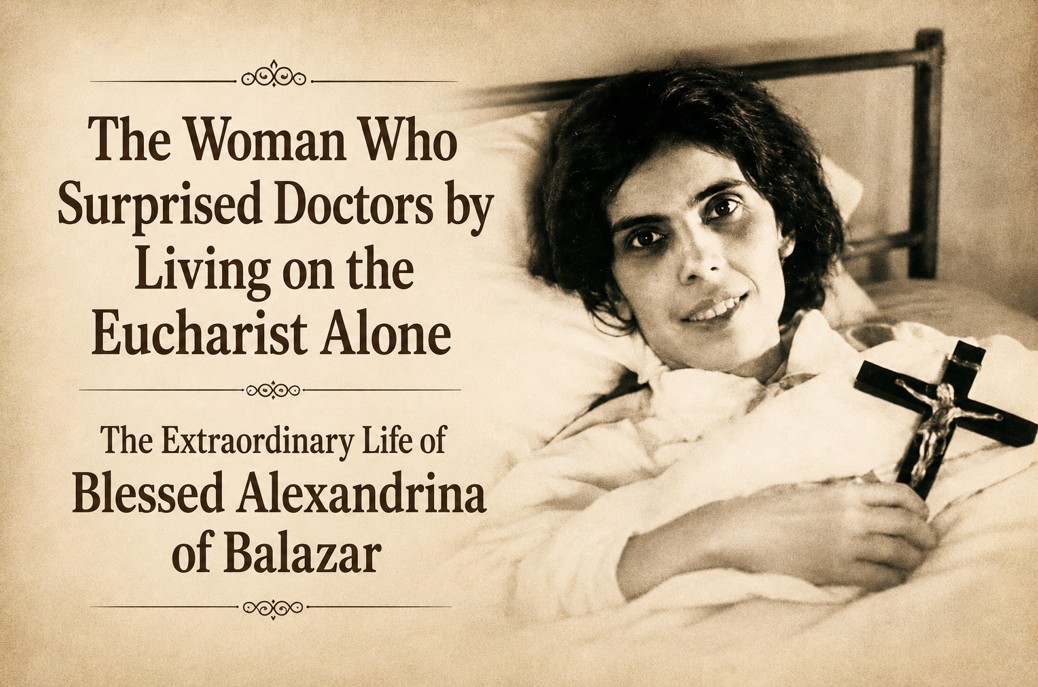
Portugal, June 24, 2026: In the quiet village of Balazar, Portugal, a young woman’s life became one of the most remarkable Eucharistic mysteries of the 20th century. Blessed Alexandrina Maria da Costa, known as Blessed Alexandrina of Balazar, astonished physicians, priests, and thousands of faithful through her extraordinary devotion to the Holy Eucharist. For more than 13 years, she was reported to have lived without ordinary food or drink, sustained only by daily Holy Communion.


Her story was not one of seeking attention or recognition, but of a deep spiritual union with Christ. Through suffering, prayer, and an intense love for the Eucharist, Alexandrina became a powerful witness to the Catholic belief in the real presence of Jesus in the Blessed Sacrament.
Born on March 30, 1904, in Balazar, Portugal, Alexandrina grew up in a humble Catholic family. From childhood, she showed a strong devotion to Jesus and a desire to live close to God.
At the age of 14, a tragic incident changed her life forever. When men entered her home with harmful intentions, Alexandrina escaped by jumping from a window. Although she survived, the injuries she suffered gradually caused her health to decline, eventually leaving her paralyzed and confined to bed.
Rather than becoming consumed by despair, Alexandrina united her suffering with the Passion of Christ. She offered her pain for the conversion of sinners and found comfort in prayer, especially before the Blessed Sacrament.
(CLICK HERE to follow Catholic Connect for regular News and Content)
Alexandrina’s devotion to the Eucharist grew deeper throughout her years of suffering. She longed to receive Jesus in Holy Communion and believed that the Eucharist was the strength that carried her through her physical trials.
In 1942, something extraordinary began. Alexandrina stopped consuming normal food and claimed that she was sustained only by the Eucharist she received at Holy Communion. This continued for approximately 13 years, until her death in 1955.
Her condition attracted the attention of doctors and Church authorities. Medical examinations were carried out, including a period of observation where she was closely monitored. According to accounts from those investigations, no ordinary food was found to be sustaining her, yet she continued to live despite the absence of normal nourishment.
For Alexandrina, the Eucharistic fast was not about creating wonder or proving a mystery. It was an expression of her complete love for Christ. She often described Jesus in the Blessed Sacrament as her source of strength, peace, and life.
During her years of illness, she experienced mystical encounters connected to the Passion of Christ and the Eucharist. She offered her suffering for the salvation of souls and encouraged others to approach the Eucharist with greater faith and devotion.
Her message was simple: Jesus is truly present, and the Eucharist is the greatest gift God gives to humanity.
After years of investigation into her life and virtues, Pope Saint John Paul II beatified Alexandrina on April 25, 2004. The Church presented her as an example of extraordinary faith, sacrifice, and Eucharistic love.
Her feast day is remembered as a reminder that holiness can grow even in moments of suffering and weakness. Though confined physically, Alexandrina’s spiritual life reached people across the world.
The story of Blessed Alexandrina of Balazar remains one of the most extraordinary Eucharistic accounts of modern times. Her life invites believers to look beyond the Eucharist as a simple ritual and to encounter it as a profound meeting with Christ.
Through her suffering, prayer, and complete trust in Jesus, Alexandrina left behind a powerful message: the Eucharist is not only received—it is lived. For those who believe, it becomes a source of strength, hope, and divine life.
By Catholic Connect Reporter
Read More on the Eucharist:
The Priest Who Stopped Before the Eucharist — The Mystical Mass of St. Padre Pio
The Pope Who Taught the World to Return to Adoration
The Saint Who Saw Flames Around the Eucharist During Prayer
The Bishop Who Refused to Leave Jesus “Abandoned”: St. Manuel González García
The Saint Who Held Up the Eucharist to Stop an Attack: The Story of St. Clare of Assisi
The Boy Who Died Protecting the Eucharist: The Story of St. Tarcisius
The Eucharist: A Symbol or Real Presence? The Biblical and Historical Evidence
The Most Sacred Moment of the Mass—Explained
Eucharistic Miracles That Science Couldn’t Ignore: The Mysteries of Lanciano and Buenos Aires
Eucharistic Miracles That Science Couldn’t Ignore Part 2: The Mysteries of Mexico and Poland
12 Eucharistic Symbols and What They Mean
More Than a Ritual: How the Eucharist Changed the Lives of Saints



© 2026 CATHOLIC CONNECT POWERED BY ATCONLINE LLP