- 23 September, 2026

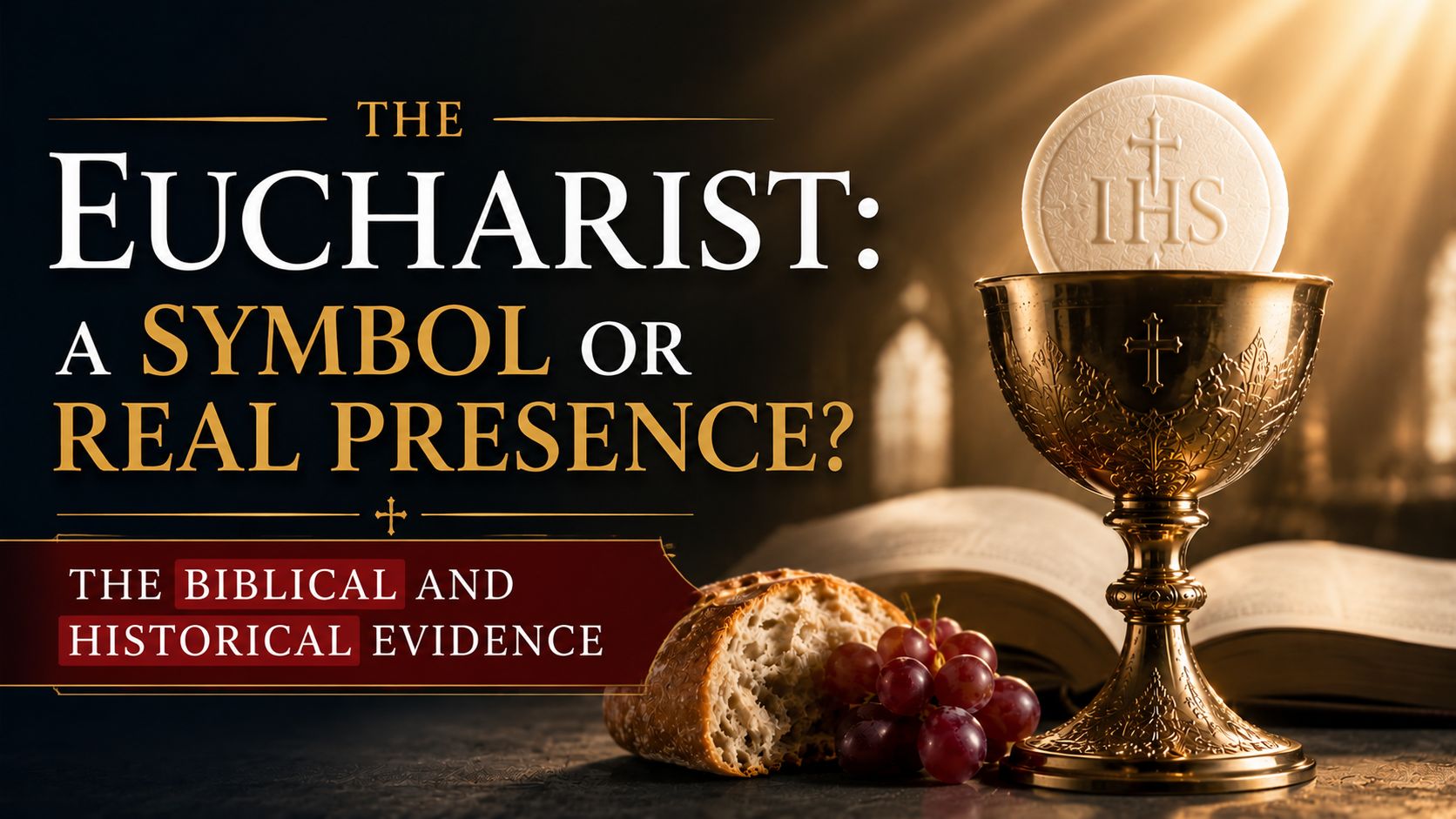
June 2, 2026: For nearly 2,000 years, Christians have gathered around a table to break bread and share the cup. Yet one question continues to divide believers across denominations: Is the Eucharist merely a symbol of Christ, or is Jesus truly present in it?


The answer shapes how Christians worship, pray, and understand their relationship with Christ. It is not a minor theological debate. At its heart lies a profound question: What did Jesus actually mean when He said, “This is my body”?
What Jesus Said at the Last Supper
On the night before His Passion, Jesus took bread, blessed it, and gave it to His disciples, saying: “Take, eat; this is my body.” (Matthew 26:26) He did not say, “This represents my body,” or “This symbolises my body.”

Likewise, taking the cup, He declared: “This is my blood of the covenant, which is poured out for many.” (Matthew 26:28) Throughout Scripture, Jesus often used parables and symbolic language. Yet when speaking about the Eucharist, His words are strikingly direct. The question is simple: Did the Apostles understand Him literally or symbolically?
John 6: The Turning Point
The strongest biblical evidence comes from John chapter 6. After miraculously feeding the five thousand, Jesus shocked His listeners by saying: “I am the living bread that came down from heaven; whoever eats this bread will live forever; and the bread that I will give for the life of the world is my flesh.” (John 6:51)
The crowd immediately understood the statement literally and objected: “How can this man give us his flesh to eat?” (John 6:52) If Jesus had intended only a symbol, this would have been the perfect moment to clarify His meaning. Instead, He intensified His teaching: “Unless you eat the flesh of the Son of Man and drink his blood, you have no life in you.” (John 6:53)
The Greek language becomes even stronger in the following verses. The verb used shifts toward a word meaning “to chew” or “to gnaw,” emphasising a real eating rather than a metaphorical one. The result was dramatic: “Many of his disciples turned back and no longer followed him.” (John 6:66)
This is one of the few instances in the Gospels where disciples abandon Jesus because of a teaching. Yet He does not call them back to explain that He meant only a symbol. Instead, He turns to the Twelve and asks: “Do you also wish to go away?” (John 6:67)
Peter responds with faith, not understanding: “Lord, to whom shall we go? You have the words of eternal life.” (John 6:68)
(CLICK HERE to follow Catholic Connect for regular Catholic News & Content)
St. Paul's Warning Makes Little Sense if It Is Only a Symbol
About twenty years after the Resurrection, St. Paul wrote to the Corinthians: “Whoever eats the bread or drinks the cup of the Lord unworthily will be guilty of profaning the body and blood of the Lord.” (1 Corinthians 11:27)
Paul goes even further: “Anyone who eats and drinks without discerning the body eats and drinks judgment upon himself.” (1 Corinthians 11:29) Think about this carefully. Would God strike believers with judgment merely for mishandling a symbol? Paul's warning only makes sense if the Eucharist truly contains the Body and Blood of Christ.
The Eucharist Foreshadowed in the Old Testament
The Eucharist was not an entirely new idea introduced at the Last Supper. Throughout the Old Testament, God prepared His people for this mystery. During the first Passover, the Israelites were commanded not only to sacrifice the lamb but also to eat it: “They shall eat the flesh that night” (Exodus 12:8). Centuries later, Jesus was revealed as the “Lamb of God, who takes away the sin of the world” (John 1:29). Likewise, when Israel wandered in the desert, God fed them with manna from heaven. Yet Jesus declared: “Your ancestors ate the manna in the wilderness, and they died... I am the living bread that came down from heaven; whoever eats of this bread will live forever” (John 6:49-51).
Other Old Testament references point in the same direction, including Melchizedek's offering of bread and wine (Genesis 14:18), the Bread of the Presence in the Temple (Leviticus 24:5-9), and Isaiah's prophecy of a heavenly banquet prepared by God (Isaiah 25:6). Together, they reveal a pattern woven throughout Scripture that finds its fulfillment in the Eucharist.
What Did the Earliest Christians Believe?
Some argue that belief in the Real Presence was a later Catholic invention. History tells a very different story. The earliest Christians—those taught by the Apostles and their immediate successors—consistently spoke of the Eucharist as truly being Christ's Body and Blood.
St. Ignatius of Antioch (c. AD 107): A disciple of the Apostle John and bishop of Antioch, Ignatius wrote: “They abstain from the Eucharist because they do not confess that the Eucharist is the flesh of our Savior Jesus Christ.” This statement was written decades before the New Testament canon was finalized.
St. Justin Martyr (c. AD 155): Justin explained Christian worship to the Roman Emperor: “We do not receive these as common bread and common drink; but... the food which has been made into the Eucharist is both the flesh and blood of that incarnated Jesus.”
St. Irenaeus of Lyons (c. AD 180): A disciple of Polycarp, who himself was a disciple of the Apostle John, Irenaeus taught: “The bread over which thanks have been given is the Body of the Lord.”
These are not isolated examples. Similar testimonies appear throughout the writings of the early Church. The historical evidence is overwhelming: **the earliest Christians believed in the Real Presence.**
So, When Did the Confusion Begin?
For the first thousand years of Christianity, belief in the Real Presence was virtually universal among Christians. The first significant challenge emerged in the eleventh century with Berengar of Tours, who questioned the traditional understanding of Christ's presence in the Eucharist. His views were rejected by the Church.
The larger shift occurred during the Protestant Reformation in the sixteenth century. Martin Luther maintained belief in Christ's real presence, although he rejected Catholic explanations regarding transubstantiation.
However, reformers such as Huldrych Zwingli argued that Communion was primarily a memorial meal and symbolic act of remembrance. From that point onward, many Protestant communities adopted varying interpretations, ranging from symbolic remembrance to spiritual presence. The debate that continues today largely traces back to these Reformation-era disagreements rather than to the beliefs of the earliest Christians.
The Logic of the Incarnation
At its deepest level, belief in the Real Presence flows naturally from belief in the Incarnation. Christianity is not a religion in which God remains distant.
God became flesh. He touched lepers. He healed with physical signs. He used water for Baptism. He breathed on the Apostles. He communicated grace through visible realities.
The Eucharist continues this pattern. The same Jesus who became visible in Bethlehem makes Himself sacramentally present on the altar. As the Catechism teaches, the Eucharist is not another sacrifice but the sacramental re-presentation of Christ's one sacrifice on Calvary.
More Than a Symbol
Symbols are important. They point beyond themselves to deeper realities. But Catholics believe the Eucharist does more than point to Christ. It is Christ. This conviction is rooted in Christ's own words, affirmed by the Apostles, defended by the early Church Fathers, and preserved through two millennia of Christian worship.
That is why Catholics kneel before the Eucharist. That is why saints spent hours in adoration before the Blessed Sacrament. And that is why the Church calls the Eucharist not merely a symbol, but the "source and summit" of the Christian life.
The question remains as relevant today as it was in the first century: Is the Eucharist truly the Body and Blood of Christ?
For the Apostles who heard Him, for the Church Fathers who defended the faith, for Christians throughout the first thousand years of Christianity, and for Catholics to this day, the answer has always been the same: Yes.
By Catholic Connect Reporter



© 2026 CATHOLIC CONNECT POWERED BY ATCONLINE LLP