- 23 September, 2026
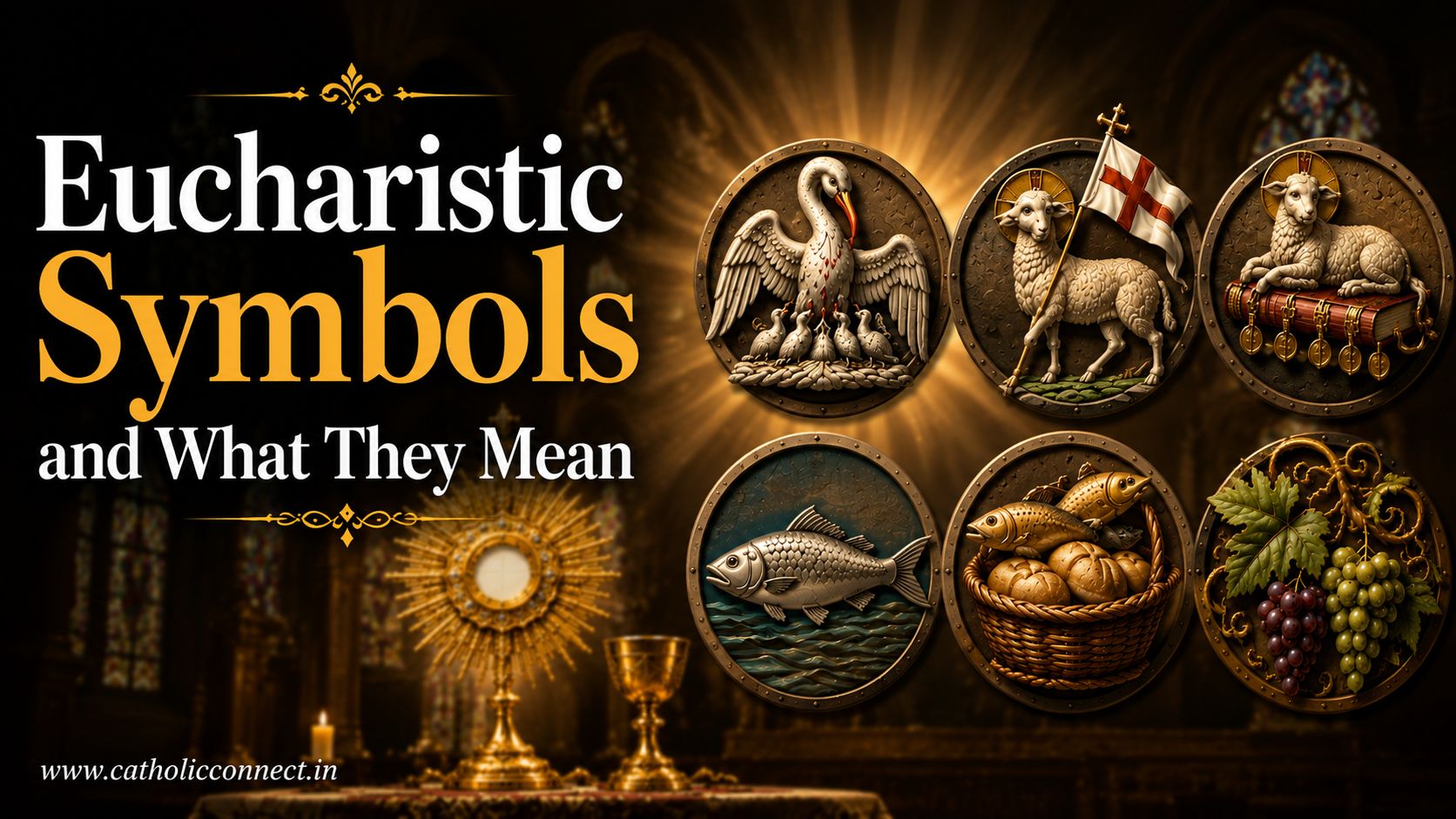
June 9, 2026: You may have seen them hundreds of times without ever noticing them. Hidden in stained-glass windows, altar carvings, tabernacles, and church decorations are symbols that reveal deep truths about the Eucharist. Some are obvious, while others are surprisingly mysterious. Here are 12 Eucharistic symbols that may change the way you look at your church.


1. The Pelican: The Bird That Feeds Its Young With Its Own Blood
One of the most unusual Eucharistic symbols found in older churches is the pelican.
According to a popular medieval legend, a mother pelican would pierce her own breast to feed her starving chicks with her blood. While the story is not scientifically accurate, Christians embraced the image as a powerful symbol of Christ, who nourishes believers with His own Body and Blood.

Look closely at tabernacles, altar carvings, and sacred vessels—you may be surprised to find a pelican hidden there.
2. The Paschal Lamb with Seven Seals
In some churches, particularly those with elaborate artwork, a lamb can be seen resting upon a book sealed with seven seals.
This image comes from the Book of Revelation and represents Christ, the victorious Lamb who was sacrificed yet lives forever. It reminds believers that every Mass unites earth with the heavenly worship described in Scripture.
3. The Monstrance: More Than a Beautiful Vessel
Many Catholics recognise a monstrance but may not realise the symbolism built into its design.
Often shaped like a radiant sun, the monstrance reflects Christ as the Light of the World. The rays extending outward signify that the presence of Jesus in the Eucharist reaches far beyond the church walls, illuminating the entire world.
(CLICK HERE to follow Catholic Connect for regular Catholic News & Content)
4. The Vine and Branches
Decorative vines twisting through church architecture are rarely there by accident.
They recall Jesus' words: "I am the vine; you are the branches." (John 15:5) The symbol speaks of believers remaining united to Christ while also pointing to the wine that becomes His Precious Blood during Mass.
5. The Fish
One of Christianity's oldest symbols, the fish often appears in church artwork and carvings.
The Greek word Ichthys formed an acronym for "Jesus Christ, Son of God, Saviour." It also recalls the multiplication of loaves and fishes, a miracle that foreshadowed the Eucharist by revealing Christ as the one who feeds His people.
6. The Lamb Carrying a Banner
Another lamb frequently found in churches is the Lamb of God carrying a cross-staff and banner. This image represents Christ's victory over sin and death. Every Eucharistic celebration makes present the sacrifice of the Lamb of God who takes away the sins of the world.
7. The Basket of Loaves
Baskets overflowing with bread appear in stained-glass windows, carvings, and mosaics in many churches. They recall the feeding of the five thousand and symbolise the abundance of God's grace. The image points forward to the Eucharist, where Christ continues to feed His people spiritually.
8. The Chalice
The chalice is among the most recognisable Eucharistic symbols, yet its significance runs deep. It recalls the cup used by Jesus at the Last Supper and represents the New Covenant sealed through His Blood. Artists often depict it alongside grapes or a host to emphasise its connection to the Eucharist.
9. The Host and the IHS Monogram
Look carefully around many sanctuaries and tabernacles and you may notice the letters "IHS." This ancient Christogram became closely associated with Eucharistic devotion. IHS comes from the first three letters of Jesus' name in Greek: ΙΗΣΟΥΣ (Iēsous) = Jesus. The first three letters are: ΙΗΣ (iota-eta-sigma)
When transliterated into the Latin alphabet, they became: IHS. Thus, IHS simply means "Jesus."
It serves as a reminder that the Eucharist is not merely a symbol of Jesus but Christ Himself truly present.
10. Grapes: A Reminder of the Precious Blood
Clusters of grapes frequently appear in church decoration, vestments, and sacred vessels. They symbolise the wine offered at Mass, which becomes the Blood of Christ. The image also recalls Christ's sacrifice, as grapes must be crushed before producing wine.
11. Wheat: The Bread of Life
Stalks of wheat are among the most common Eucharistic symbols found in churches. They represent the bread that becomes the Body of Christ and recall Jesus' declaration: "I am the bread of life." (John 6:35) Just as many grains are gathered into one loaf, the Eucharist unites believers into one Church.
12. The Sheaf of Wheat Bound Together
A related but distinct symbol is the bundle of wheat tied together. While individual stalks point to the Eucharistic bread, the bound sheaf highlights the unity of the faithful. Many grains become one bread; many believers become one body in Christ.
A Church That Speaks Without Words
Long before books were widely available, church art helped believers understand the mysteries of the faith. Every carving, mosaic, stained-glass window, and embroidered vestment was intended to teach as well as beautify.
The next time you enter a church, resist the temptation to glance only at the altar. Look at the details around you. Hidden among the stone, wood, glass, and gold may be a pelican, a vine, a cluster of grapes, or a lamb—quietly reminding you of the Eucharistic mystery at the heart of Catholic life.
By Catholic Connect Reporter


© 2026 CATHOLIC CONNECT POWERED BY ATCONLINE LLP