- 21 July, 2026

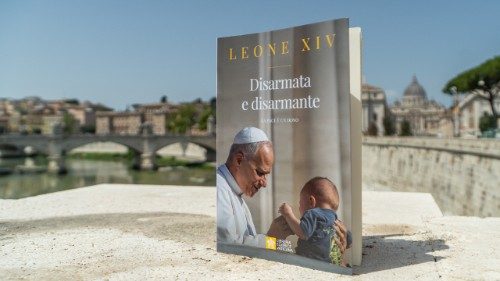
Vatican City, July 21, 2026: The Vatican Publishing House has released a new book by Pope Leo XIV titled Disarmed and Disarming: Peace Is a Gift. Edited by Alessandro Banfi, the volume compiles the Pope's speeches and reflections on peace delivered since his election on 8 May 2025. While the collection has been published in Italian, an English edition will be released soon. The book begins with a previously unpublished text written by Pope Leo XIV.


“Peace be with you” was the first greeting the Risen Jesus offered His apostles (Jn 20:19). Pope Leo XIV notes that the risen Christ first gave His friends, and the whole world, the gift of peace. Yet this gift did not come “cheap”, as Christ's glorified body still bore the wounds of the Passion. Having endured hatred, violence and the world's crucifixion, Jesus, "Disarmed and disarming", rose again. The Pope reflects that the message of the Gospel entered history then and continues to do so today, just as it did 2,000 years ago.
The Pope observes that while peace remains the deepest longing of many people, it is often endangered, violated and dismissed. He points out that around 103 States are currently involved in war in some form.[1] Conflicts continue in Ukraine, the Middle East, Sudan, Myanmar, Yemen, Congo and several other places. Recalling Pope Francis' description of today's situation as a “third world war fought piecemeal”, Pope Leo says he wishes to highlight several themes that emerge throughout the collection.


He writes that peace is first and foremost a responsibility. When people's immediate response to conflict, tension or offence is to judge, accuse or condemn others, indifference eventually gives way to hatred. Instead, he says, peace begins with each individual. Quoting Saint Augustine, he recalls: “‘The times are troubled, the times are hard, the times are wretched.’ Live good lives, and you will change the times by living good lives; you will change the times, and then you’ll have nothing to grumble about”.[2] The Pope stresses that people cannot expect world leaders to establish peace if they do not practise it in their own daily lives, within families, homes, cities and workplaces. According to him, peace is nurtured through simple everyday actions such as “the gift of a smile, an injury pardoned, a kind word.”
The Pope also says that peace must be rooted in truth. He notes that even those engaged in war often claim to be acting “in the name” of peace, since no one openly declares that they seek war simply for its own sake. He explains that every person naturally longs for justice and peace.
Referring to the devastation of Hiroshima and Nagasaki, Pope Leo recalls Saint John Paul II's warning that war has increasingly become an “adventure with no return”.[3] He also repeats Saint Paul VI's appeal to the United Nations Assembly, where the Pope declared that humanity is united by a covenant “with an oath that ought to change the future history of the world: never again war, never again war! It is peace, peace, that has to guide the destiny of the nations of all mankind”![4]
The Pope further argues that, particularly in the atomic age, truth demands the recognition that peace is secured not by nuclear weapons but by disarmament. He says that while this understanding appeared evident during earlier periods of nuclear de-escalation, it has since been overshadowed by a renewed global arms race that causes growing fear. Citing Bob Dylan's words addressed to the atomic bomb, he writes: “I hate you cause yer man-made and man-owned an’ man-handled”.[5]
He adds that the Church poses a humble but urgent question to humanity: "Must the human species continue to inhabit the Earth?" The combination of expanding cyber capabilities and worldwide rearmament, he says, makes this question increasingly pressing.
Pope Leo writes that peace also depends on the witness of individuals. He points to the examples included in the anthology, such as Blessed Floribert Bwana Chui and Servants of God Giorgio La Pira and Dorothy Day. According to the Pope, these figures represent countless men and women who promoted peace by resisting corruption, serving the poor and supporting diplomacy. Alongside these recognised figures, he says, peace is also lived out by “little-known protagonists” who faithfully follow their consciences.
He recalls the example of Soviet official Stanislav Petrov, whose decision helped avert a possible global nuclear conflict. On 26 September 1983, radar systems in a bunker near Moscow, where Petrov was on duty, indicated that several intercontinental ballistic missiles had been launched from the United States towards the Soviet Union. The warning, however, resulted from an error in the Soviet satellite detection system. Rather than report the supposed attack, Petrov chose to disregard protocol. Pope Leo notes that this decision, made according to conscience, may have prevented the deaths of millions of people. He warns that a world in which machines, however advanced and efficient, are left to decide whether to bomb defenceless people would be deeply alarming. The conscience of one individual, he says, can be worth the entire world.
Finally, Pope Leo states that peace requires hope. He says the Church will continue proclaiming charity towards all people and believes that the world today is searching for a message of peace for the future. He encourages people to look ahead with hope, finding in Jesus' message the only true source of peace. As he writes, the heart of Christ's teaching is that charity, love and self-sacrifice overcome death, isolation and violence: “I came that they may have life, and have it abundantly” (Jn 10:10).
To those tempted to lose hope because of the many wars taking place around the world, Pope Leo repeats Pope Pius XI's invitation to the Church: “Let us thank God that He makes us live among the present problems. It is no longer permitted to anyone to be mediocre”.
The Pope concludes with a prayer that God may lead humanity along the paths of non-violence. He encourages believers and all people of good will to remain committed to building peace and urges every person to make peace the mission of his or her life.
Courtesy: Vatican News
© 2026 CATHOLIC CONNECT POWERED BY ATCONLINE LLP