- 23 September, 2026

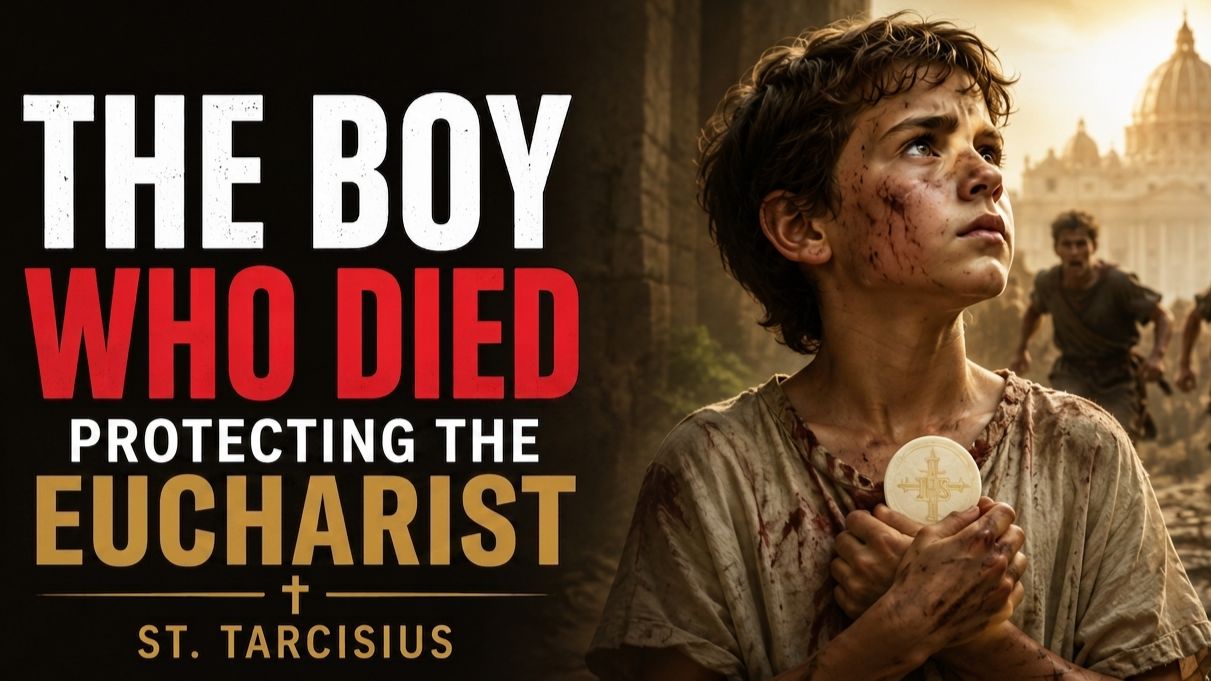
June 18, 2026: What would you be willing to die for at the age of twelve?


For most children, that question seems unimaginable. Yet nearly 1,800 years ago, a young Christian boy in Rome chose to give up his life rather than surrender what he believed was the greatest treasure on earth—the Holy Eucharist.
His name was St. Tarcisius, and though little is known about him with certainty, his witness has inspired generations of Catholics to deepen their reverence for Holy Communion.

A Dangerous Time for Christians
Tarcisius lived during the third century when Christians in the Roman Empire faced periodic persecution. Gathering for Mass was often dangerous, and many believers were imprisoned for their faith.
According to ancient tradition, Christians would secretly bring Holy Communion to those who were unable to attend the Eucharistic celebration, including prisoners awaiting execution. On one such occasion, Tarcisius volunteered to carry the Blessed Sacrament to imprisoned Christians.
Entrusted with this sacred mission, he concealed the Eucharist close to his heart and set out through the streets of Rome.
The Attack
As he made his way through the city, a group of boys noticed that Tarcisius was carrying something and demanded to see it. When he refused, determined to protect the sacred Host, they became aggressive.
The account preserved by Christian tradition states that the crowd attacked him, beating him severely. Despite the violence, Tarcisius refused to hand over the Eucharist or reveal what he was carrying.
Some versions of the story recount that a Roman soldier who was secretly sympathetic to Christians came to his aid and carried him away. By then, however, the injuries were fatal.
Tarcisius died from the attack, having remained faithful to his mission until the very end.
(CLICK HERE to follow Catholic Connect for regular News and Content)
A Martyr of the Eucharist
The earliest historical evidence about Tarcisius comes from an inscription composed by Pope Damasus I in the fourth century. The Pope compared the young martyr to St. Stephen, the Church's first martyr, praising him for choosing death rather than allowing the sacred mysteries to be profaned.
While some details of the story have been handed down through tradition, the Church has long honoured Tarcisius as a martyr who gave his life out of love and reverence for the Eucharist.
His tomb became a place of veneration in the Catacombs of St. Callixtus in Rome, and his feast is celebrated on August 15.
Why His Story Still Matters
The world in which Catholics live today is very different from that of ancient Rome. Most believers do not face death for carrying Holy Communion. Yet the witness of St. Tarcisius raises a question that remains relevant: How much do we value the Eucharist?
For many Catholics, Holy Communion can become routine. Tarcisius reminds the faithful that the Eucharist is not merely a symbol or a religious custom but the real presence of Christ, a gift worth protecting and cherishing. His courage challenges Catholics to approach Mass with greater reverence, prepare carefully to receive Communion, and recognise the extraordinary gift placed in their hands.
A Witness Beyond His Years
St. Tarcisius never preached a sermon, wrote a book, or led a movement. He was simply a young boy entrusted with a sacred responsibility.
Yet his final act of faith has echoed through the centuries. In choosing to protect the Eucharist at the cost of his own life, he became one of the Church's most powerful witnesses to the value of Holy Communion. His story continues to remind all of us that true faith is measured not by words alone, but by what one is willing to sacrifice for Christ.
By Catholic Connect Reporter
Read More on the Eucharist:
The Eucharist: A Symbol or Real Presence? The Biblical and Historical Evidence
The Most Sacred Moment of the Mass—Explained
Eucharistic Miracles That Science Couldn’t Ignore: The Mysteries of Lanciano and Buenos Aires
Eucharistic Miracles That Science Couldn’t Ignore Part 2: The Mysteries of Mexico and Poland
12 Eucharistic Symbols and What They Mean
More Than a Ritual: How the Eucharist Changed the Lives of Saints




© 2026 CATHOLIC CONNECT POWERED BY ATCONLINE LLP