- 23 September, 2026

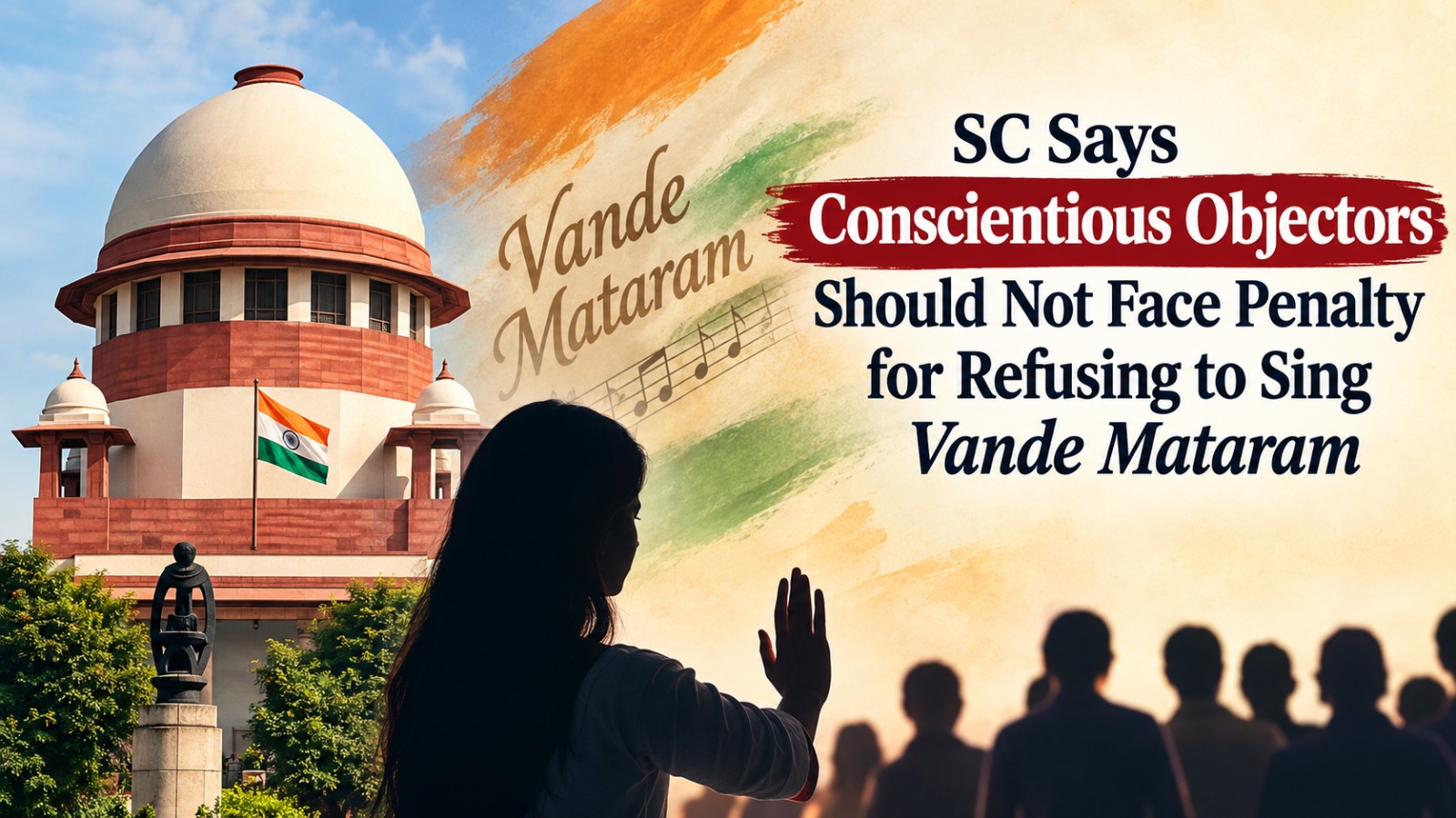
NEW DELHI, September 23, 2026: The Supreme Court has indicated that people who, on grounds of conscience or religious belief, choose not to sing Vande Mataram should not face criminal penalties, while asking the Centre to respond to a challenge against the recently amended law governing the national song.


A bench headed by Chief Justice Surya Kant, comprising Justices Joymalya Bagchi and V. Mohana, was hearing a petition filed by Carnatic vocalist T.M. Krishna challenging provisions that require the singing of all six stanzas of Vande Mataram and extend penal protection under the Prevention of Insults to National Honour Act, 1971.
The court directed the Centre to respond within two weeks. It indicated that the principle laid down in the Supreme Court's Bijoe Emmanuel v. State of Kerala judgment should apply to the amended provisions.

Court to examine penal consequences
Justice Bagchi said the court would not examine the government's decision to recognise Vande Mataram as the national song, but would consider whether refusal to sing could attract criminal consequences.
The bench observed that the court could not dictate the country's national aspirations, which were matters for the State. At the same time, it indicated that a person should not face penal action for declining to sing on grounds protected by fundamental rights, including religious freedom under Articles 25 and 26 of the Constitution.
The court referred specifically to the 1987 Bijoe Emmanuel ruling, in which it held that children belonging to the Jehovah's Witnesses faith could not be compelled to sing the national anthem when doing so conflicted with their religious beliefs. The judgment held that standing respectfully during the anthem was sufficient.
Challenge to six-stanza requirement
Krishna's petition challenges Section 3 of the Prevention of Insults to National Honour Act, as amended in 2026, as well as Union Home Ministry orders issued on January 28 and July 9.
The amended provision provides for imprisonment of up to three years, a fine, or both for intentionally preventing the singing of the national anthem or national song, or causing disturbance to an assembly engaged in such singing.
Krishna has argued that the last four stanzas of Vande Mataram contain references to Hindu deities and that making their rendition compulsory is inconsistent with India's secular constitutional framework. His petition also questions the extension of the penal law to the national song and the legal basis for defining the complete six-stanza version as the official rendition.
Senior advocate S. Muralidhar, appearing for Krishna, told the court that his principal concern was the possibility of penal action against those who refuse to sing. He also questioned the absence of a statutory definition of “national song” in the amended law and the use of Home Ministry directions to prescribe the rendition.
Centre opposes challenge
Solicitor General Tushar Mehta, appearing for the Centre, opposed the petitioner's submissions and defended Parliament's authority to legislate on the matter. During the hearing, an exchange took place after Mehta referred to “Naxalites” while arguing against objections to the law. Muralidhar objected to the remark and sought its withdrawal. The bench later indicated that it was not taking note of the exchange.
The Supreme Court's observations came at the preliminary stage of the proceedings and do not constitute a final ruling on the constitutional validity of the amended law.
The case will return after the Centre files its response, with the court expected to examine specifically whether penal consequences for refusing to sing Vande Mataram are compatible with constitutional protections of freedom of conscience and religion.
News Credit: The Telegraph Online




© 2026 CATHOLIC CONNECT POWERED BY ATCONLINE LLP