- 05 July, 2026
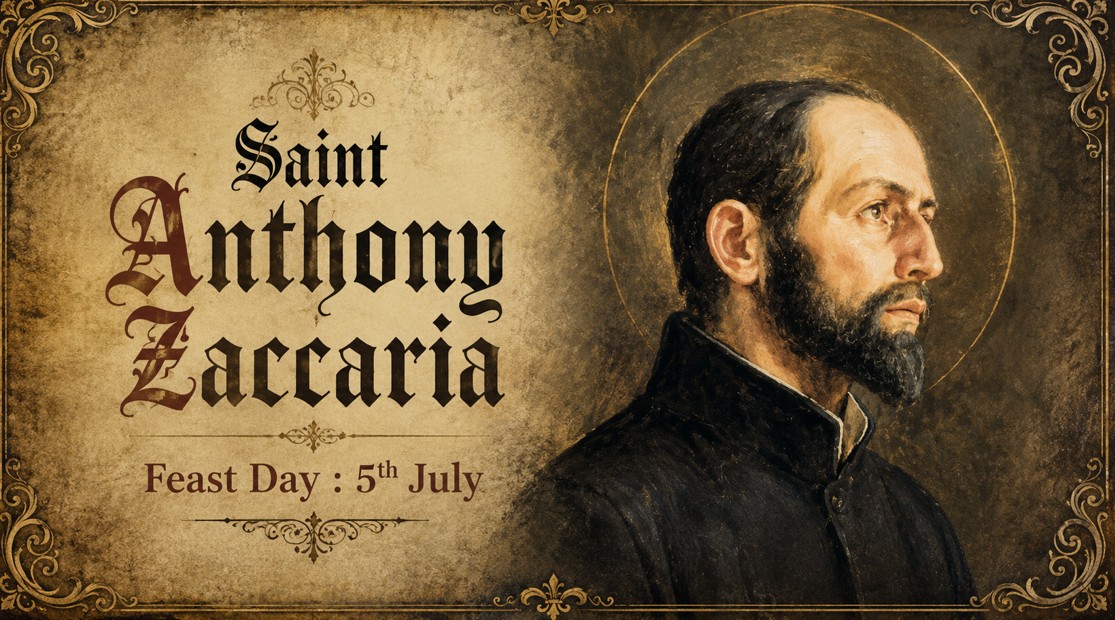
Italy, July 5, 2026: Why is Saint Anthony Maria Zaccaria remembered as one of the pioneers of Catholic renewal? Discover the remarkable story of the Italian physician who left behind a successful medical career to become a priest, founded the Barnabites, promoted Eucharistic devotion, and inspired countless Christians to seek holiness through a deeper love for Christ.


Feast Day: 5 July
Born: 1502, Cremona, Duchy of Milan (modern-day Italy)
Died: 5 July 1539, Cremona, Italy
Canonized: 27 May 1897 by Pope Leo XIII


Patron of: Physicians, the Barnabite Fathers, and Catholic reform movements
Known For: Founding the Barnabites, promoting Eucharistic devotion, encouraging the Forty Hours Devotion, and leading spiritual renewal in the Church
Title: Founder of the Barnabites
Few saints illustrate the harmony between faith and service as beautifully as Saint Anthony Maria Zaccaria.
Gifted with intelligence and compassion, Anthony first devoted his life to medicine. Yet as he cared for the sick, he came to realise that while physicians could heal the body, only Christ could heal the soul.
Following God's call, he became a priest and dedicated his life to renewing the Church through preaching, charity, and devotion to the Holy Eucharist.
Although he lived for only thirty-six years, his spiritual legacy continues to inspire Catholics throughout the world.
(CLICK HERE to follow Catholic Connect for regular News and Content)
Anthony Maria Zaccaria was born in 1502 in the northern Italian city of Cremona.
His father died shortly after his birth, and he was raised by his deeply faithful mother, Antonia Pescaroli.
She ensured that her son received an excellent education while teaching him the importance of prayer, generosity, and compassion for the poor.
From an early age, Anthony displayed remarkable intelligence and a sincere desire to serve others.
As a young man, Anthony studied medicine at the University of Padua, one of Europe's leading centres of learning.
After earning his medical degree, he practised as a physician and became respected for his knowledge and dedication to his patients.
However, his encounters with suffering gradually awakened a deeper calling.
He realised that many people needed not only physical healing but also spiritual guidance and hope.
After prayer and careful discernment, Anthony decided to leave medicine and dedicate himself entirely to God.
Anthony pursued theological studies and was ordained a priest around 1528.
His medical training had taught him compassion, but his priesthood allowed him to minister to people's deepest spiritual needs.
He devoted himself to preaching, celebrating the sacraments, caring for the poor, and encouraging Catholics to live authentic Christian lives.
His sermons were known for their clarity, passion, and practical guidance.
Recognising the need for spiritual renewal within the Church, Anthony founded the Clerics Regular of Saint Paul in 1530.
The congregation later became popularly known as the Barnabites, after the Church of Saint Barnabas in Milan where they carried out much of their ministry.
The Barnabites dedicated themselves to:
Anthony also helped establish the Angelic Sisters of Saint Paul, creating opportunities for women to participate actively in the Church's mission through prayer and apostolic service.
These religious communities became important contributors to the Catholic renewal that unfolded during the sixteenth century.
Saint Anthony Maria Zaccaria believed that the Eucharist was the source of Christian strength.
At a time when many Catholics received Holy Communion only rarely, he encouraged frequent reception of the Eucharist and deeper reverence for Christ's Real Presence.
He taught that spending time before the Blessed Sacrament transformed hearts and strengthened believers to live holy lives.
His Eucharistic spirituality remains one of his greatest contributions to the Church.
Among Anthony's lasting achievements was his encouragement of the Forty Hours Devotion, a prolonged period of Eucharistic adoration before the Blessed Sacrament.
This devotion invited Catholics to spend time in prayer, repentance, and reflection in the presence of Christ.
Over the centuries, the practice spread throughout the Catholic world and continues in many churches today.
Despite becoming a respected preacher and founder, Anthony remained remarkably humble.
He cared for the sick, comforted the poor, visited hospitals, and served anyone who needed assistance.
He believed that Christian holiness could never be separated from love for one's neighbour.
His life reflected Christ's compassion for the suffering and forgotten.
Years of constant preaching, travel, and ministry weakened Anthony's health.
Recognising that his earthly mission was nearing its end, he returned to his hometown of Cremona.
There, surrounded by his family and fellow priests, he peacefully died on 5 July 1539.
Although his ministry lasted little more than a decade, his influence continued to grow through the religious communities he founded.
Devotion to Anthony Maria Zaccaria spread steadily after his death.
The Church formally recognised his holiness when Pope Leo XIII canonized him on 27 May 1897.
Today, the Barnabite Fathers serve throughout Europe, Asia, Africa, and the Americas, continuing his mission of spreading the good word, education, and pastoral care.
His writings and example continue to inspire priests, religious, and lay faithful alike.
Anthony understood that genuine reform begins with personal conversion.
Rather than condemning the failures of his age, he encouraged Christians to grow closer to Christ through prayer, Scripture, the Eucharist, and acts of charity.
His life reminds believers that lasting renewal begins in the heart.
The life of Saint Anthony Maria Zaccaria teaches valuable lessons:
His witness encourages Catholics to become instruments of renewal in their families, parishes, and communities.
Nearly five centuries after his death, Saint Anthony Maria Zaccaria remains one of the Church's great reformers.
He was a physician who became a priest, a founder who inspired religious renewal, and a servant whose love for Christ transformed countless lives.
From Renaissance Italy to Catholic communities around the world, his legacy continues to remind believers that holiness is built through faithful service, deep prayer, and unwavering devotion to the Eucharist.
His life proclaims a timeless truth:
When hearts are renewed by Christ, the Church itself is renewed, and the light of the Gospel shines more brightly in the world.
To know about more saints please visit the spiritual section.
By Catholic Connect Reporter
Saint Anthony Maria Zaccaria, Saint Anthony Maria Zaccaria feast day, Barnabites, Clerics Regular of Saint Paul, Forty Hours Devotion, Eucharistic adoration, Catholic reform saints, Italian saints, physician saints, Catholic founders, July saints, Saint Anthony Maria Zaccaria biography, Barnabite Fathers, Catholic spirituality
© 2026 CATHOLIC CONNECT POWERED BY ATCONLINE LLP