- 15 December, 2025
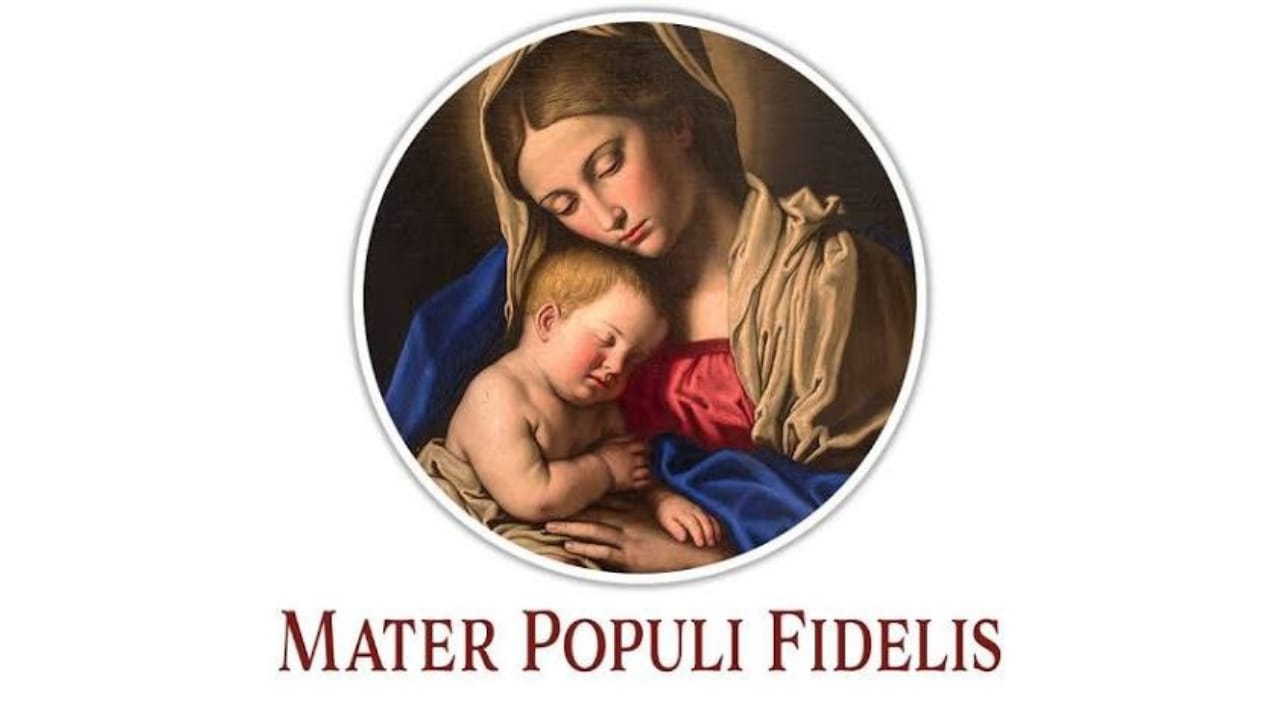
Vatican City, December 15, 2025 : Mater Populi Fidelis – Mother of the Faithful People of God is a new Decree published on 4 November 2025, the Memorial of Saint Charles Borromeo. It was approved by Pope Leo XIV on 7 October 2025, the Feast of Our Lady of the Rosary, and formally signed in Rome by Cardinal Víctor Manuel Fernández, Prefect of the Dicastery for the Doctrine of the Faith, together with Monsignor Armando Matteo, Secretary of its Doctrinal Section.

Hence, this article is based on the teachings and doctrinal clarifications presented in this Decree. Its purpose is to provide a clear and accessible understanding of the role of Mary as Mother and helper in God’s plan of salvation. Several of her traditional titles are explained in a way that preserves genuine Marian devotion while upholding the central Christian truth that Jesus Christ alone is the Redeemer and Mediator.
1. Biblical Foundations: Mary in God’s Plan of Salvation
Scripture portrays Mary as model and companion for all believers: in the Annunciation, she receives the Word of God with faith (cf. Lk 1:38), by which she enables the Incarnation; at Cana, her intercession on behalf of the newlyweds leads them to Christ’s saving act (cf. Jn 2:3–5); at the Cross, Jesus entrusts her to the beloved disciple and through him, to all believers (cf. Jn 19:27). The life of Mary demonstrates that her collaboration with God’s plan is active, faithful, and fully Christ-centered.





2. Mary and the Title of “Co-Redemptrix”
Historically, the title Co-Redemptrix came about in the fifteenth century to emphasize Mary’s role at the Cross, based on the earlier title of Redemptrix, which focused on her motherhood of the Redeemer. The Church has therefore explained that the collaboration of Mary in the redemptive work of Christ is always subordinate to Him, never adding to or competing with His unique sacrifice.
St. John Paul II acknowledged Mary’s involvement in offering our sufferings joined to Christ, especially on the Cross (General Audience at St. Peter’s Square, April 9, 1997). Pope Francis, in a homily on the feast of Our Lady of Guadalupe on 12 December 2019, underscored that Mary never sought to appropriate her Son’s work; she is a disciple, not a Co-Saviour. Christ alone is the Redeemer. This statement is deeply rooted in scripture: Jesus is “the stone you builders rejected, which has become the cornerstone. Salvation is found in no one else, for there is no other name under heaven given to mankind by which we must be saved.” (cf. Acts 4:11-12).
Thus, the decree expresses that the Co-Redemptrix title, if used, must be understood in a carefully subordinate and Christocentric sense, underlining the fidelity and maternal cooperation of Mary, rather than to indicate equality with the unique redemptive power of Christ.
3. Mary as Mediatrix
The concept of mediation has its roots in the Eastern Fathers and later in Western theology. While Christ is the one true Mediator (1 Tim 2:5–6), Mary exercises a subordinate, maternal mediation: she cooperates in God’s plan by interceding and assisting the faithful, always pointing them toward Christ. Her mediation is also manifest at the Annunciation, as she herself cooperated most prominently in bringing the Son of God into the world: “when the fullness of time had come, God sent forth his Son” (Gal 4:4), through the obedience of the Virgin: “Behold, I am the handmaid of the Lord; let it be to me according to your word” (Lk 1:38). At Cana, she presents the needs of others to Christ, urging obedience to His word (Jn 2:3–5).
The Second Vatican Council expressed preference for terms like “maternal intercession” or “cooperation” in describing her participation, terms which ensure that her role never obscures Christ’s unique mediation. Maternal intercession: “(…) By her maternal charity, she cares for the brethren of her Son (…) Therefore, the Blessed Virgin is invoked in the Church under the titles of Advocate, Auxiliatrix, Adjutrix, and Mediatrix.” (Lumen Gentium, n. 62) Cooperation: explicitly describes Mary as “a mother to us in the order of grace” and explains her cooperation in the work of salvation. (Lumen Gentium, n. 61) Subordinate mediation: “The maternal role of Mary (…) in no way obscures or diminishes the unique mediation of Christ.” (Lumen Gentium, n. 60)
4. Mary in the Unique Mediation of Christ
Mary’s participation in salvation expresses the general truth acknowledged by the Second Vatican Council that, though Christ’s mediation is unique and universal, He Himself entrusts His disciples with the capability to co-operate in His saving work. Thus, the Scripture affirms: “For we are God’s co-workers; you are God’s field, God’s building” (1 Cor 3:9). Among these cooperators, how special is the place of Mary, Mother of the Church. As the Council teaches, through a special maternal role in the order of grace, Mary continues, even in heaven, to intercede with her Son for believers so that they may obtain the gift of salvation. Her cooperation is an obedience, an intercession, and a maternal charity, all of which are exercised in full dependence on Christ's redeeming work. Mary’s collaboration, therefore, is an example for every disciple; we, too, are called to cooperate in the work of Christ, not by our powers, but by His mercy and glory.
5. Pastoral Reflection
Devotion to Mary as Mater Populi Fidelis encourages the faithful to look upon her as a spiritual mother, a model of prayer, and an example of discipleship. She calls us to Christ, strengthens our faith, and nurtures the Church in charity and unity. The decree explains that while such titles as Co-Redemptrix or Mediatrix can be pastorally used, they must never obscure in any way Christ’s singular role as Redeemer and Mediator. Mary’s maternal intercession brings comfort, hope, and encouragement to live faithfully, especially in times of suffering and trial. Her guidance keeps Christ at the centre of all prayer, devotion, and service.
Conclusion: Mater Populi Fidelis deepens our understanding of Mary’s maternal and cooperative role in Christ’s work. While Christ alone is Redeemer and Mediator, Mary’s faithful participation shows how God can take human obedience, love, and prayer and put them to the service of His plan of salvation. Personally, I look upon this decree as a pastoral and theological invitation: to draw near to Mary, learn from her fidelity, and to let her maternal guidance lead us ever closer to her Son. Mary, Mother of the Faithful People of God, nourishes the Church in grace, intercedes on behalf of all believers, and models for everyone the authentic discipleship in Christ our Lord.
From
Fr. Vivek Lionel
Commission for Theology & Doctrine
Archdiocese of Bangalore

© 2025 CATHOLIC CONNECT POWERED BY ATCONLINE LLP