- 06 July, 2026

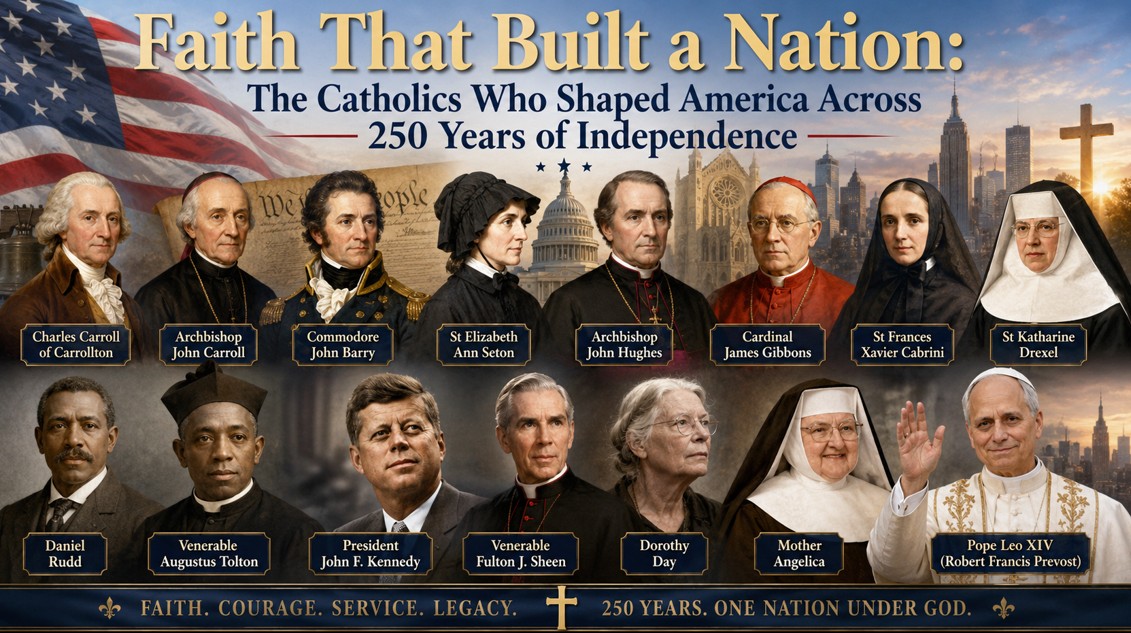
USA, July 6, 2026: As the United States marked 250 years of independence, it is fitting to remember the Catholic men and women whose faith, courage and public service helped shape the nation. Although Catholics were once a small and often mistrusted minority, they played a remarkable role in building America's political institutions, schools, hospitals, military, charitable organisations and social movements.


From the only Catholic signer of the Declaration of Independence to the election of the first American-born Pope, the Catholic story is deeply woven into the history of the United States. Here is how five generations of Catholics helped transform the nation.
The story begins with Charles Carroll of Carrollton, the only Catholic to sign the Declaration of Independence in 1776. At a time when anti-Catholic prejudice was widespread, Carroll proved that deep Catholic faith and patriotism could coexist. He later helped ratify the Constitution and served as one of Maryland's first U.S. senators.


Charles Carroll cousin, Archbishop John Carroll, became the first Catholic bishop in the United States in 1789. More than a church leader, he laid the institutional foundations of American Catholicism by organising dioceses, promoting religious freedom and founding Georgetown University, the country's oldest Catholic university.
(CLICK HERE to follow Catholic Connect for regular News and Content)
Another towering figure was Commodore John Barry, the Irish-born naval commander widely recognised as the "Father of the American Navy". His leadership during the Revolutionary War helped establish America's naval tradition.
The era also witnessed the extraordinary work of St. Elizabeth Ann Seton, America's first native-born saint. After converting to Catholicism, she founded the Sisters of Charity and established the first Catholic schools that would eventually grow into one of the world's largest faith-based education systems.
As waves of Catholic immigrants arrived from Ireland and Europe, the Church became a pillar of education, healthcare and community life.
Archbishop John Hughes, known as "Dagger John", fiercely defended Catholics during periods of anti-Catholic violence while expanding schools and churches throughout New York. His leadership demonstrated that Catholics could confidently participate in American public life.
During the same period, Cardinal James Gibbons emerged as one of the nation's most respected Catholic leaders. He promoted dialogue between Catholics and Protestants, defended workers' rights and helped integrate Catholics into mainstream American society.
Catholic institutions flourished during these decades, establishing schools, hospitals and charities that served millions regardless of religious background. These foundations would become essential parts of America's social fabric.
The late nineteenth and early twentieth centuries saw Catholic leaders dedicate themselves to immigrants, minorities and the disadvantaged.
St. Frances Xavier Cabrini, the first U.S. citizen to be canonised, established dozens of schools, orphanages and hospitals across America. Her work transformed the lives of thousands of Italian immigrants struggling to build new lives.
Another remarkable figure was St. Katharine Drexel, who gave away her vast family fortune to establish schools and missions for Native American and African American communities. Her commitment to racial justice was decades ahead of its time.
Daniel Rudd, born into slavery, founded the American Catholic Tribune, becoming one of the first major Black American Catholic journalists. He championed racial equality within both the Church and American society.
Meanwhile, Venerable Augustus Tolton, recognised as the first publicly acknowledged Black American Catholic priest in the United States, overcame racial discrimination to become a symbol of perseverance and hope.
The twentieth century brought Catholics into the highest levels of American politics, media and public life.
No figure symbolises this more than President John F. Kennedy, elected in 1960 as America's first Catholic president. His election marked a historic turning point, proving that religious prejudice need not prevent Catholics from serving at the nation's highest office.
At the same time, Venerable Fulton J. Sheen revolutionised religious communication through radio and television. His Emmy Award-winning programme Life Is Worth Living attracted millions of viewers and made Catholic teaching accessible to audiences of every background.
Another influential Catholic voice was Dorothy Day, co-founder of the Catholic Worker Movement. Through houses of hospitality, newspapers and charitable outreach, she inspired generations to place the Gospel at the centre of social justice and care for the poor.
These leaders demonstrated that Catholic influence extended beyond churches into politics, media, education and public debate.
The past fifty years have witnessed American Catholics making an even broader impact on both the nation and the global Church.
Mother Angelica transformed Catholic media by founding the Eternal Word Television Network (EWTN), now one of the world's largest religious broadcasting networks, bringing Catholic programming to millions across the globe.
American Catholics have also continued leading charitable organisations, universities, healthcare systems and humanitarian initiatives while contributing significantly to public service, science, business and education.
The most historic milestone came in 2025, when Pope Leo XIV, born Robert Francis Prevost in Chicago, became the first American-born pope in history. His election represented not only a moment of pride for American Catholics but also recognition of the maturity and global influence of the Church in the United States.
As America celebrates its 250th anniversary, the election of an American pope symbolises how far Catholics have travelled—from a small, often marginalised minority at the nation's founding to leaders shaping both the United States and the universal Church.
The Catholic contribution to America cannot be measured solely through famous names. Millions of priests, religious sisters, teachers, healthcare workers, immigrants and lay faithful quietly built schools, hospitals, universities, charities and communities that strengthened the nation for generations.
Their legacy reminds Americans that faith has never stood apart from the country's development. Instead, Catholic values of service, compassion, education and human dignity have helped shape the American story for 250 years—and continue to influence its future.
As the United States enters its next chapter, the lives of these Catholic pioneers remain a testament to how faith, perseverance and public service can help build a stronger and more compassionate nation.
By Catholic Connect Reporter
© 2026 CATHOLIC CONNECT POWERED BY ATCONLINE LLP