- 04 September, 2026
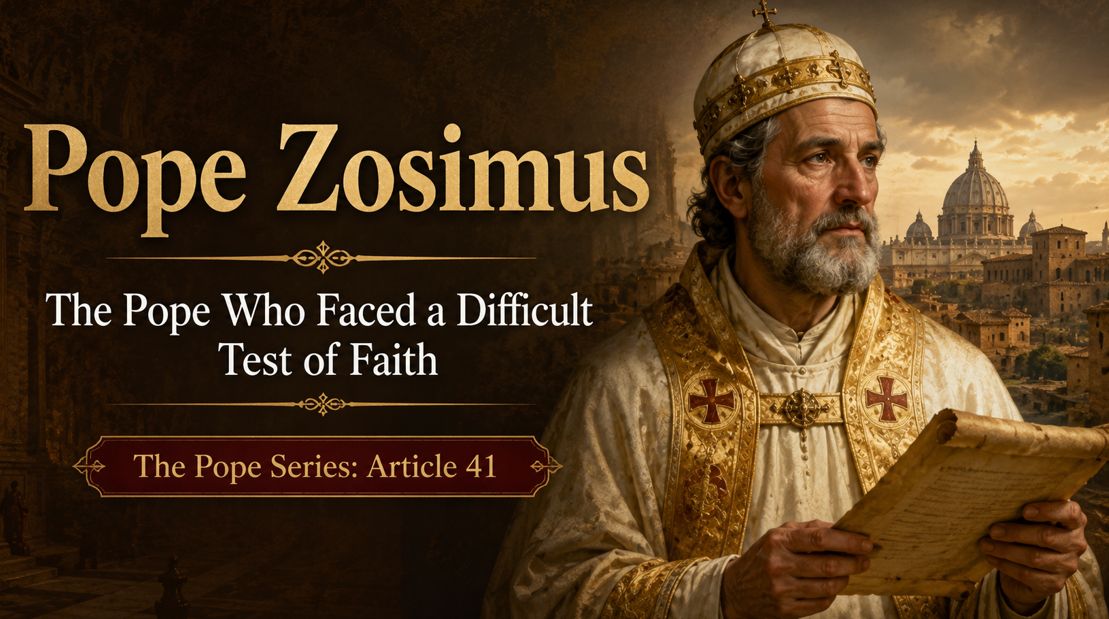
September 4, 2026: Pope Zosimus, the forty-first successor of St Peter, led the Catholic Church from 417 to 418 AD. His pontificate was brief, lasting less than two years, but it was marked by significant theological controversy and difficult questions about authority, justice and Church unity.


Zosimus is particularly remembered for his involvement in the Pelagian controversy, one of the most important theological debates of the early Church. His initial response to the controversy was later revised, and he eventually issued a strong condemnation of Pelagianism. His pontificate therefore offers a powerful reminder that Church leadership can involve difficult decisions, careful discernment and the humility to reconsider an earlier judgement.
A short papacy does not always mean an insignificant one.


Pope Zosimus inherited the leadership of the Church at a time when theological disputes were affecting Christian communities across the Roman world.
Questions concerning human freedom, sin and God's grace had become the centre of intense debate.
His response to these issues would make his brief pontificate one of the most discussed of the fifth century.
(CLICK HERE to follow Catholic Connect and to stay updated with Catholic News & Content)
Very little is known about Zosimus' life before his election as Bishop of Rome. He was of Greek origin, according to ancient records, and tradition identifies his father as a man named Abram.
The lack of detailed information about his early life reflects a common challenge in writing about many early popes. What is clear is that Zosimus had become a respected member of the Church before being chosen to lead the Christian community of Rome.
Zosimus was elected Bishop of Rome following the death of Pope Innocent I in March 417 AD.
His election came during a period of major political instability. The Western Roman Empire was weakening, and Rome itself had recently experienced the devastating Visigothic sack of 410 AD.
At the same time, the Church was becoming increasingly organised and influential. The Bishop of Rome was expected to address theological disputes arising in distant Christian communities.
Zosimus served during a changing and uncertain period.
The Church was no longer fighting primarily for survival. Its challenge was now to preserve unity and clarity of belief across an expanding Christian world.
The most important issue of Zosimus' pontificate was the controversy surrounding Pelagius and Caelestius.
Pelagian teaching placed strong emphasis on human free will and was criticised for weakening the Christian understanding of original sin and the necessity of God's grace.
Initially, Zosimus gave Pelagius and Caelestius an opportunity to defend themselves. Their professions of faith appeared to him to require further examination, and he questioned whether the accusations against them had been sufficiently established.
However, following further discussions with African bishops and the decisions of Church councils, Zosimus accepted the seriousness of the controversy.
In 418 AD, he issued the Epistola Tractoria, formally condemning Pelagianism and reaffirming the Church's teaching on grace and original sin.
This decision became his most significant contribution to the defence of Catholic doctrine.
Zosimus also dealt with questions concerning the authority of bishops and the relationship between Rome and other regions of the Church.
His interventions in disputes in Gaul and North Africa demonstrate how the Bishop of Rome was increasingly involved in matters affecting Christian communities beyond Italy.
Zosimus' pontificate reveals a leader who was willing to examine evidence before reaching a final judgement.
His approach was not without criticism, particularly because his initial handling of the Pelagian controversy caused confusion among some bishops.
Yet his eventual decision to condemn Pelagianism demonstrates another important quality: the willingness to correct a course when further evidence and reflection demanded it.
His leadership reflects:
The Pelagian controversy remains the greatest challenge associated with Zosimus.
His initial willingness to reconsider the cases of Pelagius and Caelestius created tension with the African bishops, including those influenced by the theological work of St. Augustine of Hippo.
Zosimus also faced disputes concerning the authority of the Church in Gaul and North Africa.
These controversies demonstrate the difficulties faced by a pope attempting to maintain unity among Christian communities spread across a vast and increasingly unstable Roman world.
Zosimus is remembered especially for his final defence of the Church's teaching on grace: Human beings are called to holiness, but they depend upon the grace of God.
Pope Zosimus is honoured as a saint.
Despite the controversies of his short pontificate, he is remembered within the Church as one of the early successors of St. Peter who defended Christian teaching during a difficult theological debate.
Why does Pope Zosimus matter today?
For the Church, his life demonstrates the importance of careful discernment when responding to theological controversies.
For leaders, his pontificate shows that responsible leadership requires the humility to listen, investigate and reconsider decisions when necessary.
For believers, his story reminds us that human effort alone is not enough; Christians depend ultimately upon the grace of God.
Pope Zosimus died in Rome in 418 AD after a short but eventful pontificate. His legacy continues through the structured life of the Church today, carried forward by his successors.
To know more about the previous Popes, click here
By Catholic Connect Reporter
Pope Zosimus, Pope Zosimus biography, Pope Zosimus 417–418, Saint Zosimus, Pope Zosimus and Pelagianism, Pelagian controversy, Pope Zosimus history, Epistola Tractoria, Pope Zosimus and St Augustine, 41st Pope, early Catholic popes, Catholic Church history, ancient popes, history of the papacy, Pope Zosimus feast day




© 2026 CATHOLIC CONNECT POWERED BY ATCONLINE LLP