- 25 August, 2026
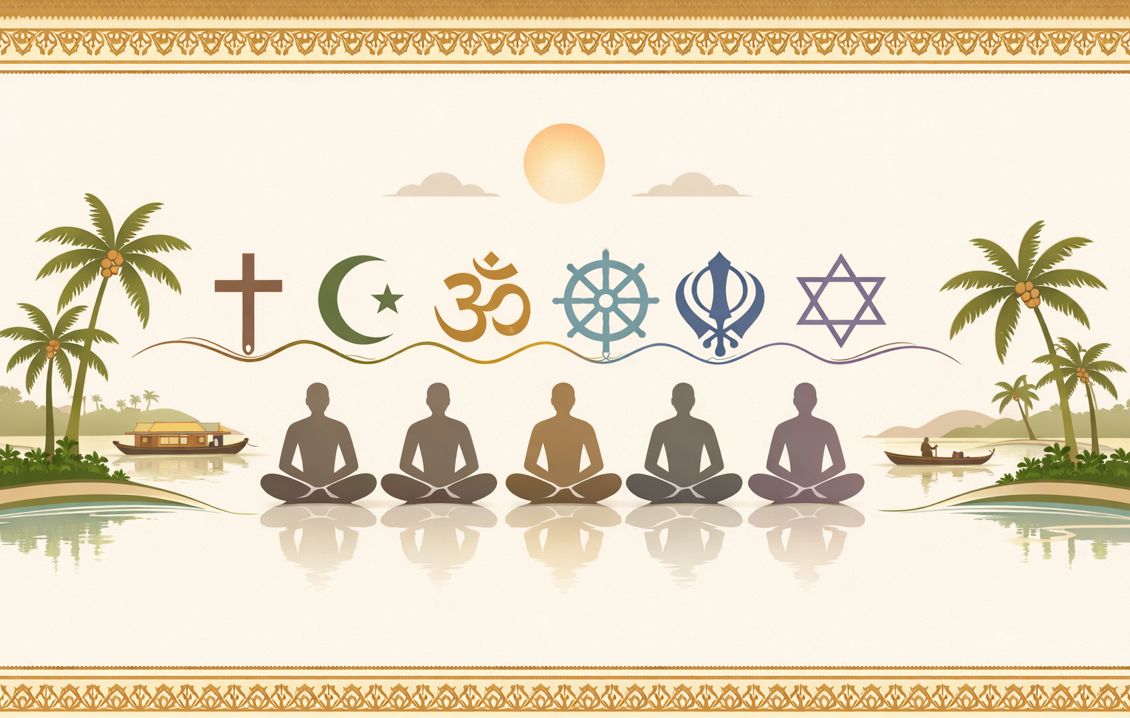
Kerala, August 25, 2026: In a world where religion is often associated with conflict and division, Kerala offers a strikingly different story — one shaped by coexistence, trade, hospitality, and mutual respect over more than two thousand years.


A Land Where Faiths Found a Home
Along Kerala’s historic Malabar Coast, ancient Hindu temples stand beside some of India’s oldest churches, mosques, and synagogues. Within a small region near Kochi and Kodungallur, one can trace the arrival of Hinduism’s ancient traditions, Christianity through St. Thomas, Islam through Arab traders, and Judaism through early Jewish settlers.
Few places on earth embody “unity in diversity” as naturally as Kerala.


Long before secularism became a modern political ideal, Kerala was quietly practicing it.
History and the Ancient Trade Routes
Kerala’s story as a global meeting point began with one precious commodity — pepper. Known as “black gold,” Kerala’s spices attracted merchants from Rome, Arabia, Persia, Africa, and the Mediterranean world.
The ancient port of Muziris, believed to have existed near present-day Kodungallur and Pattanam, became one of the busiest trading centres of the ancient world nearly 2,000 years ago. Ships carrying gold, silk, wine, and precious stones arrived on Kerala’s shores and returned loaded with spices from its fertile lands.
But traders did not simply visit — many settled permanently. Arabs, Jews, Persians, Romans, and later Europeans made Kerala their home, turning the region into a vibrant crossroads of civilizations.
Unlike many regions where religions spread through conquest or political domination, Kerala’s diversity grew through ports, marketplaces, and human relationships.
Ancient Temples of Hinduism
At the heart of Kerala’s story stood its deeply rooted Hindu civilisation. Long before other faiths arrived, Kerala was home to thriving temples, Sanskrit learning, classical arts, and rich spiritual traditions.
Ancient temples such as the Vadakkunnathan Temple in Thrissur and the Sree Padmanabhaswamy Temple in Thiruvananthapuram became centres of culture, philosophy, music, and community life.
What makes Kerala remarkable is that Hindu rulers and local communities often welcomed incoming faiths rather than resisting them. Christians, Muslims, and Jews were granted land, trading rights, and freedom to worship.
This spirit of openness laid the foundation for Kerala’s unique culture of coexistence.
The First Church in India
According to long-standing Christian tradition, Saint Thomas the Apostle arrived on the Malabar Coast and began spreading Christianity in Kerala.
The oldest church in India is widely believed to be St. Thomas Syro-Malabar Church, established in 52 CE by him.
This means Christianity in India predates European colonialism by many centuries.
It also flourished peacefully under Hindu rulers, who allowed Christians to worship freely and participate in public life.
Kerala thus became one of the world’s earliest examples of enduring religious coexistence.
The First Mosque in India
Islam also arrived in Kerala through peace and trade rather than conquest.
The Cheraman Juma Mosque in Kodungallur, traditionally dated to 629 CE, is widely regarded as India’s oldest mosque. According to local tradition, Cheraman Perumal, a Chera king, encountered Arab traders, learned about Islam, and embraced the faith before sending companions back to Kerala.
Even today, the mosque reflects Kerala’s cultural blending. Its sloping roofs, wooden interiors, and oil lamps resemble traditional Kerala architecture more than Middle Eastern styles — a beautiful symbol of harmony between local culture and global faith.
The First Synagogue and the Jewish Legacy
Kerala is also home to one of India’s oldest Jewish communities.
Jewish traditions trace their arrival to the Malabar Coast to the period following the destruction of the Second Temple in Jerusalem in 70 CE. Over time, Jewish communities settled in Kodungallur and Kochi, eventually building the famous Paradesi Synagogue in 1568.
Perhaps the most remarkable part of Kerala’s Jewish history is that Jews lived here for centuries without suffering the large-scale anti-Semitic persecution seen elsewhere in the world. They were welcomed, protected, and allowed to preserve their traditions peacefully.
Onam: Kerala’s Greatest Celebration of Unity
Nothing reflects Kerala’s secular and inclusive culture more beautifully than Onam, the state’s biggest festival.
Although Onam is rooted in Hindu customs— celebrating the return of the beloved King Mahabali — it has evolved into a cultural festival embraced by people of all religions across Kerala. Hindus, Christians, and Muslims participate together in the celebrations, transcending religious boundaries in a uniquely Malayali expression of unity.
Families across the state create colourful floral carpets known as Pookalam, enjoy the grand vegetarian feast called Onasadya, and take part in music, dance, games, and cultural events.
What makes Onam special is that it is celebrated less as a strictly religious occasion and more as a shared cultural identity of Kerala. It marks the harvest season and the Malayalam New Year while bringing together communities from every background.
While many festivals in India are celebrated across communities, the scale of participation in Onam by all sections of society is one of Kerala’s most distinctive features.
Recognized officially as Kerala’s state festival, Onam stands as a living symbol of harmony, inclusiveness, and shared heritage.
A Lesson for the Modern World
Today, as much of the world struggles with religious polarization and intolerance, Kerala offers a powerful lesson: unity does not require uniformity.
The temples, churches, mosques, synagogues, and shared festivals of Kerala remind us that civilizations can grow stronger through coexistence rather than conflict.
In Kerala, religions did not merely arrive. They found a home.
Courtesy Live History India

© 2026 CATHOLIC CONNECT POWERED BY ATCONLINE LLP