
- 10 August, 2026

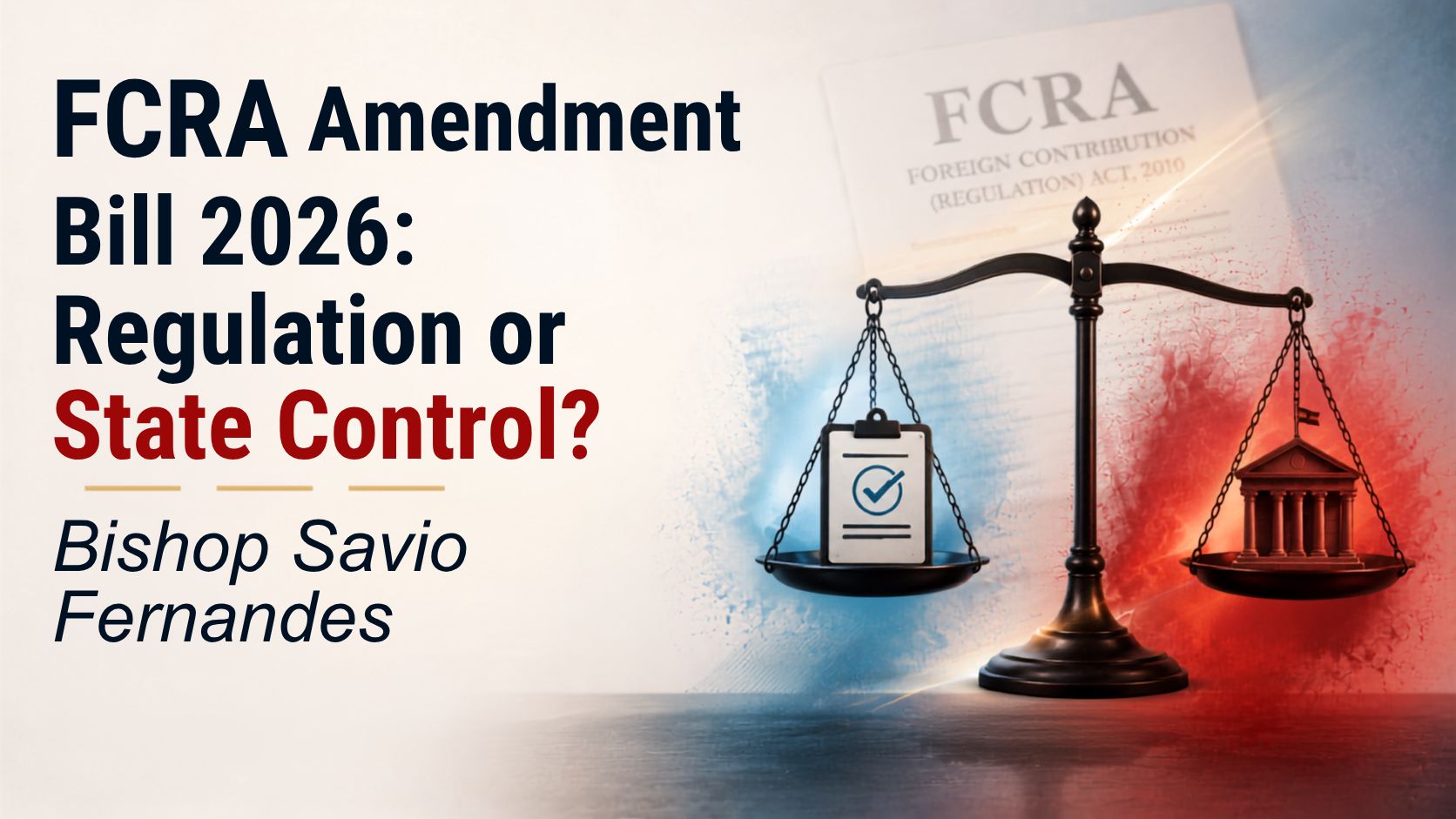
August 10, 2026: The Foreign Contribution (Regulation) Act, 2010 (FCRA) was enacted to regulate the acceptance and utilisation of foreign contributions and to safeguard national interest. Few would dispute the legitimacy of that objective. Yet the Foreign Contribution (Regulation) Amendment Bill, 2026, together with the stringent regulatory changes introduced through the amended FCRA Rules, raises a fundamental question: is this about regulation – or about control and takeover?


For decades, charitable and faith-based institutions across India have made a substantial contribution to nation-building. Their work has complemented the State’s efforts to address social challenges. Through schools, colleges, hospitals, social-service programmes, poverty alleviation, community development and humanitarian assistance, these institutions have often served communities that public institutions have found difficult to reach. Foreign contributions have, in many instances, enabled organisations to supplement these efforts.
The relevant legal question, therefore, should not be whether an institution receives foreign contribution, but whether its activities and finances comply with the law and whether there is credible evidence of conduct prejudicial to the statutory objectives of the FCRA or the national interest. Regulation must rest on demonstrable violations and prescribed legal standards, rather than on a generalised presumption of distrust towards civil society.


The most alarming feature of the proposed 2026 Amendment Bill is its treatment of foreign-funded assets when an organisation’s FCRA registration is cancelled, surrendered or ceases through non-renewal. The proposed framework contemplates the appointment of a Designated Authority and provides for the custody, management and, in specified circumstances, eventual disposal or transfer of foreign contributions and assets acquired from such contributions. This represents an extraordinary concentration of power.
The practical consequences could be profound. The State could, in effect, assume control over schools, hospitals, buildings and other infrastructure created wholly or partly with foreign contributions. Even where an organisation’s domestic activities continue, the loss of FCRA status could place its assets and institutional functioning at serious risk. Such sweeping powers therefore require the strongest safeguards against arbitrariness, misuse and disproportionate interference with institutional autonomy.
This concern is particularly significant for religious and charitable institutions whose constitutional and legal rights to establish and administer institutions cannot simply be disregarded. Those rights are, of course, subject to reasonable regulation and applicable law; they do not create immunity from financial or regulatory scrutiny. But regulation must remain proportionate to its legitimate purpose. It should not become a mechanism for extinguishing institutional autonomy except where the law, supported by compelling facts and due process, clearly warrants such action.
Another important development in 2026 Bill concerns the objects or purposes for which an organisation may obtain and retain FCRA registration. Under the amended Rules, an applicant must identify the particular purpose or purposes for which registration is sought from a prescribed Schedule and specify the States or Union Territories in which the proposed activities will be undertaken. The Schedule broadly covers religious, cultural, economic, educational and social activities. Existing organisations must also intimate the purposes and geographical areas for which they seek to retain registration.
This change deserves careful consideration. A charitable institution may have an integrated mission encompassing education, healthcare, relief of poverty, community development and humanitarian assistance. Under the new framework, however, foreign-funded activities must correspond to the purposes specifically approved under the FCRA regime and be undertaken within the geographical areas specified in the registration. Changes to those purposes or geographical areas may require further governmental approval.
Such requirements should not be administered so rigidly that legitimate charitable organisations lose the flexibility to respond to genuine and unforeseen social needs. A school, hospital or social-service organisation does not operate within neat administrative compartments. Its mission may require an integrated response to poverty, education, health and human dignity. A broad charitable mission should not be reduced to a narrowly licensed activity.
The Rules introduce other stringent requirements. The definition of “key functionary” has been widened to include directors, partners, trustees, members of governing or controlling bodies and others responsible for management. The 2026 framework also increases compliance burdens through expanded disclosure requirements, scrutiny of key functionaries, reporting obligations and conditions relating to the utilisation of foreign contributions. Such measures may be justified where they enhance transparency and accountability. But the cumulative effect must also be considered. Compliance should strengthen responsible governance, not become so onerous or uncertain that it effectively discourages legitimate civil-society activity.
Equally important is procedural fairness. The growing perception that FCRA renewal has become opaque and impersonal cannot simply be dismissed. Where an application for registration or renewal is rejected, an organisation should be able to understand the material reasons for the decision and have a meaningful opportunity, within the statutory framework, to respond to adverse findings. Administrative power cannot be divorced from the principles of natural justice, reasoned decision-making and non-arbitrariness.
Foreign contributions are already subject to multiple layers of scrutiny, including designated banking channels, statutory audits, reporting requirements and governmental oversight. Where violations occur, enforcement is necessary. But isolated or technical compliance failures should ordinarily invite proportionate corrective measures rather than consequences that threaten the existence, assets or autonomy of an institution. The severity of the response should correspond to the nature and seriousness of the violation.
Moreover, funds received under FCRA often represent the sacrifice and generosity of individuals and organisations across the world who seek to support marginalised communities in India. Such contributions facilitate essential social and developmental work that complements the efforts of the State and reinforce global solidarity in addressing poverty and inequality.
At a broader level, the Bill reflects a worrying trend towards centralising authority without adequate consultation with stakeholders. The question is whether the regulatory framework remains a means of ensuring transparency, accountability and national interest, or becomes an instrument through which the State exercises excessive control over institutions that have served society for decades.
Democratic governance requires consultation, transparency and accountability. Laws affecting thousands of charitable, educational, religious and social institutions should be shaped through meaningful engagement with those who will be governed by them. Civil society should not be treated as an adversary merely because it operates independently of government. In many areas, these organisations are partners in nation-building, particularly in reaching the poor, vulnerable and marginalised.
National interest and institutional autonomy are not inherently competing values. Both can be protected through clear standards, due process, independent review and proportionate enforcement. A government that seeks accountability from civil society must itself remain accountable in the exercise of its regulatory powers.
The proposed FCRA Amendment Bill, 2026 therefore deserves careful reconsideration, particularly its provisions concerning the vesting and eventual disposal of assets. The new Rules also warrant review to ensure that purpose-specific and geographical restrictions do not unnecessarily constrain legitimate charitable activity. In its present form, the Foreign Contribution (Regulation) Amendment Bill, 2026 is not acceptable and must be withdrawn.
The objective should be to prevent misuse of foreign contributions — not to undermine the institutions that use them to serve society and build a stronger, more compassionate India.
Bishop Savio Fernandes
Auxiliary Bishop, Archdiocese of Bombay


© 2026 CATHOLIC CONNECT POWERED BY ATCONLINE LLP