- 06 August, 2026

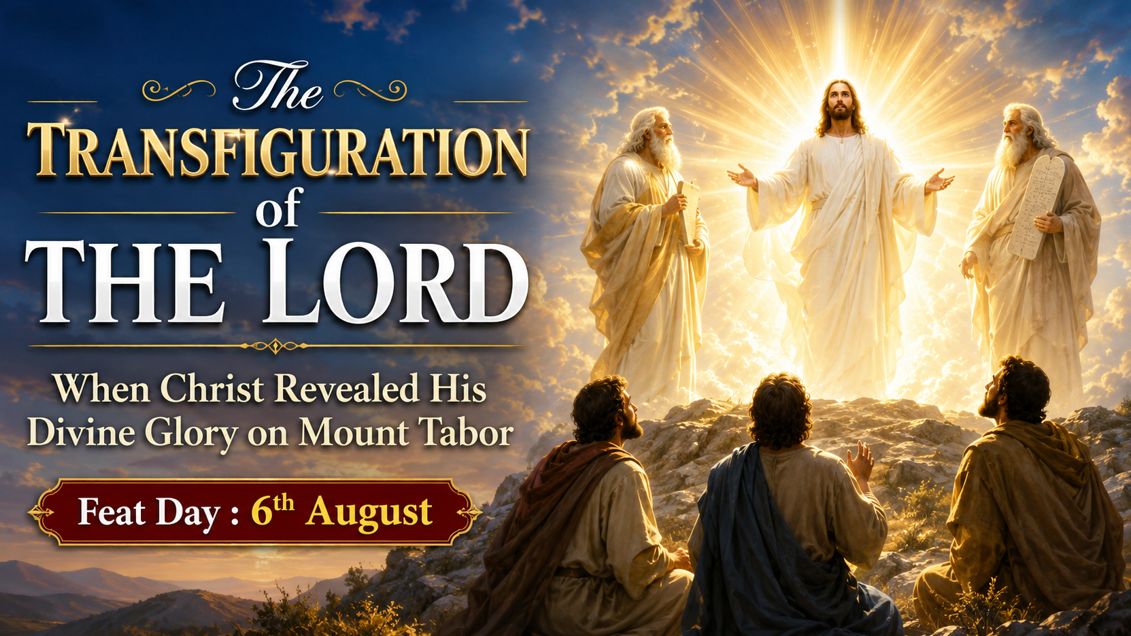
August 6, 2026: Why does the Church celebrate the Feast of the Transfiguration of the Lord? Discover the extraordinary Gospel event in which Jesus revealed His divine glory before Peter, James, and John, strengthening their faith before His Passion and offering Christians a glimpse of the glory of the Resurrection.


Feast Day: 6 August
Biblical References: Matthew 17:1–8, Mark 9:2–8, Luke 9:28–36
Location: Traditionally identified as Mount Tabor, Israel
Celebrated By: Catholic Church, Orthodox Church, and many Christian denominations


Known For: The revelation of Christ's divine glory, the appearance of Moses and Elijah, and the Father's voice from heaven
Spiritual Theme: God's glory, transformation, hope, and preparation for the Cross
Among the most extraordinary events recorded in the Gospels, the Transfiguration of the Lord stands as a powerful revelation of Jesus' divine identity. For a brief moment atop a mountain, Christ allowed three of His closest disciples to witness the glory that had always belonged to Him as the Son of God.
The dazzling vision transformed the faith of Peter, James, and John and prepared them for the suffering they would soon witness during Christ's Passion. Today, the Feast of the Transfiguration reminds Christians that beyond every cross lies the promise of resurrection and eternal glory.
(CLICK HERE to follow Catholic Connect and to stay updated with Catholic News & Content)
About a week after foretelling His Passion and teaching His disciples about taking up the cross, Jesus took Peter, James, and John up a high mountain to pray.
Christian tradition has long identified this mountain as Mount Tabor in the Holy Land, although some scholars suggest Mount Hermon. Regardless of the exact location, the mountain became a sacred place where heaven touched earth.
As Jesus prayed, something extraordinary happened.
The Gospel tells us that Jesus was transfigured before His disciples.
His face shone like the sun, and His garments became dazzling white—brighter than any earthly light could produce. The divine glory that had been hidden beneath His humanity became visible for a brief moment.
The disciples stood in awe as they witnessed the majesty of the One they had chosen to follow.
The Transfiguration revealed that Jesus was not merely a great teacher or prophet but the eternal Son of God.
As the disciples watched, two towering figures from Israel's history appeared beside Jesus.
Moses, the great lawgiver, represented the Law, while Elijah, the greatest of the prophets, represented the Prophets. Together they testified that Jesus was the fulfillment of everything God had promised throughout the Old Testament.
According to St. Luke's Gospel, they spoke with Jesus about His "departure"—His coming Passion, Death, Resurrection, and Ascension that would bring salvation to the world.
The appearance of Moses and Elijah demonstrated that the entire history of salvation pointed toward Christ.
Overwhelmed by the beauty of the vision, Peter exclaimed: "Lord, it is good that we are here."
Wanting the experience to continue, he proposed building three tents—one for Jesus, one for Moses, and one for Elijah.
Peter did not yet fully understand the meaning of the event. He wished to remain in the glory of the mountain, unaware that Jesus would soon descend toward Jerusalem to embrace the Cross.
The Transfiguration teaches that Christians are called not to remain on the mountaintop but to carry the light of Christ into everyday life.
As Peter was still speaking, a bright cloud overshadowed them.
Throughout Scripture, the cloud symbolizes God's presence. From within it came the voice of the Father: "This is my beloved Son, with whom I am well pleased; listen to Him."
The disciples fell face down in fear.
Then Jesus approached, touched them gently, and said: "Rise, and do not be afraid."
When they looked up, they saw only Jesus.
The Father's command—"Listen to Him"—remains one of the central messages of the Christian faith.
The Transfiguration was not merely a spectacular miracle.
It was God's way of strengthening the disciples before the sorrow of Calvary. Only weeks later, these same apostles would witness Jesus arrested, mocked, scourged, and crucified.
By allowing them to see His divine glory beforehand, Jesus gave them hope that His suffering would not be the end of the story.
The Cross would lead to the Resurrection.
The Transfiguration has been celebrated in the Eastern Church since the early centuries of Christianity.
In the Western Church, devotion spread gradually before Pope Callixtus III extended the feast to the universal Church in 1457. He did so in thanksgiving after the Christian victory at the Siege of Belgrade on August 6, a triumph attributed to God's providence.
Today, the feast is celebrated by Catholics, Orthodox Christians, and many other Christian communities around the world.
Churches dedicated to the Transfiguration stand on every continent, reminding believers of Christ's divine majesty.
The Feast of the Transfiguration offers profound lessons for every Christian.
It reminds believers that Christ is both fully human and fully divine. It encourages perseverance during suffering by revealing the glory that follows faithful endurance.
The feast also points toward the transformation promised to every believer. Through God's grace, Christians are called to become ever more like Christ, allowing His light to shine through their lives.
Just as the apostles were changed by their encounter with Jesus on the mountain, every disciple is invited to be transformed through prayer, Scripture, and the sacraments.
The Transfiguration speaks powerfully to modern Christians.
Life often includes suffering, uncertainty, and moments of darkness. Yet the feast reminds us that God never abandons His people. Even when the Cross seems overwhelming, Christ's glory remains certain.
The Father's words continue to echo today: "Listen to Him."
In a noisy world filled with competing voices, the Transfiguration calls believers to place Christ at the center of their lives and trust His guidance.
More than two thousand years later, the Transfiguration remains one of the Church's greatest celebrations of hope.
It reveals Jesus as the beloved Son of God, confirms the fulfillment of the Law and the Prophets, and offers a glimpse of the heavenly glory awaiting those who remain faithful.
From the heights of Mount Tabor to churches across the world, the Feast of the Transfiguration continues to inspire Christians to look beyond present struggles and fix their eyes on the eternal light of Christ.
For every believer, the Transfiguration is a reminder that God's glory is stronger than suffering, His promises are certain, and those who follow Christ will one day share in His everlasting kingdom.
To know about more saints please visit the spiritual section.
By Catholic Connect Reporter
Transfiguration of the Lord, Feast of the Transfiguration, August 6 feast day, Mount Tabor, Jesus transfigured, Peter James John, Moses and Elijah, Voice of the Father, Catholic feast days, Gospel of the Transfiguration, Christ's divine glory, Christian holy days, Catholic Connect
© 2026 CATHOLIC CONNECT POWERED BY ATCONLINE LLP