- 08 August, 2026

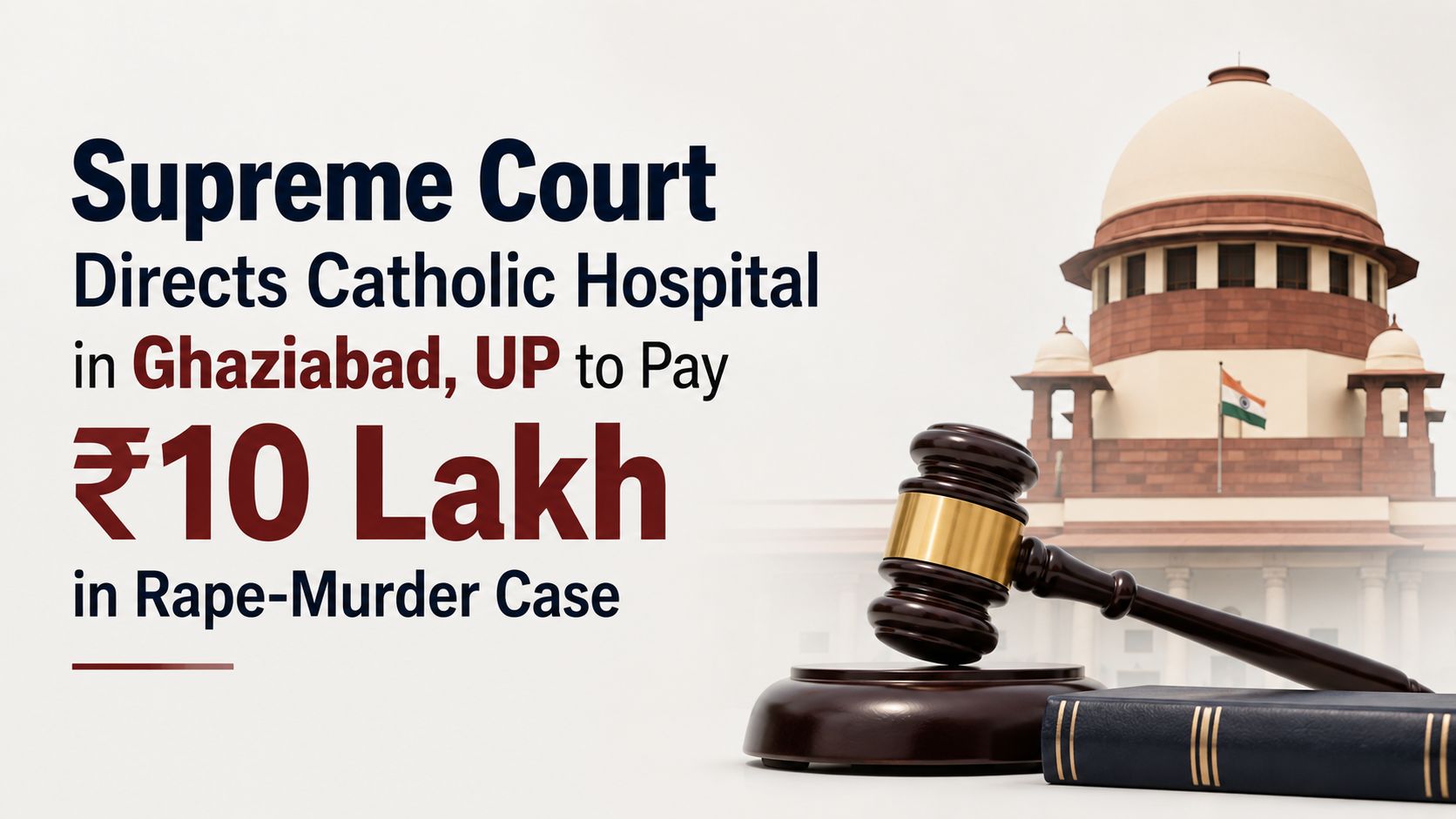
New Delhi, August 8, 2026: The Supreme Court has directed a Catholic hospital in Ghaziabad in Uttar Pradesh to pay ₹10 lakh to the family of a four-year-old girl who died after being allegedly denied timely medical treatment following sexual assault.


The direction concerning St. Joseph (Mariam Nagar) Hospital came during a hearing before a bench headed by Chief Justice of India Surya Kant and comprising Justices Joymalya Bagchi and V. Mohana.
The court also directed another private hospital, Khajan Singh Mannvi Health Care, to pay ₹2 lakh to the bereaved family. Both hospitals agreed to make the payments voluntarily, and the court ordered that the amounts be deposited through demand drafts within four weeks.


The child was allegedly sexually assaulted and seriously injured in Ghaziabad's Nandgram area on March 16. Her family reportedly approached two private hospitals seeking emergency medical assistance but subsequently took her to a government hospital, where she was declared dead.
The Supreme Court had earlier ordered a Special Investigation Team to examine the circumstances surrounding the child's death, including allegations that private hospitals failed to provide timely treatment.
The case has drawn particular attention to St Joseph (Mariam Nagar) Hospital because of its Catholic identity and its association with the Church's tradition of healthcare and service to vulnerable people.
However, the hospital has disputed the allegation that it refused treatment. According to its representatives, the child was brought to the hospital in a critical condition and her attendants left before medical examination and treatment could be completed.
The Supreme Court's intervention has highlighted the responsibility of healthcare institutions to respond promptly to victims of sexual violence and other medical emergencies. The court has also indicated that it may frame guidelines concerning timely medical care and the handling of sexual-assault cases.
For the Catholic community, the case carries a particular pastoral significance. Catholic healthcare institutions in India have traditionally sought to place the dignity of the human person, especially the poor and vulnerable, at the heart of their mission. The death of a child following a traumatic assault therefore raises serious questions about how such institutions respond to people in situations of extreme vulnerability.
At the same time, the hospital's position that it did not refuse treatment remains part of the record and is important in presenting the matter fairly while the broader legal process continues.
The Supreme Court's action has renewed attention on the need for hospitals to ensure that victims of sexual violence receive immediate and compassionate care, irrespective of their circumstances.
The case also serves as a reminder of the Church's responsibility to ensure that its institutions remain places where the suffering, dignity and rights of the most vulnerable are protected with particular care.
By Catholic Connect Reporter
Compiled from various sources



© 2026 CATHOLIC CONNECT POWERED BY ATCONLINE LLP