- 08 August, 2026

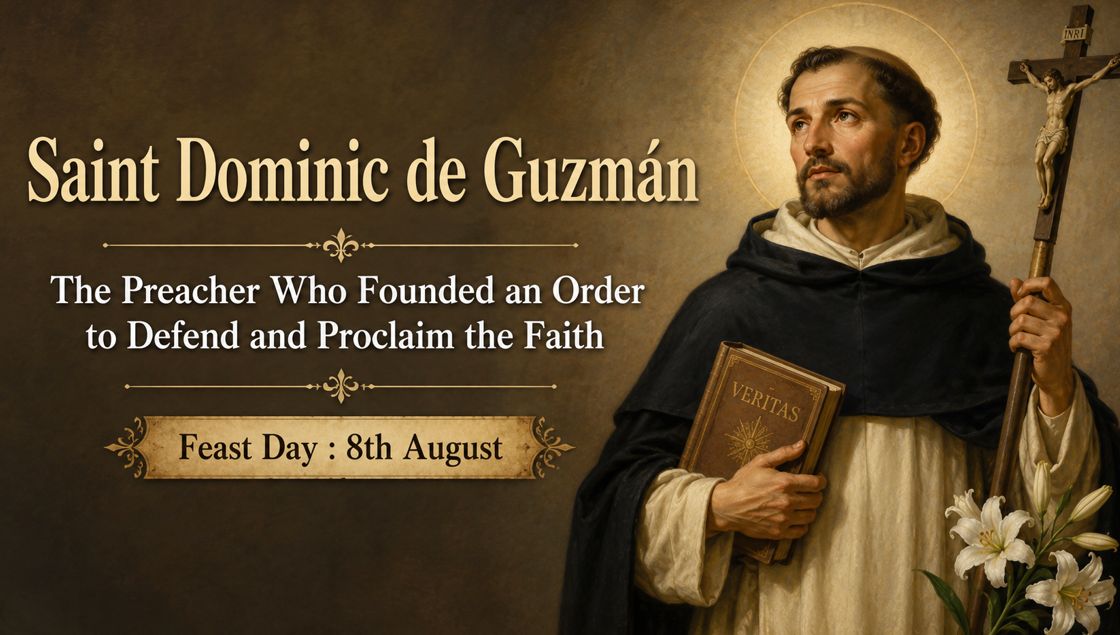
Italy, August 8, 2026: Why is Saint Dominic de Guzmán remembered as one of the greatest preachers in the history of the Catholic Church? Discover the extraordinary story of the Spanish priest who devoted his life to preaching the Gospel, defending the truth, serving the poor, and founding the Order of Preachers—the Dominicans.


Feast Day: 8 August
Born: c. 1170, Caleruega, Kingdom of Castile, Spain
Died: 6 August 1221, Bologna, Italy
Canonized: 1234 by Pope Gregory IX


Founded: Order of Preachers (Dominicans)
Patron of: Astronomers, scientists, and the Dominican Order
Known For: Preaching the Gospel, defending Catholic teaching, founding the Dominican Order, and promoting prayer and study
Title: Founder of the Order of Preachers
Few saints have influenced Catholic preaching and theological education as profoundly as Saint Dominic de Guzmán.
Born in medieval Spain, Dominic witnessed a Europe filled with religious confusion and divisions. Rather than respond with anger or force, he dedicated himself to learning, prayer, poverty, and preaching the truth of the Gospel.
(CLICK HERE to follow Catholic Connect and to stay updated with Catholic News & Content)
His vision eventually gave birth to the Order of Preachers, commonly known as the Dominicans, one of the most influential religious orders in Catholic history.
More than eight centuries after his death, the Dominican tradition continues to proclaim the Gospel through preaching, education, scholarship, missionary work, and prayer.
Dominic was born around the year 1170 in Caleruega, in the Kingdom of Castile.
According to tradition, his mother, Blessed Joan of Aza, was a woman of deep faith who played an important role in his spiritual formation.
Medieval accounts also preserve stories of unusual signs surrounding Dominic's birth, reflecting the devotion that developed around him after his death.
As a young man, Dominic showed a strong desire for learning.
He studied at the University of Palencia, where he became deeply devoted to Sacred Scripture and theology.
While studying, Dominic encountered severe famine among the poor.
Moved by their suffering, he reportedly sold his valuable books and possessions to provide food for those in need.
His action reflected a principle that would remain central throughout his life: knowledge and material possessions have meaning only when they are placed at the service of God and others.
Dominic's compassion for the poor would later become an important part of his preaching ministry.
Dominic became a priest and joined the Canons Regular of Osma.
His life changed dramatically when he travelled through southern France with Bishop Diego of Osma.
There he encountered the Cathar movement, which had attracted many followers and challenged important teachings of the Catholic Church.
Dominic realized that simply condemning people was not enough.
He believed that the Church needed well-trained preachers who could explain the Christian faith clearly, live lives of genuine poverty, and engage people with charity and truth.
This insight would shape the rest of his life.
Dominic began travelling on foot, preaching and teaching throughout France.
He rejected the wealth and comfort that could have accompanied an influential religious position. Instead, he embraced a simple life modeled on the Gospel.
His preaching combined deep theological knowledge with personal holiness.
He wanted people to encounter not only convincing arguments but also the credibility of a Christian life transformed by faith.
Dominic gradually gathered companions who shared his vision.
In 1216, Pope Honorius III formally approved the Order of Preachers.
The new order was revolutionary in its approach.
The Dominicans were dedicated to preaching, study, prayer, community life, and missionary work. They were especially committed to receiving a strong theological education so that they could explain and defend Catholic teaching.
The order soon spread throughout Europe.
Its members established schools, universities, convents, and centers of learning that would profoundly influence Catholic intellectual life.
Saint Dominic has traditionally been associated with the spread of the Rosary.
According to a long-standing Dominican tradition, the Blessed Virgin Mary appeared to Dominic and entrusted the Rosary to him as a powerful means of prayer and spreading the good word.
Historians debate the details of this tradition, and the Rosary developed gradually over many centuries. Nevertheless, Dominican spirituality became deeply connected with devotion to the Rosary.
The prayer remains one of the most beloved Marian devotions in Catholic life.
Despite his reputation as a powerful preacher and organizer, Dominic was deeply devoted to prayer.
Tradition describes him spending long hours in prayer, especially at night.
He is remembered as a man who wept for sinners and prayed intensely for the salvation of souls.
His preaching did not come merely from academic knowledge. It flowed from a heart deeply concerned about bringing people closer to Christ.
Dominic spent the final years of his life strengthening the rapidly growing Dominican Order.
While travelling and working among his friars, his health began to decline.
He arrived in Bologna, Italy, where he died on 6 August 1221.
He was buried in the Dominican church there, where his tomb remains an important place of pilgrimage.
Only a few years after his death, Dominic was canonized by Pope Gregory IX in 1234.
The Dominican Order continued to grow rapidly.
Among its greatest members would be extraordinary theologians, missionaries, preachers, and saints—including St. Thomas Aquinas, St. Albert the Great, St. Catherine of Siena, and St. Vincent Ferrer.
Through these men and women, Dominic's vision of a learned and missionary preaching order reached generations of Christians across the world.
Saint Dominic teaches that defending the faith requires both truth and charity.
He understood the importance of studying Scripture and theology, but he also recognized that Christian teaching must be supported by a life of prayer, humility, and service.
His example challenges Catholics to become people who know their faith deeply and are willing to share it with others.
In an age filled with misinformation and confusion, Dominic's emphasis on truth, education, and thoughtful preaching remains remarkably relevant.
More than eight centuries after his death, Saint Dominic continues to influence the Catholic Church through the worldwide Dominican family.
His greatest legacy is not simply the religious order he founded. It is his conviction that the Gospel must be proclaimed with courage, intelligence, humility, and love.
From medieval Europe to modern universities, parishes, missions, and communities around the world, the sons and daughters of Saint Dominic continue his mission.
His life reminds Christians that the truth of the Gospel is not something to hide or fear. It is a gift to be studied, lived, and proclaimed.
Saint Dominic de Guzmán remains a powerful witness that when prayer, learning, compassion, and preaching come together, the Gospel can transform hearts and renew the Church.
To know about more saints please visit the spiritual section.
By Catholic Connect Reporter
Saint Dominic de Guzmán, Saint Dominic feast day, August 8 feast day, Dominican Order, Order of Preachers, Catholic saints, Dominican saints, Saint Dominic and the Rosary, Catholic preaching, Saint Dominic biography, Spanish saints, founders of religious orders, Catholic Church history, Dominican spirituality
© 2026 CATHOLIC CONNECT POWERED BY ATCONLINE LLP