- 16 October, 2026
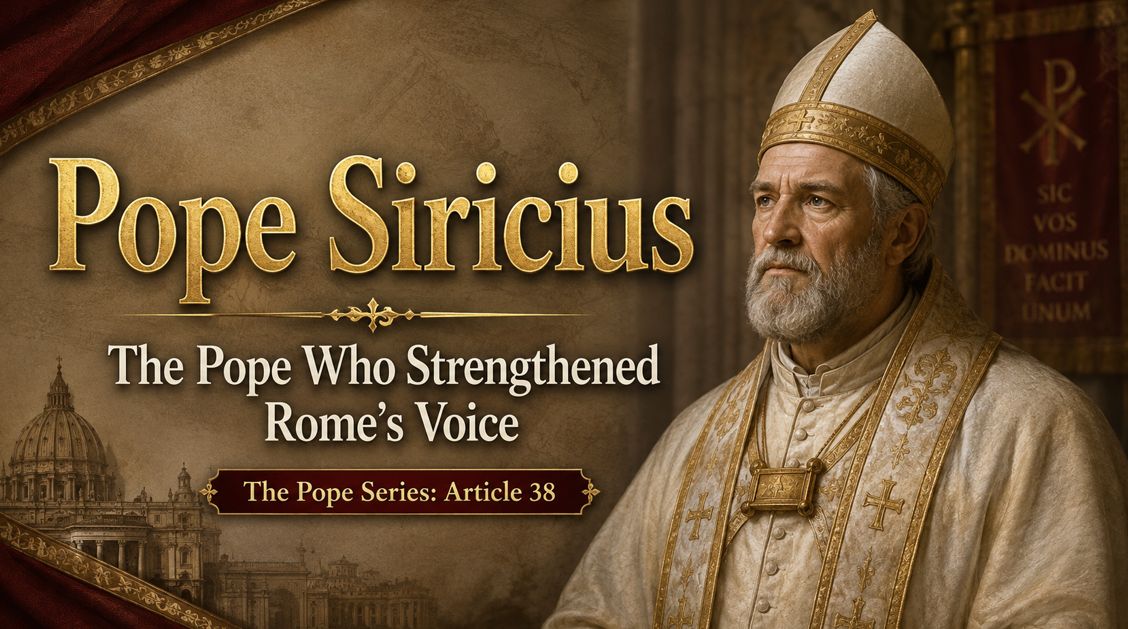
August 8, 2026: Pope Siricius, the thirty-eighth successor of St. Peter, led the Catholic Church from 384 to 399 AD during a period when Christianity was becoming firmly established within the Roman Empire. His pontificate was less dramatic than those of some of his predecessors, but it was important for the growing organisation and authority of the Church.


Siricius is particularly remembered for issuing what is generally regarded as the first surviving papal decretal—a formal letter dealing with matters of Church discipline. Through such correspondence, the Bishop of Rome increasingly exercised his pastoral authority beyond the city of Rome, helping shape a more organised and united Church.
When the early Church faced questions about discipline, clergy and Christian living, how could communities spread across the Roman world remain united?
Pope Siricius helped provide an answer: through clear pastoral guidance from Rome.
His pontificate demonstrated that the Bishop of Rome was becoming more than the leader of the local Roman Christian community. The pope was increasingly recognised as a source of guidance for churches in other parts of the Western Church.
(CLICK HERE to follow Catholic Connect and to stay updated with Catholic News & Content)
Little is known about Siricius' early life. He was born in Rome and was already a member of the Roman clergy before becoming pope. He served as a deacon and was closely involved in the Church's administration.
His experience within the Roman Church prepared him to lead at a time when Christianity had moved from the margins of Roman society towards the centre of public life.
Siricius was elected Bishop of Rome following the death of St. Damasus I in 384 AD.
His election came at a significant moment. The Church was no longer primarily concerned with surviving persecution. Instead, it faced the challenge of organising a rapidly expanding Christian society while maintaining unity in teaching and discipline.
He continued many of Damasus' priorities, particularly the strengthening of Roman authority and the preservation of Church discipline.
Siricius served during the reigns of several Roman emperors, including Theodosius I.
The Church's greatest challenge was now not simply survival but responsible growth.
Siricius is especially significant for his use of papal decretals. In 385 AD, he issued a letter to Bishop Himerius of Tarragona in Spain addressing questions of Church discipline.
The letter gave instructions concerning matters such as clerical discipline, baptism and penance. It also expected the bishop to communicate these decisions to other churches.
This was important because it showed the Bishop of Rome exercising a wider pastoral authority over churches beyond Rome.
Siricius emphasised standards for clergy and encouraged discipline within the Church. His teaching reflected the growing understanding that priests and bishops had responsibilities not only towards God but also towards the integrity of the Christian community.
By responding to questions from bishops in other regions, Siricius helped encourage greater consistency in Church practice. His correspondence became part of a developing tradition in which Rome served as an important reference point for questions affecting the wider Western Church.
Siricius is remembered as a disciplined, pastoral and administrative leader rather than a dramatic public figure.
His spirituality emphasised:
His legacy shows that strengthening the Church sometimes happens through careful administration and consistent guidance rather than through spectacular events.
Siricius inherited a Church still dealing with theological disagreements and internal tensions.
He also faced the challenge of balancing Roman authority with the traditions and independence of local bishops. The increasing influence of the Bishop of Rome was welcomed by some but could also raise questions about how authority should be exercised within the wider Church.
Nevertheless, his approach helped establish patterns of communication and governance that would become increasingly important in the centuries that followed.
Siricius left no famous theological work comparable to later papal writings, but his leadership offers a lasting lesson: A growing Church needs both faith and faithful discipline.
Pope Siricius is honoured as a saint.
He is remembered particularly for his contribution to the development of papal correspondence and Church discipline.
Why does Pope Siricius matter today?
For the Church, his pontificate demonstrates the importance of unity and responsible governance.
For Church leaders, his example highlights the need for clear guidance and accountability.
For believers, his life reminds us that the strength of a Christian community depends not only on its size but also on its faithfulness and discipline.
Siricius helped strengthen the growing structure of the Western Church and contributed to the developing role of the papacy. His legacy continues through the structured life of the Church today, carried forward by his successors.
To know more about the previous Popes, click here
By Catholic Connect Reporter
Pope Siricius, Pope Siricius biography, Pope Siricius 384–399, first papal decretal, Pope Siricius decretal, Pope Siricius history, Saint Siricius, 38th Pope, early Catholic popes, papal authority, Catholic Church history, ancient popes, history of the papacy
© 2026 CATHOLIC CONNECT POWERED BY ATCONLINE LLP