- 01 August, 2026

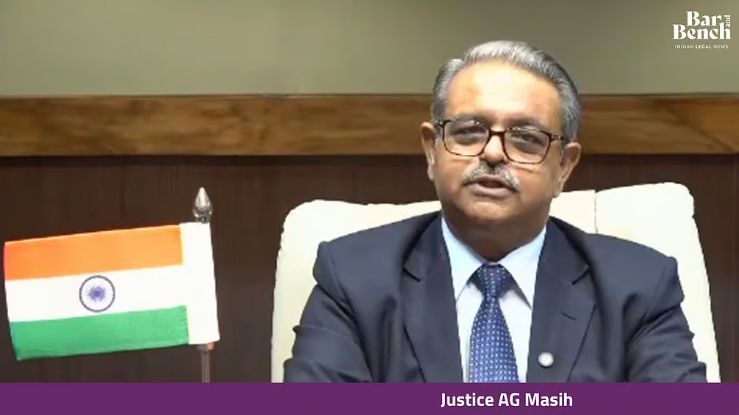
New Delhi, August 1: Supreme Court judge Justice A.G. Masih has cautioned against the growing influence of social media on public perceptions of judicial proceedings, saying cases are increasingly being “judged online in minutes” even as courts take months to examine evidence and arguments.


Speaking at the fifth Justice H.R. Khanna Memorial National Symposium on “Without Fear or Favour – Reimagining Perspectives on an Independent Indian Judiciary in the Digital and Globalised World”, Justice Masih said viral courtroom clips, selective content and online outrage could distort the public understanding of cases and undermine confidence in the justice system.
“Justice cannot be weighed in retweets, and constitutional morality cannot be settled by algorithmic trends,” Justice Masih said.


He said the credibility of the judiciary could not be protected by judges alone and called for advocates, law students, legal academics and others associated with the justice system to uphold the integrity of legal institutions.
‘Evidence is tested by cross-examination’
Justice Masih drew a distinction between the judicial process, which relies on evidence and legal scrutiny, and social media discussions, which can rapidly form opinions without access to the complete record.
“A case is argued over months but judged online in minutes,” he said. “Evidence is tested by cross-examination, while opinion is manufactured by circulation.”
He said short captions, edited videos and selective excerpts from court proceedings could shape public opinion without providing the context in which a particular observation was made.
The consequences, he said, could be particularly serious for accused persons who may face continued public condemnation even after being acquitted by a court.
“The court's judgment becomes, in effect, an appeal against a verdict that was never lawfully entered,” he said.
Concern over edited courtroom clips
Justice Masih also warned about the circulation of selectively edited clips from court hearings. Social media algorithms, he said, often favour speed, outrage and certainty over deliberation and context.
“A 19-second clip lifted out of a six-hour hearing, stripped of context and accompanied by a misleading caption, can quickly become a settled verdict in the public mind,” he said.
He cautioned against the spread of what he termed “cooked information and distorted facts”, saying such material could affect litigants as well as the judicial process.
Judges must resist pressure for viral remarks
Justice Masih also spoke about the pressures created by constant online scrutiny of judges and described social media as a “digital panopticon”.
While judges must remain open to questioning parties and expressing doubts during hearings, he said they should not make observations with an eye on headlines or social media reactions.
“Every sentence spoken from that chair either upholds the constitutional ethos or betrays it,” he said.
He cautioned judges against the temptation to seek public approval through quotable remarks.
“The temptation is to play to the gallery, to trade the slow labour of reasoned judgment for the quick applause of a quotable line,” he said. “That is the precise moment a judge ceases to be an oracle of the law and becomes merely one more voice in the noise.”
Justice Masih concluded by emphasising judicial restraint as a key safeguard of the rule of law. The justice system, he said, must remain guided by evidence, constitutional principles and reasoned decision-making rather than the rapidly changing currents of online opinion.
Courtesy Bar and Bench




© 2026 CATHOLIC CONNECT POWERED BY ATCONLINE LLP