- 05 September, 2026
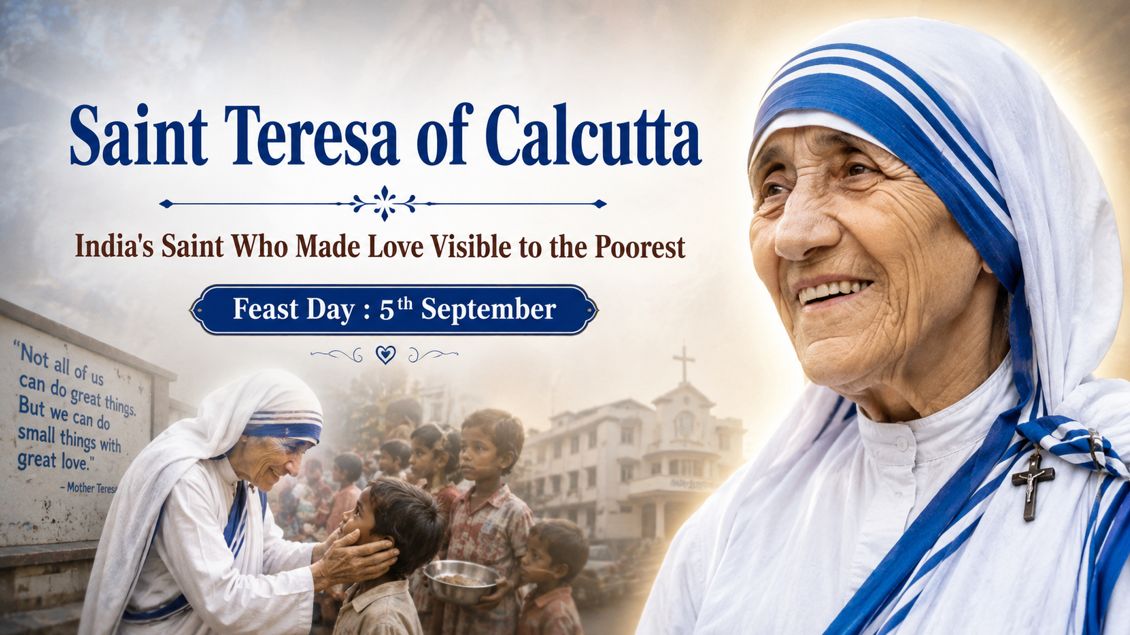
Kolkata, September 5, 2026: Why is Saint Teresa of Calcutta remembered as one of the most influential Catholic figures of the 20th century? Discover the extraordinary life of the Albanian-born nun who made India her home, founded the Missionaries of Charity, served the poorest and most abandoned, and became a global symbol of compassion, dignity and Christian love.


Feast Day: 5 September
Born: 26 August 1910, Skopje, Ottoman Empire (now North Macedonia)
Died: 5 September 1997, Calcutta, India
Birth Name: Agnes Gonxha Bojaxhiu


Religious Name: Sister Mary Teresa
Beatified: 19 October 2003 by Pope John Paul II
Canonised: 4 September 2016 by Pope Francis
Patron of: World Youth Day 2016 volunteers
Known For: Serving the poorest, caring for the sick and dying, founding the Missionaries of Charity, and defending the dignity of every human person
Title: Virgin and Religious; Saint Teresa of Calcutta
Few Catholic figures have become as recognisable across the world as Saint Teresa of Calcutta.
Born Agnes Gonxha Bojaxhiu, she travelled to India as a young religious sister and eventually devoted her entire life to people living in poverty, illness and abandonment.
For Saint Teresa, charity was not simply about providing material assistance. It was about seeing Christ in every person, particularly those whom society had forgotten. The Norwegian Nobel Committee later recognised her work for bringing help to suffering humanity.
Her story is inseparably connected with India, where she spent most of her religious life and where her ministry grew from a small beginning in the streets of Calcutta into an international religious family.
Agnes was born on 26 August 1910 in Skopje to an Albanian Catholic family.
From the age of twelve, she felt a strong desire to dedicate her life to God and to serve the poor. At eighteen, she left her family home and joined the Sisters of Loreto, an Irish religious congregation with missions in India.
After a short period of formation in Ireland, she travelled to India.
In 1931, she made her initial religious vows and took the name Teresa, inspired by Saint Thérèse of Lisieux.
For many years, Sister Teresa taught at St. Mary's School in Calcutta.
She loved teaching and served her students faithfully. Yet outside the convent walls she increasingly encountered another reality—the extreme poverty, sickness and loneliness affecting thousands of people.
In 1946, while travelling by train, she experienced what she later described as a "call within a call": a profound interior conviction that she was being asked to leave her teaching ministry and serve the poorest people directly.
After receiving permission, she left the Loreto convent in 1948.
She exchanged her religious habit for the simple white sari with a blue border that would later become internationally associated with her mission.
Saint Teresa began her new ministry with very little money and few resources.
She opened an open-air school for children living in the slums and gradually attracted volunteers and former students who wanted to join her work.
She also received training in nursing before returning to Calcutta and beginning her direct service among the poor.
Her ministry focused on people whom she believed were often treated as if they had no value—the abandoned, the sick, the dying and those living without family support.
Her guiding conviction was simple: every human being possesses dignity because every person is loved by God.
On 7 October 1950, the Missionaries of Charity was officially established in the Archdiocese of Calcutta.
The congregation's mission was to care for people who had been neglected and abandoned. Over the following decades, it expanded far beyond India.
The sisters established homes for the dying, orphaned children and people suffering from serious illnesses. Their work also included food kitchens, mobile clinics, leprosy centres and other forms of practical assistance.
In 1965, the congregation received papal recognition and began establishing communities around the world.
The Missionaries of Charity eventually developed branches of sisters, brothers and priests, while lay volunteers and co-workers also became part of the wider mission.
Saint Teresa's work attracted international attention.
In 1979, she was awarded the Nobel Peace Prize for her work bringing help to suffering humanity. The Nobel Committee particularly highlighted her respect for the dignity and value of every human person.
Rather than treating the prize as a personal achievement, she consistently directed attention towards the poor and the responsibility of people to love and serve one another.
Her message reached beyond Catholic communities and religious boundaries.
People of different faiths and nationalities supported her work, while her houses spread to countries across Asia, Africa, Europe, the Americas and elsewhere.
Behind Saint Teresa's public ministry was a deeply prayerful life.
She began each day with the Eucharist and prayer before going out to serve those in need. The Vatican's biography describes how she carried a rosary while searching for Christ among people who were unwanted, unloved and uncared for.
For her, serving the poor was not separate from serving Jesus.
This spiritual vision shaped everything she did.
Saint Teresa continued her ministry despite declining health.
After meeting Pope John Paul II for the final time, she returned to Calcutta and spent her last weeks receiving visitors and guiding the sisters of her congregation.
She died on 5 September 1997 in Calcutta at the age of 87. The Government of India honoured her with a state funeral, and she was buried at the Mother House of the Missionaries of Charity.
Her tomb soon became a place of prayer and pilgrimage for people of many faiths.
The Church recognised Saint Teresa's holiness remarkably quickly.
Pope John Paul II beatified her on 19 October 2003.
On 4 September 2016, Pope Francis canonised her in St Peter's Square in Rome.
Her canonisation was especially significant for India, the country that had become her spiritual home.
Today, the Missionaries of Charity continue the work she began, serving vulnerable communities in India and around the world.
Saint Teresa's life offers powerful lessons for Christians:
Her life shows that holiness does not necessarily begin with extraordinary achievements.
Sometimes it begins by noticing the person whom everyone else has stopped seeing.
Saint Teresa remains one of the most recognisable Catholic saints associated with India.
Her white-and-blue sari became a symbol of a life dedicated to the poorest, while Calcutta became inseparable from her story and mission.
Yet her greatest legacy is not simply the institutions she founded. It is the conviction that no human being is worthless, forgotten or beyond the reach of love.
From the streets of Calcutta to communities around the world, Saint Teresa of Calcutta showed that compassion can cross barriers of religion, nationality, wealth and social status.
Her message remains as relevant today as when she first stepped beyond the convent walls:
Love without counting the cost. Serve without seeking recognition. See Christ in the poorest and most forgotten. And remember that even the smallest act of love can change a life.
To know about more saints please visit the spiritual section.
By Catholic Connect Reporter
Saint Teresa of Calcutta, Mother Teresa, Mother Teresa of India, Saint Teresa feast day, September 5 feast day, Mother Teresa biography, Missionaries of Charity, Catholic saints of India, saints in India, Calcutta saint, Mother Teresa miracles, Mother Teresa canonisation, Pope Francis, Pope John Paul II, Nobel Peace Prize, Catholic charity, service to the poor, Indian Catholic saints, Catholic missionaries, Christian charity, saints of India.



© 2026 CATHOLIC CONNECT POWERED BY ATCONLINE LLP